 Back
The Molecular Basis of Inheritance: DNA Structure and Function
Study Guide - Smart Notes
 Tailored notes based on your materials, expanded with key definitions, examples, and context.
DNA: The Substance of Inheritance
Hereditary Information and DNA
DNA is the fundamental molecule responsible for storing and transmitting hereditary information in all living organisms. Its chemical structure encodes the instructions for the development and functioning of diverse traits in cells and organisms.
DNA Program: Directs cellular activities and trait development.
Inheritance: DNA is reproduced in all cells, ensuring continuity of genetic information.
Evidence That DNA Can Transform Bacteria
Griffith's Transformation Experiment
Frederick Griffith's experiments with Streptococcus pneumoniae demonstrated that an unknown substance could transform nonpathogenic bacteria into pathogenic forms, suggesting the transfer of genetic material.
S Strain: Pathogenic due to protective capsule.
R Strain: Nonpathogenic, lacks capsule.
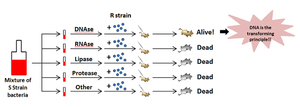
Transformation: Mixing heat-killed S strain with living R strain resulted in pathogenic bacteria, indicating genetic material transfer.
Avery, MacLeod, and McCarty: Identifying DNA as the Transforming Principle
Further experiments showed that only DNA, not proteins or RNA, was responsible for transformation, confirming DNA as the genetic material.
Enzyme Treatments: DNase destroyed transformation, while RNase, protease, and other enzymes did not.
Conclusion: DNA is the transforming principle.
Viruses and DNA: Bacteriophages as Genetic Tools
Bacteriophages and Molecular Genetics
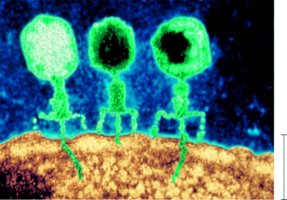
Bacteriophages, viruses that infect bacteria, have been instrumental in studying DNA's role as genetic material. Their simple structure allows researchers to track genetic information transfer.
Phage Structure: Composed of a head (containing DNA), tail, and tail fibers.
Genetic Material: DNA is injected into bacterial cells during infection.
DNA Structure: Components and Organization
Nucleotides: Building Blocks of DNA
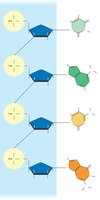
DNA is a polymer made of nucleotides, each consisting of a nitrogenous base, a deoxyribose sugar, and a phosphate group. The sequence of these nucleotides encodes genetic information.
Nitrogenous Bases: Adenine (A), Thymine (T), Cytosine (C), Guanine (G).
Deoxyribose Sugar: Five-carbon sugar unique to DNA.
Phosphate Group: Links nucleotides together, forming the backbone.
Chargaff's Rules: Base Composition of DNA
Erwin Chargaff discovered that DNA composition varies between species and that the amount of adenine equals thymine, and cytosine equals guanine. This provided evidence for base pairing.
Chargaff's Rule: %A = %T and %C = %G in DNA.
Molecular Diversity: DNA composition differs among species, supporting its role as genetic material.
Building the Structural Model of DNA
X-ray Crystallography and Franklin's Contributions
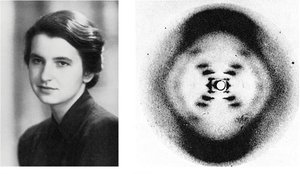
Rosalind Franklin and Maurice Wilkins used X-ray crystallography to study DNA's structure. Franklin's famous photograph revealed the helical nature of DNA and provided key measurements for its dimensions.
X-ray Diffraction: Technique used to visualize molecular structure.
Franklin's Photo: Showed DNA's double helix and regular spacing.
Watson and Crick: The Double Helix Model
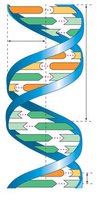
Watson and Crick, using Franklin's data, deduced that DNA is a double helix with two antiparallel sugar-phosphate backbones and paired nitrogenous bases in the interior.
Double Helix: Two strands twisted around each other.
Antiparallel Strands: Strands run in opposite directions (5' to 3' and 3' to 5').
Base Pairing: Adenine pairs with thymine (A-T), cytosine pairs with guanine (C-G).
Hydrogen Bonds: Hold base pairs together.
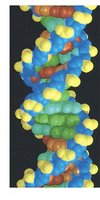
Space-Filling Model of DNA
The space-filling model illustrates the three-dimensional arrangement of atoms in the DNA double helix, highlighting the compact and stable nature of the molecule.
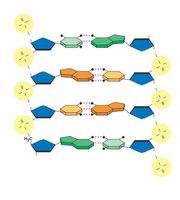
Chemical Structure of DNA
The partial chemical structure of DNA shows the arrangement of nucleotides, sugar-phosphate backbone, and hydrogen bonds between base pairs.
Phosphodiester Bonds: Link the 5' phosphate group of one nucleotide to the 3' hydroxyl group of the next.
Hydrogen Bonds: Two between A-T, three between C-G.
Summary Table: Key Features of DNA Structure
Feature | Description |
|---|---|
Double Helix | Two antiparallel strands twisted together |
Nucleotide Components | Nitrogenous base, deoxyribose sugar, phosphate group |
Base Pairing | A-T (2 H bonds), C-G (3 H bonds) |
Backbone | Sugar-phosphate, covalently bonded |
Antiparallel Orientation | Strands run in opposite directions (5' to 3', 3' to 5') |
Key Equations
Chargaff's Rule: and
Phosphodiester Bond Formation:
Conclusion
DNA's structure and function are central to the molecular basis of inheritance. The discovery of its double helix, base pairing, and role as the genetic material revolutionized biology and paved the way for modern genetics.
