 Back
The Molecular Basis of Inheritance: DNA Structure, Function, and Replication
Study Guide - Smart Notes
 Tailored notes based on your materials, expanded with key definitions, examples, and context.
CHAPTER 16: The Molecular Basis of Inheritance
Scientific Inquiry: Genes and Chromosomes
The discovery that genes are located on chromosomes was a pivotal moment in biology. Chromosomes are composed of two main components: DNA and proteins. Determining which of these is the genetic material was a major scientific question in the early 20th century.
The Search for Genetic Material: DNA or Protein?
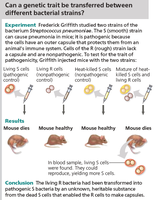
Early experiments sought to identify whether DNA or protein carried genetic information. Frederick Griffith's experiment in 1928 provided evidence that DNA can transform bacteria, demonstrating that a heritable substance from dead S cells enabled R cells to become pathogenic by making capsules.
Transformation: Change in genotype and phenotype by assimilation of external DNA by a cell.
Example: Griffith's experiment showed that non-pathogenic bacteria could acquire pathogenic traits from dead pathogenic cells.
Evidence that Viral DNA Can Program Cells
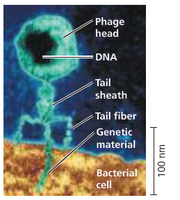
In 1952, Hershey and Chase used bacteriophages (viruses that infect bacteria) to show that DNA, not protein, is the genetic material. The T2 phage injects its DNA into the host cell, while the protein components remain outside.
Bacteriophage Structure: Head and tail made of proteins; DNA enclosed in the head.
Key distinction: DNA contains phosphorus, no sulfur; proteins contain sulfur, no phosphorus.
Conclusion: Viral DNA carries genetic information necessary for the production of new viruses.
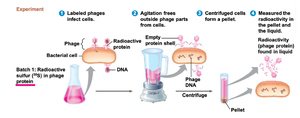
Hershey-Chase Experiment: Is DNA or Protein the Genetic Material?
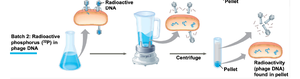
Hershey and Chase labeled phage proteins with radioactive sulfur and phage DNA with radioactive phosphorus to track which component entered the bacterial cell.
Batch 1 (Protein labeled): Radioactivity remained outside the cell, indicating protein did not enter.
Batch 2 (DNA labeled): Radioactivity was found inside the cell, indicating DNA entered and was responsible for genetic transformation.
The Structure of a DNA Strand
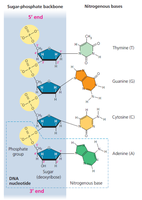
DNA is composed of four nucleotides: two with purine bases (Adenine (A) and Guanine (G)) and two with pyrimidine bases (Thymine (T) and Cytosine (C)). Chargaff's rules (1950) established that:
The amounts of A, T, G, and C are identical in identical twins, vary between individuals, and vary more between species.
In each species, the amount of A equals T, and G equals C.
Nucleotide Composition of DNA
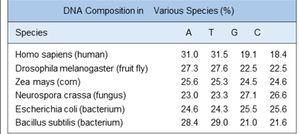
DNA composition varies among species, but the ratios of A:T and G:C remain constant within a species.
Species | A (%) | T (%) | G (%) | C (%) |
|---|---|---|---|---|
Homo sapiens (human) | 31.0 | 31.5 | 19.1 | 18.4 |
Drosophila melanogaster (fruit fly) | 27.3 | 27.6 | 22.5 | 22.5 |
Zea mays (corn) | 25.6 | 25.3 | 24.5 | 24.6 |
Neurospora crassa (fungus) | 23.0 | 23.3 | 27.1 | 26.6 |
Escherichia coli (bacterium) | 24.6 | 24.3 | 25.5 | 25.6 |
Bacillus subtilis (bacterium) | 28.4 | 29.0 | 21.0 | 21.6 |
Structural Model of DNA
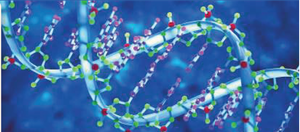
Rosalind Franklin used X-ray crystallography to reveal that DNA has two sugar-phosphate backbones with nitrogenous bases paired in the interior. Watson and Crick (1953) proposed the double-helix model: two polynucleotide strands twisted together.

Antiparallel Strands and Backbone Structure
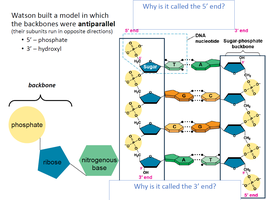
DNA strands are antiparallel, meaning their sugar-phosphate backbones run in opposite directions (5' to 3' and 3' to 5'). The backbone is formed by phosphodiester bonds between the phosphate group and the sugar.
Phosphodiester Bond
A phosphodiester bond links the phosphate group to the sugar above and below, forming the polynucleotide chain. DNA synthesis always occurs in the 5' to 3' direction.
Base Pairing Rules
Base pairing is essential for DNA structure and replication:
Adenine pairs with Thymine via two hydrogen bonds.
Cytosine pairs with Guanine via three hydrogen bonds.
The width of DNA remains constant due to these pairings.
Semiconservative Replication of DNA
DNA replication follows the semiconservative model: parental strands separate, each serving as a template for a new strand. Each new DNA molecule consists of one old and one new strand.
Example: If one strand is 5'-ACTAGCTCA-3', the complementary strand is 3'-TGATCGAGT-5'.
Meselson and Stahl Experiment
Experiments by Meselson and Stahl confirmed the semiconservative model. After one replication, a hybrid band (14N-15N) was observed; after two replications, both hybrid and light bands (14N-14N) appeared.
Basics of DNA Replication
DNA replication involves three main stages:
Unwinding: Helicase unwinds the DNA.
Complementary base pairing: DNA polymerase adds nucleotides in the 5' to 3' direction.
Joining of segments: Ligase joins DNA fragments.
Replication Fork and Initiation Proteins
The replication fork is a Y-shaped region where parental DNA is unwound. Several proteins are involved:
Topoisomerase: Breaks and rejoins parental strands to relieve tension.
Helicase: Unwinds and separates DNA strands.
Single-stranded Binding Proteins (SSB): Stabilize unwound strands.
RNA Primase: Synthesizes RNA primers.
DNA Polymerase: Starts new DNA synthesis from the 3' end of the RNA primer.
Leading and Lagging Strands
DNA polymerase synthesizes DNA in the 5' to 3' direction:
Leading strand: Elongates continuously.
Lagging strand: Elongates discontinuously as Okazaki fragments.
Proofreading and Repairing DNA
Errors in DNA replication are rare (one in ten billion nucleotides). Repair mechanisms include:
Nuclease: Cuts damaged DNA.
DNA Polymerase: Repairs DNA.
DNA Ligase: Seals gaps.
Chromatin Packing in Eukaryotic Chromosomes
Chromatin consists of DNA double helix packed with histone proteins. Chromosomes are highly organized structures of DNA and protein.
What is a Gene?
A gene is a region of specific nucleotide sequence along the DNA molecule of a chromosome. Genes are discrete units of inheritance that affect phenotypic characters and are assigned to specific loci on chromosomes.
Additional info: The notes above expand on the original content with academic context, definitions, and examples to ensure completeness and clarity for General Biology students.
