Back
The Molecular Basis of Inheritance: DNA Structure, Replication, and Mutation
Study Guide - Smart Notes
 Tailored notes based on your materials, expanded with key definitions, examples, and context.
The Molecular Basis of Inheritance
Key Concepts in DNA Replication and Inheritance
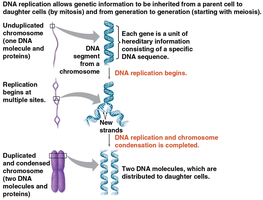
DNA replication is fundamental for the transmission of genetic information from parent to daughter cells during cell division. The structure of DNA enables accurate replication and repair, while mutations introduce genetic variation.
DNA structure allows for complementary base pairing and semiconservative replication.
Replication proceeds in the 5′ → 3′ direction, involving multiple enzymes for leading and lagging strand synthesis.
DNA repair mechanisms maintain fidelity, while mutations can cause genetic diseases.
DNA Structure and Discovery
X-ray Evidence and the Double Helix
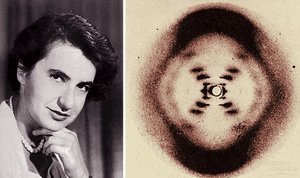
The helical structure of DNA was revealed through X-ray crystallography by Rosalind Franklin and Maurice Wilkins. The scattering pattern of X-rays indicated repeating distances characteristic of a helix.
Helical structure is essential for DNA's function and replication.
Each gene is a unit of hereditary information consisting of a specific DNA sequence.
Nucleotides: Building Blocks of DNA
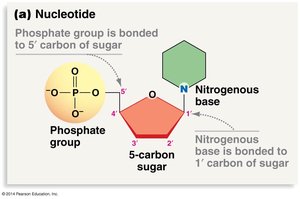
Nucleic acids are polymers made of nucleotides, each consisting of a phosphate group, a 5-carbon sugar, and a nitrogenous base.
Phosphate group attaches to the 5′ carbon of the sugar.
Sugar attaches to the nitrogenous base at the 1′ carbon.
The Double Helix and Base Pairing
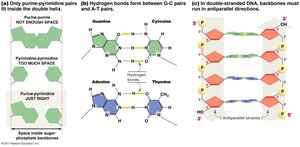
DNA consists of two antiparallel strands held together by complementary base pairs. The sugar-phosphate backbone is hydrophilic and located on the outside, while base pairs are on the inside.
Antiparallel strands run in opposite directions (5′ → 3′ and 3′ → 5′).
Base pairs: Adenine (A) pairs with Thymine (T), Guanine (G) pairs with Cytosine (C).
Base Pairing and DNA Replication
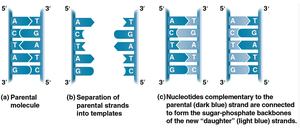
Complementary base pairing enables semiconservative replication, where each strand serves as a template for a new strand.
Semi-conservative replication: Each new DNA molecule contains one old and one new strand.
Result: Two identical DNA molecules with the same genetic information.
DNA Replication Process
Origins and Replication Bubbles
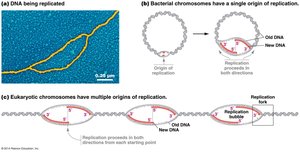
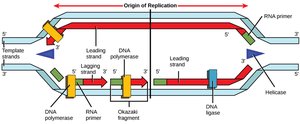
DNA replication begins at specific sites called origins, forming replication bubbles. The replication fork is the Y-shaped region where DNA is unwound and copied.
Eukaryotes have multiple origins and bubbles, allowing rapid replication.
Bacteria typically have a single origin.
Replication Proteins and Enzymes
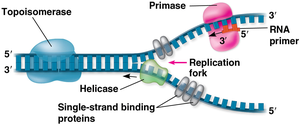
Several proteins are involved in opening, stabilizing, and preparing DNA for replication.
Helicase: Unwinds the double helix.
Single-strand binding proteins: Stabilize separated strands.
Topoisomerase: Relieves tension ahead of the fork.
Primase: Synthesizes RNA primer.
Primer: Provides a free 3′-OH for DNA polymerase.
DNA Polymerase and Nucleotide Addition
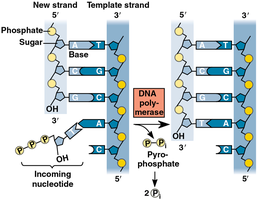
DNA polymerase III adds nucleotides to the 3′ end of the primer using dNTPs. The addition releases pyrophosphate, powering the formation of the phosphodiester bond.
Direction: DNA polymerase synthesizes DNA only in the 5′ → 3′ direction.
dNTPs: Deoxyribonucleoside triphosphates are the substrates for DNA synthesis.
Leading and Lagging Strand Synthesis
The leading strand is synthesized continuously toward the replication fork, while the lagging strand is synthesized discontinuously in short segments called Okazaki fragments.
Leading strand: Continuous synthesis.
Lagging strand: Discontinuous synthesis, requiring repeated priming and joining by DNA ligase.
DNA Replication Accuracy and Repair
Proofreading and Mismatch Repair
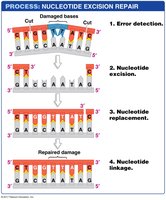
DNA polymerase has proofreading ability, reducing errors during replication. Mismatch repair further corrects errors, resulting in high fidelity.
Proofreading: DNA polymerase removes mispaired bases.
Mismatch repair: Removes and replaces mismatches after replication.
Final accuracy: Less than 1 error per billion bases.
Replication of Chromosome Ends: Telomeres
Telomeres and Telomerase
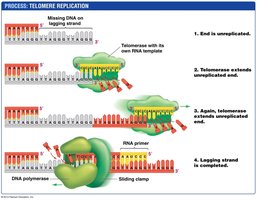
Telomeres are repetitive DNA sequences at chromosome ends, protecting them from degradation. Telomerase extends telomeres, preventing shortening during replication.
Telomeres: Non-coding, repetitive sequences at chromosome ends.
Telomerase: Enzyme with its own RNA template, adds repeats to telomeres.
Importance: Prevents loss of genetic information and chromosome instability.
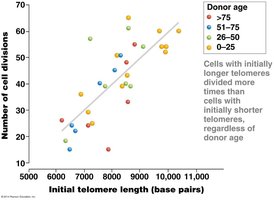
Telomere Length and Cell Division
Most somatic cells lack telomerase, leading to telomere shortening and limited cell division. Cancer cells often reactivate telomerase, enabling unlimited division.
Cell lifespan is limited by telomere length.
Cancer: Telomerase reactivation allows continued division despite DNA damage.
Mutations: Source of Genetic Variation
Types and Effects of Mutations
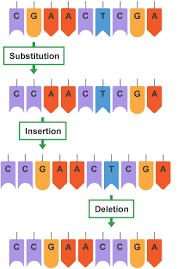
Mutations are changes in the DNA sequence, occurring spontaneously or due to environmental factors. They can be neutral, harmful, or beneficial, and are a major source of genetic diversity.
Types: Substitutions, insertions, deletions.
Effects: May cause disease, contribute to evolution, or have no effect.
Point Mutations and Their Consequences
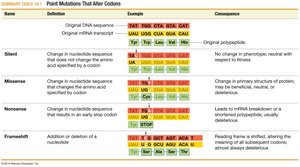
Point mutations alter single nucleotides and can affect protein coding.
Silent: No change in protein.
Missense: Changes amino acid, may affect protein function.
Nonsense: Creates stop codon, truncates protein.
Frameshift: Alters reading frame, often severely affects protein.
Type | Definition | Example | Consequence |
|---|---|---|---|
Silent | Change in nucleotide sequence that does not change amino acid | UAA UGG GTA GUA CAT | No change in phenotype |
Missense | Change in nucleotide sequence that changes amino acid | UAA UGG GTA GUA CAT → UAA UGG GTA GUA CCT | Change in primary structure of protein |
Nonsense | Change in nucleotide sequence that results in early stop codon | UAA UGG GTA GUA CAT → UAA UGG GTA UAA CAT | Leads to mRNA breakdown or truncated protein |
Frameshift | Addition or deletion of a nucleotide | UAA UGG GTA GUA CAT → UAA UGG GTG UAC AT | Reading frame is shifted, changing amino acid sequence |
Chromosomal Mutations
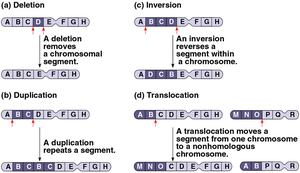
Chromosomal mutations involve changes in chromosome structure, such as deletions, duplications, inversions, and translocations.
Deletion: Removes a segment.
Duplication: Repeats a segment.
Inversion: Reverses a segment.
Translocation: Moves a segment to another chromosome.