 Back
The Molecular Basis of Inheritance: DNA as Genetic Material and Its Replication
Study Guide - Smart Notes
 Tailored notes based on your materials, expanded with key definitions, examples, and context.
The Molecular Basis of Inheritance
Introduction
This chapter explores the discovery that DNA is the genetic material, the experiments that established its role, and the structural features that enable its function in inheritance. It also introduces the models of DNA replication and the evidence supporting the semiconservative mechanism.
Evidence That DNA Is the Genetic Material
Griffith’s Transformation Experiment
Frederick Griffith’s experiments in 1928 demonstrated that a genetic trait could be transferred between bacterial strains, leading to the concept of transformation.
Transformation: A change in genotype and phenotype due to assimilation of foreign DNA.
Experiment: Mixing heat-killed pathogenic bacteria with living harmless bacteria resulted in some harmless bacteria becoming pathogenic.
Implication: Suggested that some "transforming principle" was responsible for genetic change.
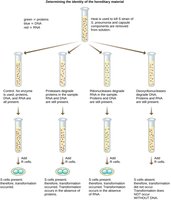
Avery, McCarty, and MacLeod’s Identification of DNA
These researchers demonstrated that DNA, not protein or RNA, was the transforming substance responsible for genetic change in bacteria.
Experimental Approach: Used enzymes to selectively degrade DNA, RNA, or protein in bacterial extracts.
Result: Only extracts with intact DNA could transform bacteria, confirming DNA as the genetic material.
The Hershey–Chase Experiment
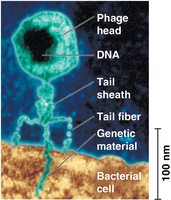
Alfred Hershey and Martha Chase used bacteriophages (viruses that infect bacteria) to show that DNA, not protein, enters the host cell and directs viral reproduction.
Bacteriophage: A virus composed of DNA (or RNA) enclosed in a protein coat.
Experiment: Radioactive labeling of DNA and protein in phages showed that only DNA entered E. coli cells during infection.
Conclusion: DNA is the genetic material responsible for viral replication.
Chargaff’s Rules and DNA Composition
Chargaff’s Findings
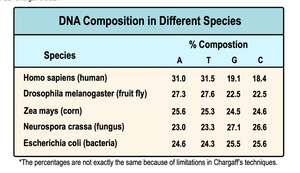
Erwin Chargaff discovered that DNA composition varies between species and that the amount of adenine (A) equals thymine (T), and guanine (G) equals cytosine (C).
Base Composition: The proportion of A, T, G, and C bases differs among species.
Chargaff’s Rules: In any species, A = T and G = C.
Species | A (%) | T (%) | G (%) | C (%) |
|---|---|---|---|---|
Homo sapiens (human) | 31.0 | 31.5 | 19.1 | 18.4 |
Drosophila melanogaster (fruit fly) | 27.3 | 27.6 | 22.5 | 22.5 |
Zea mays (corn) | 25.6 | 23.3 | 24.5 | 24.6 |
Neurospora crassa (fungus) | 23.0 | 23.3 | 27.1 | 26.6 |
Escherichia coli (bacteria) | 24.6 | 24.3 | 25.6 | 25.6 |
Building a Structural Model of DNA
X-ray Crystallography and Franklin’s Contribution
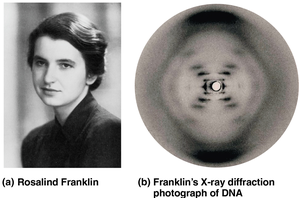
Maurice Wilkins and Rosalind Franklin used X-ray crystallography to study DNA’s molecular structure. Franklin’s X-ray diffraction photo provided critical evidence for the helical structure of DNA.
X-ray Crystallography: Technique used to visualize the three-dimensional structure of molecules.
Franklin’s Photo: Revealed the helical nature and dimensions of DNA.
Watson and Crick’s Double Helix Model
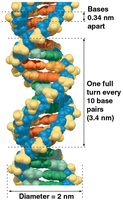
James Watson and Francis Crick built a model of DNA as a double helix, with two antiparallel sugar-phosphate backbones and nitrogenous bases paired in the interior.
Antiparallel Strands: The two DNA strands run in opposite directions.
Double Helix: The structure consists of two intertwined strands, with bases spaced 0.34 nm apart and one full turn every 10 base pairs (3.4 nm).
Base Pairing and Structural Specificity
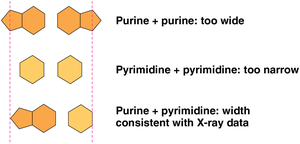
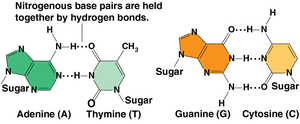
Watson and Crick determined that base pairing is specific: adenine pairs with thymine, and guanine pairs with cytosine. Pairing a purine with a pyrimidine results in a uniform width consistent with X-ray data.
Purines: Adenine (A) and Guanine (G)
Pyrimidines: Thymine (T) and Cytosine (C)
Specific Pairing: A-T and G-C pairs are held together by hydrogen bonds.
DNA Replication: Models and Mechanisms
Semiconservative, Conservative, and Dispersive Models
DNA replication ensures the faithful transmission of genetic information. Three models were proposed: semiconservative, conservative, and dispersive.
Semiconservative Model: Each daughter DNA molecule consists of one old (parental) strand and one newly synthesized strand.
Conservative Model: The parental strands rejoin, and the daughter molecule consists of entirely new strands.
Dispersive Model: Each strand is a mix of old and new DNA.
Base Pairing to a Template Strand
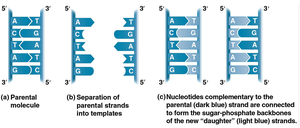
During replication, each DNA strand serves as a template for the synthesis of a complementary strand, resulting in two identical DNA molecules.
Template Mechanism: The sequence of bases on each strand determines the sequence on the new strand.
Replication Process: Separation of parental strands, followed by synthesis of new complementary strands.
Experimental Evidence: Meselson-Stahl Experiment
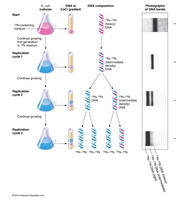
Matthew Meselson and Franklin Stahl provided experimental evidence supporting the semiconservative model of DNA replication.
Experiment: Used isotopic labeling and density gradient centrifugation to track DNA replication in E. coli.
Result: After one round of replication, DNA consisted of hybrid strands; after two rounds, both hybrid and new strands were observed, confirming the semiconservative model.
Key Terms and Concepts
Gene: A segment of DNA that codes for a functional product, usually a protein.
Bacteriophage: A virus that infects bacteria.
Transformation: The process by which a cell incorporates foreign DNA, resulting in genetic change.
Base Composition: The relative proportions of A, T, G, and C in DNA.
Summary Table: DNA Replication Models
Model | Description | Experimental Evidence |
|---|---|---|
Semiconservative | Each daughter molecule has one old and one new strand | Supported by Meselson-Stahl experiment |
Conservative | Parent strands rejoin; daughter molecule is entirely new | Not supported by experiment |
Dispersive | Each strand is a mix of old and new DNA | Not supported by experiment |
Additional info: The chapter also introduces the importance of accurate DNA replication for inheritance and cell division, and sets the stage for further exploration of the molecular mechanisms involved in DNA replication and repair.
