 Back
The Molecular Basis of Inheritance: From Genes to Proteins
Study Guide - Smart Notes
 Tailored notes based on your materials, expanded with key definitions, examples, and context.
The Molecular Basis of Inheritance
Introduction
The molecular basis of inheritance explores how genetic information is stored, replicated, and expressed in living organisms. This topic is foundational to understanding genetics, molecular biology, and the flow of genetic information from DNA to proteins.
History Behind the Nucleic Acid Concept
Discovery of DNA
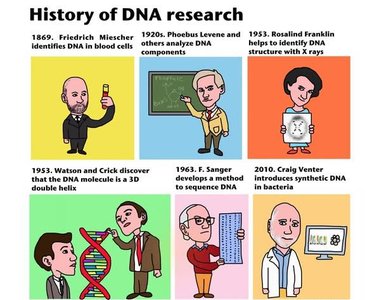
Friedrich Miescher (1860s): Isolated the first sample of DNA, which he called "nuclein." This discovery marked the beginning of molecular genetics.
Early 20th Century: Scientists debated whether proteins or DNA were the genetic material due to the complexity of proteins compared to the apparent simplicity of DNA.
Criteria for Genetic Material
Able to store information
Ability to replicate
Ability to express information
Able to change/transform
Experimental Evidence for DNA as Genetic Material
Griffith's Transformation Experiment (1928)
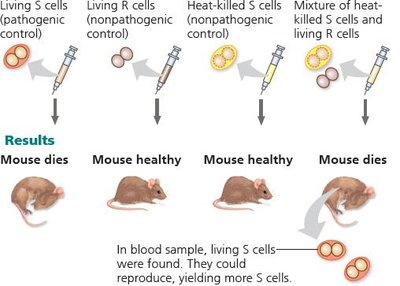
Frederick Griffith demonstrated that a heritable substance from dead pathogenic bacteria could transform harmless bacteria into a pathogenic form, suggesting the presence of a "transforming principle." This experiment laid the groundwork for identifying DNA as the genetic material.
Avery, MacLeod, and McCarty (1944)
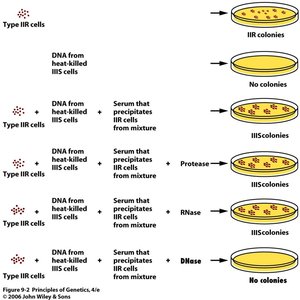
Oswald Avery and colleagues identified DNA as the "transforming principle" by showing that only DNA, not proteins or RNA, could transform non-pathogenic bacteria into pathogenic forms.
Hershey-Chase Experiment (1952)
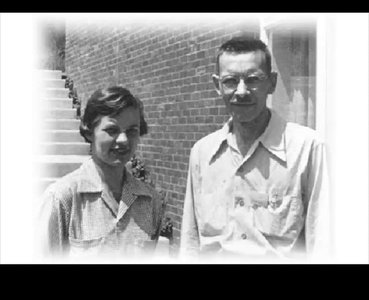
Alfred Hershey and Martha Chase used bacteriophages labeled with radioactive isotopes to demonstrate that DNA, not protein, is the genetic material transmitted to bacteria during viral infection.
Discovery of DNA Structure
Chargaff's Rules
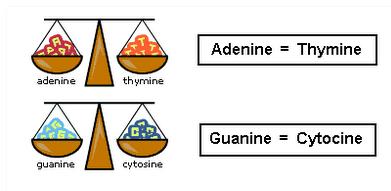
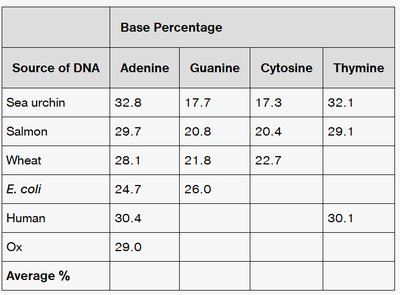
Erwin Chargaff analyzed the base composition of DNA from various organisms and found two key rules:
DNA base composition varies between species.
In any species, the amount of adenine (A) equals thymine (T), and the amount of guanine (G) equals cytosine (C).
Source of DNA | Adenine (%) | Guanine (%) | Cytosine (%) | Thymine (%) |
|---|---|---|---|---|
Sea urchin | 32.8 | 17.7 | 17.3 | 32.1 |
Salmon | 29.7 | 20.8 | 20.4 | 29.1 |
Wheat | 28.1 | 21.8 | 22.7 | 27.4 |
E. coli | 24.7 | 26.0 | 25.7 | 23.6 |
Human | 30.4 | 19.6 | 19.9 | 30.1 |
Ox | 29.0 | 21.0 | 21.0 | 29.0 |
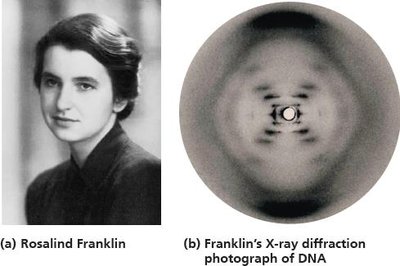
Rosalind Franklin and X-ray Crystallography
Rosalind Franklin produced the first X-ray diffraction images of DNA, revealing its helical structure and providing critical evidence for the double helix model.
Watson and Crick's Double Helix Model
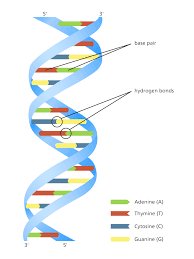
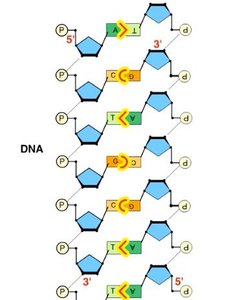
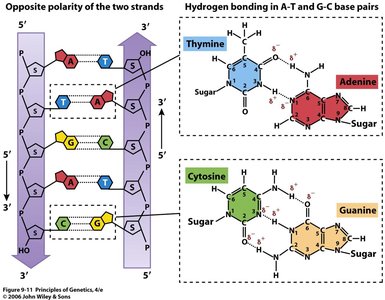
James Watson and Francis Crick, using Franklin's data and Chargaff's rules, proposed the double helix structure of DNA. The model features two antiparallel sugar-phosphate backbones with specific base pairing (A with T, G with C) held together by hydrogen bonds.
DNA Structure
Nucleotide Composition
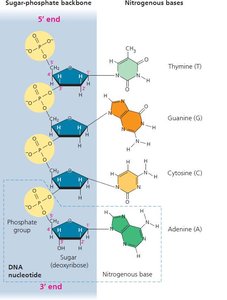
Each DNA nucleotide consists of three components: a deoxyribose sugar, a phosphate group, and a nitrogenous base (A, T, G, or C).
Nucleotides are joined by 3’-5’ phosphodiester bonds, forming the sugar-phosphate backbone.
Base Pairing and Hydrogen Bonds
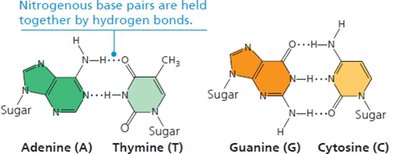
Adenine (A) pairs with Thymine (T) via two hydrogen bonds.
Guanine (G) pairs with Cytosine (C) via three hydrogen bonds, making GC pairs more stable than AT pairs.
Pyrimidines and Purines
Pyrimidines: Cytosine (C) and Thymine (T), each with a single ring.
Purines: Adenine (A) and Guanine (G), each with two rings.
Pairing a purine with a pyrimidine maintains the uniform diameter of the double helix.
DNA vs. RNA Structure
Comparison of DNA and RNA
Both are polymers of nucleotides, but DNA contains deoxyribose sugar, while RNA contains ribose sugar.
DNA uses thymine (T) as a base, while RNA uses uracil (U).
DNA is typically double-stranded (double helix), while RNA is usually single-stranded.
Genetic Information Flow: From DNA to Protein
Central Dogma of Molecular Biology
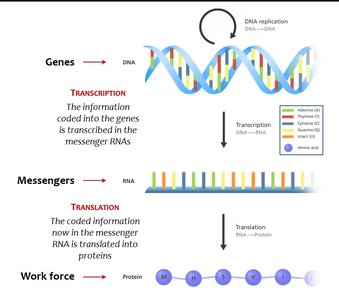
The central dogma describes the flow of genetic information: DNA is transcribed into RNA, which is then translated into protein. This process underlies gene expression and the synthesis of cellular machinery.
Transcription: The process by which information in a DNA gene is copied into messenger RNA (mRNA).
Translation: The process by which the information in mRNA is used to synthesize proteins.
Scientific Skills Exercise: Chargaff’s Rules
Application of Chargaff’s Rules
Given the percentage of one base, the percentages of the other bases can be calculated using Chargaff’s rules:
If A = 26.5%, then T = 26.5% (A = T).
The remaining percentage (100% - 2 × 26.5% = 47%) is divided equally between G and C, so G = C = 23.5%.
Stability of DNA Sequences
GC-rich vs. AT-rich DNA
GC-rich DNA sequences are more stable than AT-rich sequences of the same length because G-C pairs form three hydrogen bonds, compared to two in A-T pairs. This increased hydrogen bonding provides greater thermal stability to the DNA molecule.
Summary Table: Key Properties of DNA
Property | Description |
|---|---|
Genetic Material | Stores, replicates, and transmits genetic information |
Structure | Double helix of antiparallel strands |
Base Pairing | A=T, G=C (Chargaff’s rules) |
Stability | GC pairs more stable than AT pairs |
Expression | Transcription and translation produce proteins |
Additional info: The discovery of the molecular basis of inheritance has enabled advances in biotechnology, genomics, and medicine, including genetic engineering and the Human Genome Project.
