 Back
The Molecular Basis of Inheritance: Structure and Replication of DNA
Study Guide - Smart Notes
 Tailored notes based on your materials, expanded with key definitions, examples, and context.
Chapter 16: The Molecular Basis of Inheritance
Concept 16.1: DNA is the Genetic Material
The identification of DNA as the genetic material was a pivotal discovery in biology. Early experiments with bacteria and viruses provided the first evidence that DNA, not protein, carries genetic information.
Evidence That DNA Can Transform Bacteria
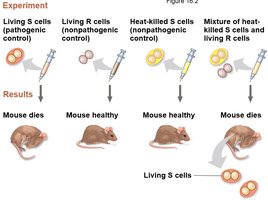
Frederick Griffith's Experiment (1928): Griffith discovered the phenomenon of transformation by working with two strains of Streptococcus pneumoniae: a pathogenic (S) strain and a non-pathogenic (R) strain.
When heat-killed S cells were mixed with living R cells and injected into mice, the mice died, and living S cells were recovered, indicating that some "transforming principle" from the dead S cells converted R cells into S cells.
Evidence That Viral DNA Can Program Cells
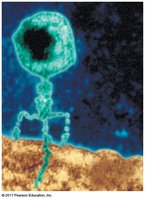
Bacteriophages (phages): Viruses that infect bacteria consist of DNA (or RNA) enclosed in a protein coat.
Hershey-Chase Experiment (1952): Demonstrated that DNA, not protein, is the genetic material injected by phages into bacteria to program viral replication.
Additional Evidence: Chargaff’s Rules
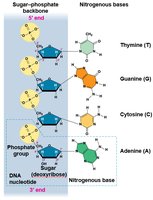
DNA is a polymer of nucleotides, each composed of a nitrogenous base, a deoxyribose sugar, and a phosphate group.
Chargaff’s Rules: The amount of adenine (A) equals thymine (T), and the amount of guanine (G) equals cytosine (C) in DNA. The base composition varies between species.
Watson and Crick’s Model and X-ray Crystallography
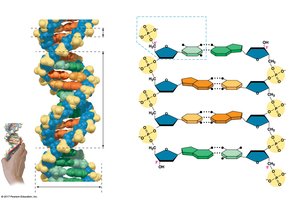
Watson and Crick deduced the double helix structure of DNA, with specific base pairing (A with T, G with C), explaining Chargaff’s rules.
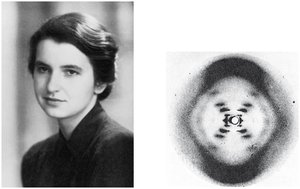
Maurice Wilkins and Rosalind Franklin used X-ray crystallography to reveal the helical structure of DNA.
Concept 16.2: Many Proteins Work Together in DNA Replication and Repair
DNA replication is a highly coordinated process involving multiple enzymes and proteins to ensure accurate copying of genetic information.
Models of DNA Replication
Semiconservative Model: Each new DNA molecule consists of one parental strand and one newly synthesized strand. Supported by Meselson and Stahl’s experiments.
Other models (conservative, dispersive) were disproven by experimental evidence.
DNA Replication: Initiation and Elongation
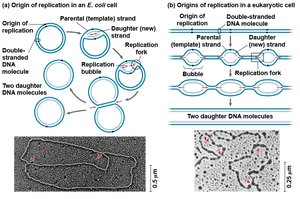
Replication begins at origins of replication, forming replication bubbles that expand in both directions.
At each end of a bubble is a replication fork, where DNA is unwound and new strands are synthesized.
Key Enzymes and Proteins in DNA Replication
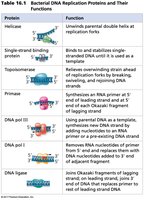
Protein | Function |
|---|---|
Helicase | Unwinds the parental double helix at replication forks |
Single-strand binding protein | Binds to and stabilizes single-stranded DNA |
Topoisomerase | Relieves overwinding strain ahead of replication forks by breaking, swiveling, and rejoining DNA strands |
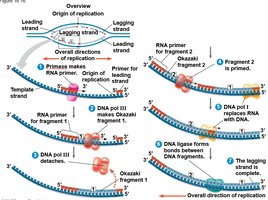
Primase | Synthesizes RNA primers for DNA polymerase to begin synthesis |
DNA polymerase III | Elongates new DNA strand by adding nucleotides to the 3' end |
DNA polymerase I | Removes RNA primers and replaces them with DNA |
DNA ligase | Joins Okazaki fragments on the lagging strand |
Leading and Lagging Strand Synthesis
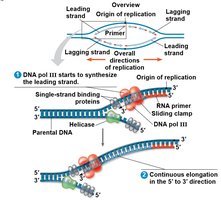
DNA polymerases can only add nucleotides to the free 3′ end, so synthesis proceeds in the 5′ to 3′ direction.
The leading strand is synthesized continuously toward the replication fork.
The lagging strand is synthesized discontinuously, away from the fork, as short Okazaki fragments that are later joined by DNA ligase.
Proofreading and DNA Repair
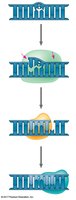
DNA polymerases proofread each nucleotide as it is added, correcting errors.
Mismatch repair corrects errors missed during replication.
Nucleotide excision repair removes and replaces damaged DNA segments.
Mutations that escape repair can be inherited and contribute to genetic variation.
Concept 16.3: Chromosome Structure and DNA Packaging
DNA molecules are packaged with proteins to form chromosomes, allowing efficient storage and regulation of genetic information.
Bacterial Chromosomes
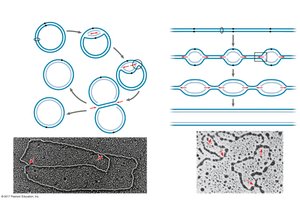
Bacterial DNA is typically a double-stranded, circular molecule found in the nucleoid region.
DNA is "supercoiled" to fit within the cell.
Eukaryotic Chromosomes and Chromatin Structure
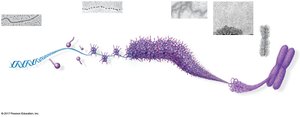
In eukaryotes, DNA is combined with proteins (mainly histones) to form chromatin.
DNA wraps around histone proteins to form nucleosomes, which further coil and fold to form higher-order structures, ultimately producing condensed chromosomes during cell division.
Chromosome Organization in the Nucleus
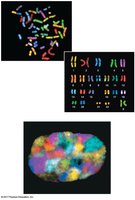
During interphase, chromosomes occupy specific regions within the nucleus, preventing entanglement and facilitating gene regulation.
Additional info: The structure and replication of DNA are central to understanding heredity, genetic variation, and the molecular mechanisms underlying evolution and disease. The accuracy of DNA replication and repair ensures the faithful transmission of genetic information, while occasional mutations provide the raw material for evolution.
