 Back
BackThe Molecular Revolution: Biotechnology, Genomics, and New Frontiers
Study Guide - Smart Notes
 Tailored notes based on your materials, expanded with key definitions, examples, and context.
Biotechnology: Concepts and Applications
Introduction to Biotechnology
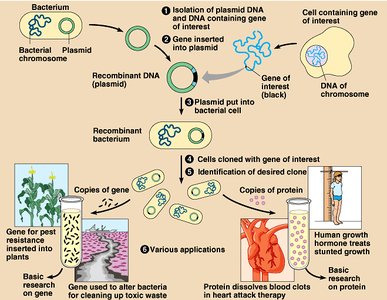
Biotechnology is the manipulation of living organisms or their components to produce useful products. It has revolutionized science, medicine, agriculture, and forensics by enabling precise genetic modifications and analysis.
Genetic engineering refers to the direct manipulation of DNA sequences in organisms.
Recombinant DNA technology involves combining DNA from different sources to create novel genetic combinations.
Applications include forensics (e.g., DNA fingerprinting), medicine (e.g., production of recombinant proteins like human growth hormone), and agriculture (e.g., genetically modified crops).
Key Techniques in Genetic Engineering
Restriction Enzymes and Plasmid Cloning
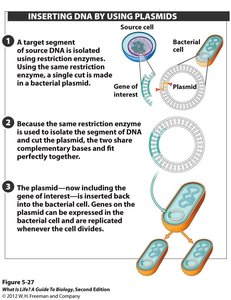
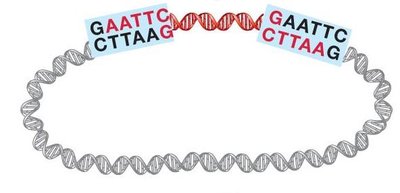
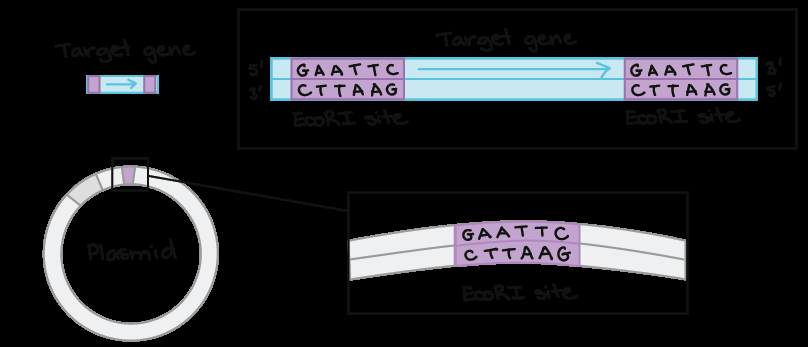
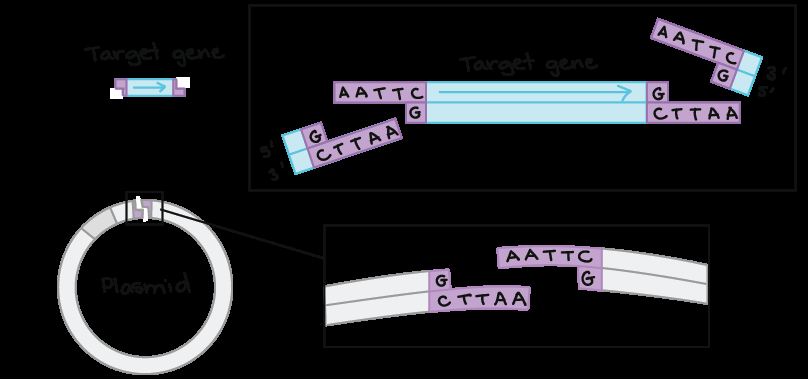
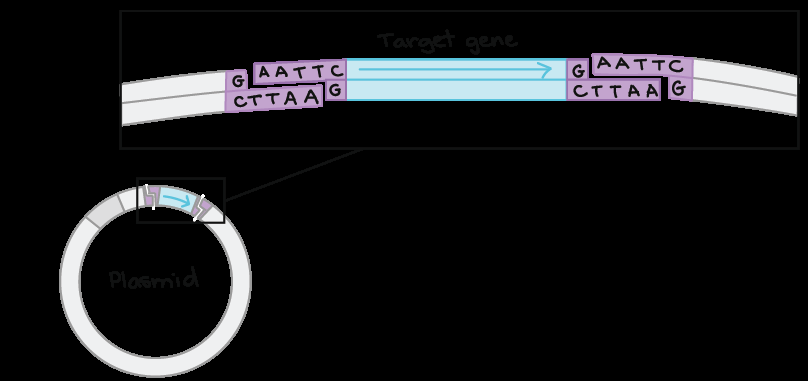
Restriction enzymes are proteins that recognize specific DNA sequences and cut the DNA at or near these sites. They are essential tools for cutting out genes of interest and opening plasmids for gene insertion.
Restriction enzymes (e.g., EcoRI) recognize palindromic sequences in DNA and make precise cuts.
Plasmids are small, circular DNA molecules found in bacteria that can replicate independently of the bacterial chromosome. They serve as vectors for gene cloning.
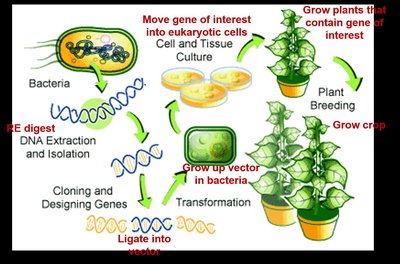
After cutting both the gene of interest and the plasmid with the same restriction enzyme, the gene can be inserted into the plasmid, and the DNA is sealed with DNA ligase.
Transformation and Cloning
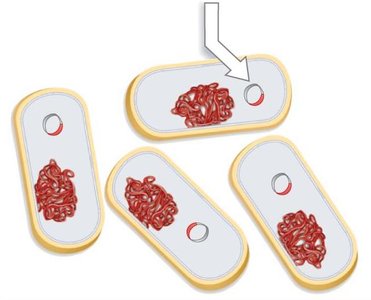
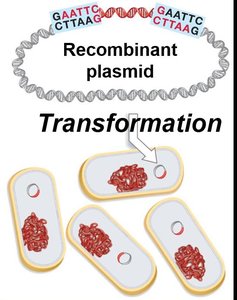
Once recombinant plasmids are created, they are introduced into bacterial cells through a process called transformation. The bacteria then replicate, producing many copies of the recombinant DNA.
Transformation allows the uptake of recombinant plasmids by bacteria.
As bacteria divide, they replicate the plasmid, amplifying the gene of interest.
This process is used to produce large quantities of DNA or protein products.
Gel Electrophoresis
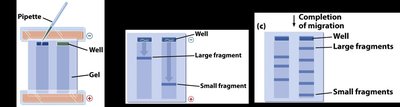
Gel electrophoresis is a technique used to separate DNA fragments based on size, shape, and charge. It is essential for analyzing DNA fragments produced by restriction enzymes or PCR.
DNA samples are loaded into a gel matrix and subjected to an electric field.
Smaller DNA fragments migrate faster through the gel than larger ones.
A molecular weight marker (ladder) is used as a reference to estimate fragment sizes.
Polymerase Chain Reaction (PCR)
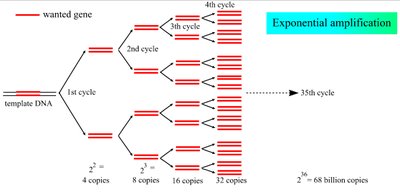
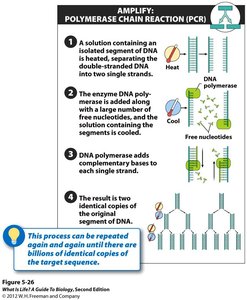
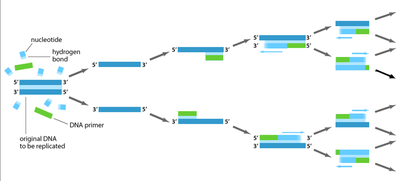
PCR is a method for amplifying specific DNA sequences from small samples, generating millions to billions of copies. It is widely used in research, diagnostics, and forensics.
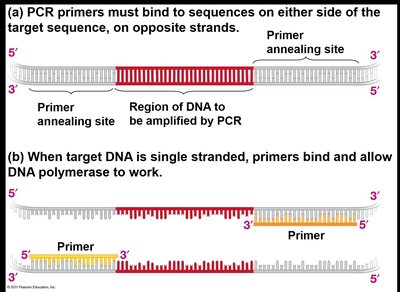
Requires a DNA template, two primers (one for each strand), dNTPs, and a heat-stable DNA polymerase (e.g., Taq polymerase).
Three main steps: Denaturation (separates DNA strands), Annealing (primers bind to target sequences), and Extension (polymerase synthesizes new DNA).
Each cycle doubles the amount of target DNA, leading to exponential amplification: copies after n cycles.
DNA Sequencing
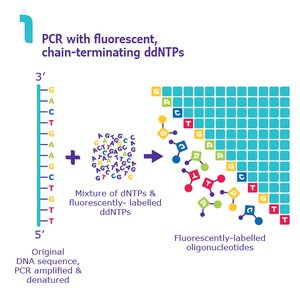
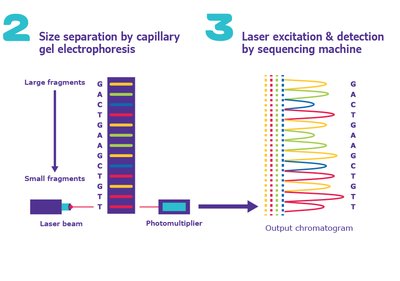
DNA sequencing determines the exact order of nucleotides in a DNA molecule. Modern methods use fluorescently labeled chain-terminating nucleotides (ddNTPs) to generate fragments of varying lengths, which are then separated and detected.
Sequencing reactions are similar to PCR but include ddNTPs that terminate DNA synthesis at specific bases.
Fragments are separated by size using capillary gel electrophoresis.
A laser detects the fluorescent labels, and a computer reconstructs the DNA sequence.
Applications of Biotechnology
Genetically Modified Organisms (GMOs)
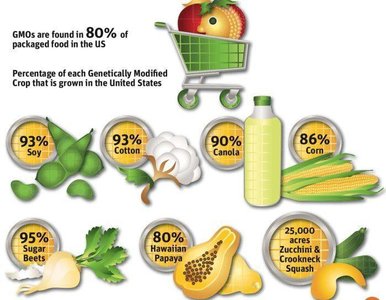
GMOs are organisms whose genomes have been altered using genetic engineering techniques. They are widely used in agriculture to improve crop yield, resistance to pests, and nutritional value.
Common GM crops include cotton, canola, sugar beets, and papaya.
GMOs are also used in medicine (e.g., production of insulin, growth hormones) and environmental applications (e.g., bacteria engineered to clean up toxic waste).
Summary Table: Key Techniques in Biotechnology
Technique | Main Purpose | Key Components | Applications |
|---|---|---|---|
Restriction Enzymes | Cut DNA at specific sequences | Restriction enzyme, recognition site | Gene cloning, recombinant DNA |
Plasmid Cloning | Insert foreign DNA into host cells | Plasmid vector, ligase, host cell | Gene amplification, protein production |
Gel Electrophoresis | Separate DNA fragments by size | Agarose gel, electric field, DNA samples | DNA analysis, forensics |
PCR | Amplify specific DNA sequences | Primers, dNTPs, Taq polymerase | Diagnostics, cloning, forensics |
DNA Sequencing | Determine nucleotide sequence | ddNTPs, primers, polymerase | Genomics, mutation analysis |
Additional info: These techniques form the foundation of modern molecular biology and have enabled advances in genomics, personalized medicine, and synthetic biology.
