 Back
The Molecules of Cells: Structure and Function of Biological Macromolecules
Study Guide - Smart Notes
 Tailored notes based on your materials, expanded with key definitions, examples, and context.
Chapter 3: The Molecules of Cells
Introduction
Biological molecules are essential for the structure and function of living organisms. For example, the enzyme lactase is required to digest lactose in dairy products. The inability to produce lactase leads to lactose intolerance, illustrating the importance of enzymes and other biological molecules in daily life.

Introduction to Organic Compounds
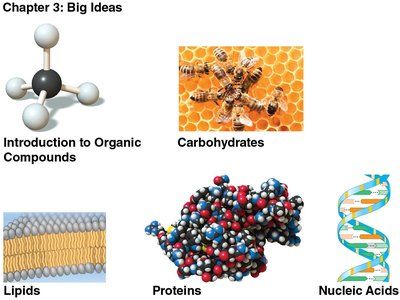
3.1 Life’s Molecular Diversity Is Based on the Properties of Carbon
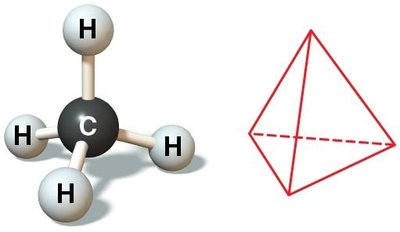
Carbon is the foundation of organic molecules due to its ability to form four covalent bonds, allowing for a diversity of stable structures. The versatility of carbon enables the formation of large, complex molecules essential for life.
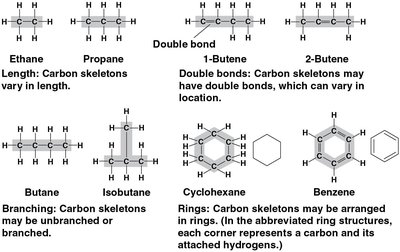
Carbon chains form the backbone of most organic molecules.
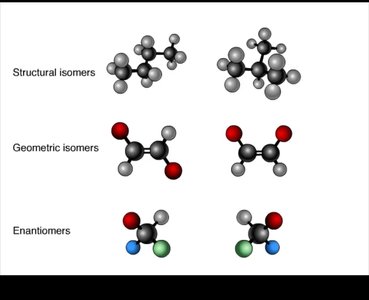
Isomers are compounds with the same molecular formula but different structures, leading to different properties.
Hydrocarbons are composed only of carbon and hydrogen.
Isomerism
Structural isomers: Differ in the covalent arrangements of their atoms.
Geometric isomers: Differ in spatial arrangements due to inflexible double bonds.
Enantiomers: Mirror images of each other, important in pharmaceuticals.
Chemical Groups and Biological Function
3.2 A Few Chemical Groups are Key to the Functioning of Biological Molecules
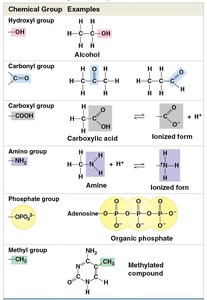
The properties of organic compounds depend on the size and shape of their carbon skeletons and the chemical groups attached. Functional groups are specific groups of atoms that confer particular chemical properties to molecules. Many functional groups are hydrophilic, increasing solubility in water.
Chemical Group | Examples |
|---|---|
Hydroxyl (–OH) | Alcohols |
Carbonyl (–C=O) | Aldehydes, Ketones |
Carboxyl (–COOH) | Carboxylic acids |
Amino (–NH2) | Amines |
Phosphate (–OPO32–) | Organic phosphates |
Methyl (–CH3) | Methylated compounds |
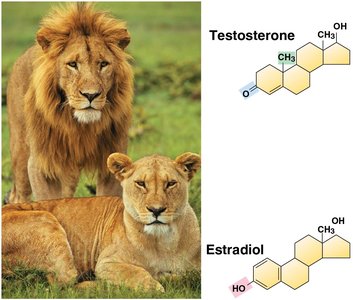
Sex Hormones and Functional Groups
Testosterone and estradiol differ only in the functional groups attached to their carbon skeletons, yet these differences result in distinct biological activities.
Macromolecules: Polymers and Monomers
3.3 Cells Make Large Molecules from a Limited Set of Small Molecules
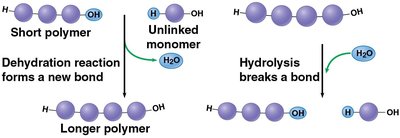
Cells construct macromolecules (large molecules) by linking together smaller units called monomers to form polymers. The four major classes of biological macromolecules are carbohydrates, lipids, proteins, and nucleic acids.
Dehydration reactions join monomers by removing water.
Hydrolysis breaks polymers into monomers by adding water.
Enzymes catalyze both dehydration and hydrolysis reactions.
Carbohydrates
3.4 Monosaccharides are the Simplest Carbohydrates
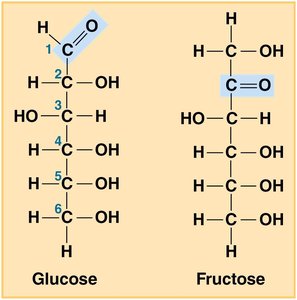
Carbohydrates include sugars and polymers of sugars. The simplest carbohydrates are monosaccharides, which generally have the formula (CH2O)n and contain hydroxyl and carbonyl groups.
Examples: Glucose, fructose (C6H12O6).
Monosaccharides serve as fuel and building blocks for other molecules.
3.5 Two Monosaccharides Are Linked to Form a Disaccharide
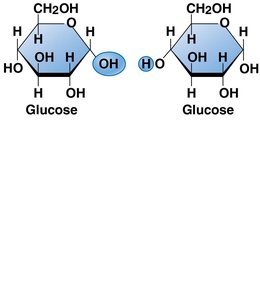
Two monosaccharides can join via a dehydration reaction to form a disaccharide. For example, glucose + fructose forms sucrose; glucose + galactose forms lactose.
General formula for a disaccharide: C12H22O11 (due to loss of H2O).
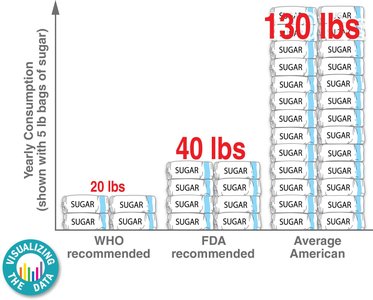
3.6 Connection: Are We Eating Too Much Sugar?
Excessive sugar intake is linked to health risks. The FDA recommends limiting added sugars to 10% of daily calories. "Empty calories" refers to foods high in energy but low in nutrients.
3.7 Polysaccharides Are Long Chains of Sugar Units
Polysaccharides are polymers of monosaccharides and serve various functions:
Starch: S
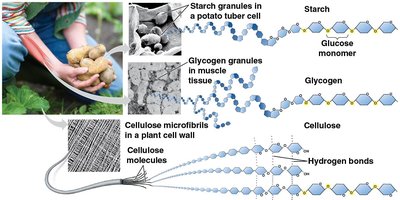 torage form in plants.
Glycogen: Storage form in animals.
Cellulose: Structural component of plant cell walls.
Chitin: Structural component in fungi and arthropods.
Lipids
3.8 Fats Are Lipids That Are Mostly Energy-Storage Molecules
Lipids are hydrophobic molecules mainly composed of carbon and hydrogen. Fats (triglycerides) consist of glycerol and three fatty acids. Fatty acids can be saturated (no double bonds) or unsaturated (one or more double bonds).
Saturated fats: Solid at room temperature, found in animal fats.
Unsaturated fats: Liquid at room temperature, found in plant oils.
Trans fats: Produced by hydrogenating unsaturated fats; associated with health risks.
3.10 Phospholipids and Steroids Are Important Lipids with a Variety of Functions
Phospholipids are major components of cell membranes, consisting of two fatty acids, a glycerol, and a phosphate group. Steroids have a structure of four fused rings; cholesterol is a key steroid in animal cell membranes and a precursor for hormones.
Proteins
3.12 Proteins Have a Wide Range of Functions and Structures
Proteins are polymers of amino acids and perform many functions, including catalysis (enzymes), transport, defense, signaling, movement, structure, and storage. The function of a protein depends on its specific shape, which can be lost by denaturation.
Proteins are made from 20 different amino acids.
Denaturation disrupts protein structure and function.
3.13 Proteins Are Made from Amino Acids Linked by Peptide Bonds
Amino acids have a central carbon bonded to an amino group, a carboxyl group, a hydrogen atom, and an R group. Peptide bonds link amino acids via dehydration reactions, forming polypeptides.
3.14 A Protein’s Functional Shape Results from Four Levels of Structure
Primary structure: Sequence of amino acids.
Secondary structure: Coiling or folding (e.g., alpha helix, beta sheet) stabilized by hydrogen bonds.
Tertiary structure: Overall 3D shape due to interactions among R groups.
Quaternary structure: Association of multiple polypeptide chains.
Nucleic Acids
3.15 The Nucleic Acids DNA and RNA Are Information-Rich Polymers of Nucleotides
Nucleic acids (DNA and RNA) are polymers of nucleotides, each consisting of a sugar, a phosphate group, and a nitrogenous base. DNA is double-stranded (double helix), while RNA is single-stranded. DNA stores genetic information; RNA is involved in protein synthesis.
Complementary base pairing (A-T, G-C in DNA) is essential for DNA replication and function.
Evolution Connection: Lactose Tolerance
Lactose tolerance in adults is a recent evolutionary adaptation resulting from mutations that keep the lactase gene active. This trait is common in populations with a history of dairy farming.
Summary Table: Major Classes of Biological Molecules
Class | Monomer | Polymer | Function |
|---|---|---|---|
Carbohydrates | Monosaccharide | Polysaccharide | Energy, structure |
Lipids | Fatty acids, glycerol | Fats, phospholipids, steroids | Energy storage, membranes, hormones |
Proteins | Amino acid | Polypeptide | Catalysis, structure, transport, etc. |
Nucleic Acids | Nucleotide | DNA, RNA | Genetic information |
Additional info: This chapter provides foundational knowledge for understanding the chemical basis of life, including the structure and function of macromolecules, their synthesis and breakdown, and their roles in evolution and health.
