 Back
The Molecules of Cells: Structure and Function of Biological Molecules
Study Guide - Smart Notes
 Tailored notes based on your materials, expanded with key definitions, examples, and context.
The Chemical Basis of Life
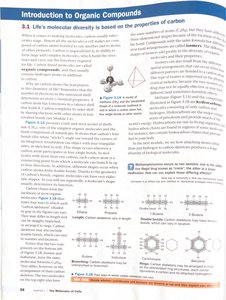
Introduction to Organic Compounds
Organic compounds are molecules primarily composed of carbon atoms bonded with hydrogen, oxygen, nitrogen, and other elements. The versatility of carbon allows for the formation of a wide variety of molecular structures, which are essential for life. Carbon's ability to form four covalent bonds enables the creation of complex molecules such as carbohydrates, lipids, proteins, and nucleic acids.
Carbon Skeletons: Carbon atoms can form chains, branched structures, and rings, providing the backbone for organic molecules.
Isomers: Molecules with the same molecular formula but different structures, leading to different properties.
Hydrocarbons: Compounds composed only of carbon and hydrogen; they are nonpolar and hydrophobic.
Functional Groups: Specific groups of atoms attached to carbon skeletons that confer distinct chemical properties.
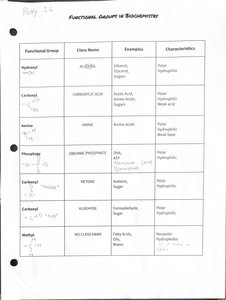
Functional Groups in Biochemistry
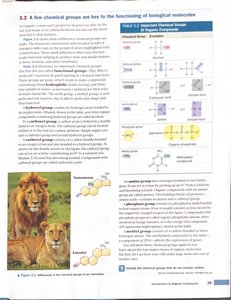
Functional groups are key to the chemical behavior of organic molecules. They are specific clusters of atoms that participate in chemical reactions and determine the properties of molecules. The most common functional groups in biological molecules include hydroxyl, carbonyl, carboxyl, amino, phosphate, and methyl groups.
Hydroxyl Group (-OH): Found in alcohols; polar and hydrophilic.
Carbonyl Group (C=O): Found in aldehydes and ketones; polar.
Carboxyl Group (-COOH): Found in carboxylic acids; acidic and polar.
Amino Group (-NH2): Found in amines; basic and polar.
Phosphate Group (-PO4): Found in nucleotides; polar and important in energy transfer.
Methyl Group (-CH3): Nonpolar; affects gene expression and molecular shape.
The Molecules of Cells
Cells Make Large Molecules from Small Molecules
Cells synthesize macromolecules by joining smaller molecules (monomers) into polymers through dehydration reactions. Polymers are broken down into monomers by hydrolysis reactions. This process is fundamental to the formation and breakdown of carbohydrates, proteins, and nucleic acids.
Dehydration Reaction: Removes a water molecule to form a covalent bond between monomers.
Hydrolysis Reaction: Adds a water molecule to break a covalent bond in a polymer.
Carbohydrates: Structure and Function
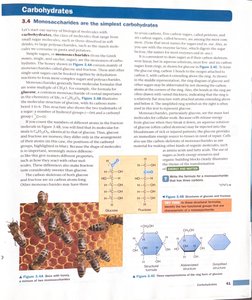
Carbohydrates are organic molecules composed of carbon, hydrogen, and oxygen, typically in a ratio of 1:2:1. They serve as energy sources and structural components in cells. The simplest carbohydrates are monosaccharides, which can combine to form disaccharides and polysaccharides.
Monosaccharides: Simple sugars such as glucose and fructose; serve as fuel for cellular work.
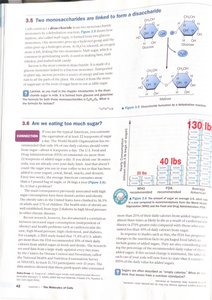
Disaccharides: Formed by joining two monosaccharides via a dehydration reaction (e.g., sucrose, lactose).
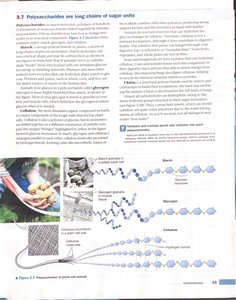
Polysaccharides: Long chains of monosaccharide units; include starch, glycogen, and cellulose.
Lipids: Structure and Function
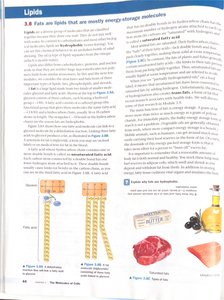
Lipids are hydrophobic molecules that include fats, phospholipids, and steroids. They are important for energy storage, membrane structure, and signaling. Fats are composed of glycerol and fatty acids, while phospholipids form the basis of cell membranes.
Fats: Energy storage molecules; composed of glycerol and three fatty acids.
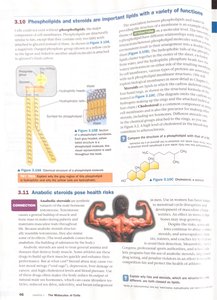
Phospholipids: Major component of cell membranes; contain a hydrophilic head and hydrophobic tails.
Steroids: Lipids with a four-ring structure; include cholesterol and hormones.
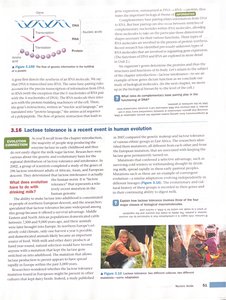
Proteins: Structure and Function
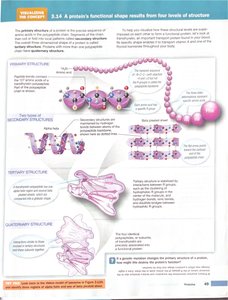
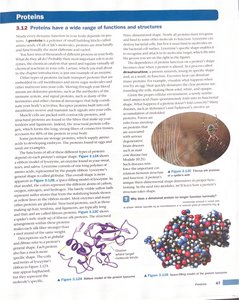
Proteins are polymers of amino acids and perform a wide range of functions, including catalysis, structural support, transport, and signaling. The structure of a protein determines its function and is organized into four levels: primary, secondary, tertiary, and quaternary.
Primary Structure: Sequence of amino acids in a polypeptide chain.
Secondary Structure: Local folding into alpha helices and beta sheets, stabilized by hydrogen bonds.
Tertiary Structure: Overall three-dimensional shape of a polypeptide.
Quaternary Structure: Association of multiple polypeptide chains.
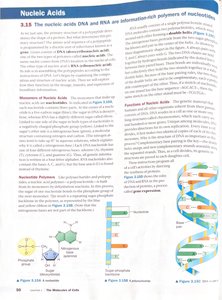
Nucleic Acids: DNA and RNA
Nucleic acids are polymers of nucleotides that store and transmit genetic information. DNA and RNA are the two main types, each with distinct functions and structures. DNA is double-stranded and forms a double helix, while RNA is single-stranded and involved in protein synthesis.
DNA: Deoxyribonucleic acid; stores genetic information.
RNA: Ribonucleic acid; involved in gene expression and protein synthesis.
Nucleotide Structure: Each nucleotide consists of a sugar, phosphate group, and nitrogenous base.
Review and Synthesis
Summary Table: Functional Groups in Biochemistry
The following table summarizes the main functional groups found in biological molecules, their class names, examples, and characteristics.
Functional Group | Class Name | Examples | Characteristics |
|---|---|---|---|
Hydroxyl | Alcohol | Ethanol, Sugars | Polar, Hydrophilic |
Carbonyl | Carboxylic Acid | Acetic Acid, Sugars | Polar, Hydrophilic |
Amino | Amine | Amino Acids | Polar, Hydrophilic |
Phosphate | Organic Phosphate | ATP, DNA, RNA | Polar, Hydrophilic |
Carbonyl | Ketone | Acetone, Sugars | Polar, Hydrophilic |
Carbonyl | Aldehyde | Formaldehyde, Sugars | Polar, Hydrophilic |
Methyl | No class name | Methylated DNA | Nonpolar, Hydrophobic |
Connecting Concepts
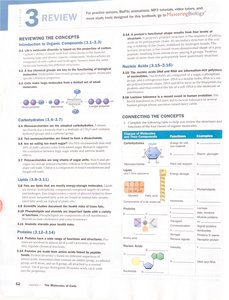
Biological molecules are interconnected through their structure and function. Carbohydrates, lipids, proteins, and nucleic acids are all built from smaller units and play essential roles in cellular processes. Understanding their chemical properties and functional groups is fundamental to studying biology.
Additional info:
Some content was inferred from textbook context and standard biology curriculum.
Equations for dehydration and hydrolysis reactions:
