 Back
The Nature of Molecules: Elements, Atoms, and Chemical Bonding
Study Guide - Smart Notes
 Tailored notes based on your materials, expanded with key definitions, examples, and context.
The Nature of Molecules
Levels of Biological Organization
Biological systems are organized hierarchically, from the simplest chemical components to complex cellular structures. Understanding these levels is fundamental to studying biology.
Atoms: The smallest unit of matter, forming the basis of all substances.
Molecules: Groups of atoms bonded together, forming chemical compounds.
Macromolecules: Large molecules essential for life, such as DNA and proteins.
Organelles: Specialized structures within cells, such as mitochondria.
Cells: The basic unit of life, capable of independent existence.
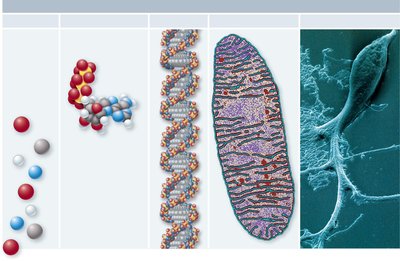
Elements and Atoms
Elements are pure substances that cannot be broken down by ordinary chemical means. Each element is defined by its unique atomic structure.
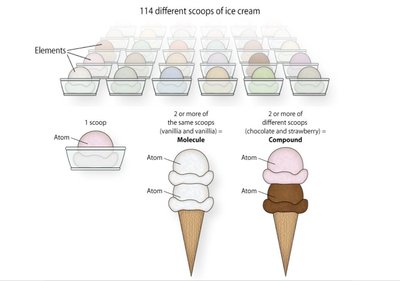
Element: A substance consisting of only one type of atom.
Atom: The smallest unit of an element, retaining its properties.
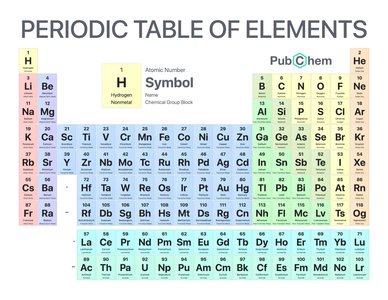
Periodic Table: Organizes elements by atomic number and properties.
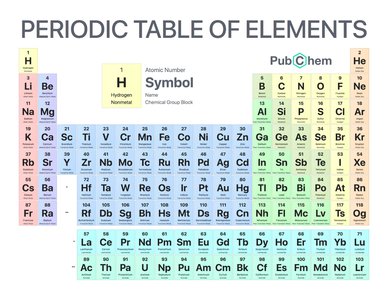
Examples of Elements
Gold (Au): A pure element, often used as an example of elemental matter.
Mercury (Hg): Another pure element, notable for being liquid at room temperature.
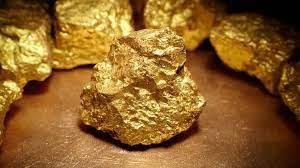

Atomic Structure and Subatomic Particles
Atoms are composed of three main subatomic particles, each with distinct properties and roles.
Protons: Positively charged particles found in the nucleus; determine the atomic number.
Neutrons: Neutral particles found in the nucleus; contribute to atomic mass.
Electrons: Negatively charged particles orbiting the nucleus; determine chemical behavior.
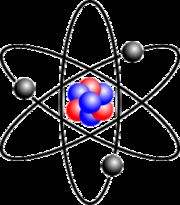
Atomic Number and Mass Number
Atomic Number: Number of protons in the nucleus; unique to each element.
Mass Number: Sum of protons and neutrons in the nucleus.
Isotopes: Variants of elements with different numbers of neutrons.
Molecules and Compounds
Atoms combine to form molecules and compounds, which are essential for biological processes.
Molecule: Two or more atoms of the same element bonded together.
Compound: Two or more atoms of different elements bonded together.
Electron Configuration and Chemical Behavior
The arrangement of electrons in an atom determines its chemical properties and reactivity.
Electron Shells: Energy levels where electrons reside; the first shell holds 2 electrons, the second holds 8.
Valence Electrons: Electrons in the outermost shell; crucial for chemical bonding.
Octet Rule: Atoms tend to fill their valence shell with 8 electrons for stability.
Periodic Table and Chemical Properties
The periodic table groups elements with similar properties, primarily based on their valence electrons.
Elements in the same column have the same number of valence electrons.
Valence electrons determine reactivity and bonding behavior.
Chemical Bonding
Chemical bonds are lasting attractions between atoms, ions, or molecules, enabling the formation of compounds.
Covalent Bonds: Electrons are shared between atoms.
Nonpolar Covalent: Electrons are shared equally.
Polar Covalent: Electrons are shared unequally.
Ionic Bonds: Electrons are transferred from one atom to another, creating charged ions.
Bond Formation and the Octet Rule
Atoms bond to fill their valence shell, achieving stability.
Electrons may be shared, lost, or gained to satisfy the octet rule.
Summary Table: Elements, Atoms, Molecules, and Compounds
Term | Definition | Example |
|---|---|---|
Element | Pure substance with only one kind of atom | Gold (Au), Mercury (Hg) |
Atom | Smallest unit of an element | Hydrogen atom |
Molecule | Two or more atoms of the same element | O2 (oxygen gas) |
Compound | Two or more atoms of different elements | H2O (water) |
Additional info:
Electrons are responsible for chemical reactions because they are not tightly bound to the nucleus and can interact with other atoms.
Protons and neutrons contribute to atomic mass, but electrons are negligible in mass.
Isotopes have the same number of protons but different numbers of neutrons, affecting their mass but not their chemical properties.
