 Back
The Nature of Science: Foundations and Methods in Biology
Study Guide - Smart Notes
 Tailored notes based on your materials, expanded with key definitions, examples, and context.
The Nature of Science
What is Science?
Science is a systematic process for acquiring knowledge about the universe through observation, questioning, and experimentation. It is a fact-driven discipline that seeks to understand natural phenomena by relying on evidence and reproducible results, rather than assertions or beliefs.
Observation: Gathering information about the natural world using the senses or instruments.
Questioning: Posing questions based on observations to guide investigation.
Experimentation: Testing hypotheses through controlled and repeatable procedures.
Demonstration over Assertion: Scientific claims must be supported by evidence, not simply stated as fact.
Scientific and Non-Scientific Questions
Scientific questions are those that can be tested and answered through observation and experimentation. For example, "Water freezes at 0°C" is a scientific statement because it can be tested and verified. In contrast, questions about the meaning of life or subjective preferences (e.g., "Stag beetles are cooler than fire ants") are not scientific because they cannot be objectively tested.
Key Terminology in Science
Theory: An explanation for a broad class of phenomena or observations that is supported by a large body of evidence. Theories are predictive and can be refined as new evidence emerges.
Hypothesis: A testable statement that explains a specific phenomenon or observation. Hypotheses are more narrowly focused than theories.
Prediction: A measurable or observable result that must be correct if a hypothesis is valid.
Historical Models in Science
Geocentric Model of the Solar System
The geocentric model, proposed by ancient Greek astronomers, placed the Earth at the center of the universe, with all other celestial objects revolving around it. This model was widely accepted until the Renaissance.

Heliocentric Model of the Solar System
In 1543, Copernicus proposed the heliocentric model, which correctly placed the Sun at the center of the solar system. This model was a true scientific theory because it was predictive and based on mathematical evidence.
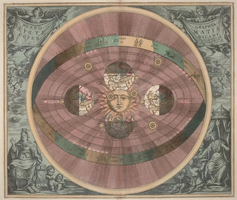
Additional info: Islamic scholars had proposed similar sun-centered models as early as the 1300s.
Important Western Scientific Theories
Heliocentrism: Copernicus, 1543
Plate Tectonics: Wegener, 1912; Wilson, 1960s
Evolution by Natural Selection: Charles Darwin, 1859
Oxygen Theory of Combustion: Antoine Lavoisier, 1770s
Relativity: Einstein, 1905–1915
The Scientific Method
Characteristics of a Scientific Hypothesis
Testable: Can be evaluated through experiments or observations.
Falsifiable: Can be proven false by evidence.
Measurable: Produces results that can be quantified or observed.
Reproducible: Can be repeated with the same results by others.
Objective: Free from personal bias.
Hypotheses can be refined as new evidence is gathered. Multiple hypotheses may exist for a phenomenon, but testing helps identify the most likely explanation.
Steps of Hypothesis-Based Science (The Scientific Method)
Formulate a hypothesis
Design an experiment or observational sampling scheme
Include replicates (multiple samples or trials)
Include controls (samples that do not receive the experimental treatment)
Test the hypothesis through objective experiments or observations
Reject or fail to reject the hypothesis based on results
Experiments vs. Observational Studies
Experiments: Manipulate one or more variables while keeping others constant to test a hypothesis.
Observational Studies: Observe and record phenomena without manipulation, often using statistical techniques to control for variation.
Both approaches aim to maximize the number of observations (replicates) and are valid forms of scientific inquiry.
Scientific Method Example: Batesian Mimicry
Batesian Mimicry
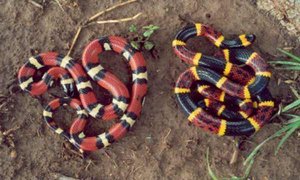
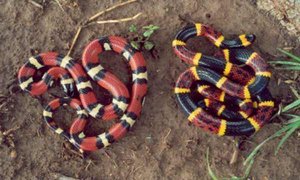
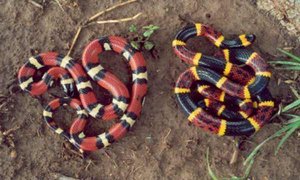
Batesian mimicry is a phenomenon where a harmless species (the mimic) evolves to resemble a harmful or unpalatable species (the model) to avoid predation. For example, some non-venomous snakes mimic the coloration of venomous snakes.
Formulating Hypotheses
Hypothesis 1: The coloration of non-venomous king snakes mimics venomous coral snakes, providing protection from predators.
Hypothesis 2: When the venomous snake is absent from an area, the non-venomous mimic does not benefit from mimicry.
Experimental Design
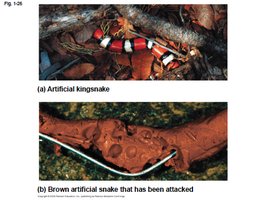
Artificial king snakes (mimics) and brown control snakes were placed in different regions to measure predation rates.
Controls ensure that the material of the artificial snake does not affect predation rates.
Predictions
Where both snakes live together, predation on artificial king snakes should be lower than on brown control snakes (predators avoid striped snakes).
Where only the non-venomous snake lives, predation on artificial king snakes should be higher than on brown control snakes (predators do not recognize the warning coloration).
Results
Region | Artificial Kingsnakes Attacked (%) | Brown Artificial Snakes Attacked (%) |
|---|---|---|
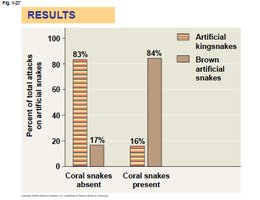
Coral snakes absent | 83 | 17 |
Coral snakes present | 16 | 84 |
Conclusion
The data support the hypothesis that mimicry provides protection only where the model species is present. In regions without the venomous coral snake, the mimic does not benefit and may even be more vulnerable to predation.
Observational Studies
Observational studies involve careful monitoring of phenomena without experimental manipulation. For example, studying the rare Western Prairie Fringed Orchid involves long-term observation and statistical analysis to understand its ecology, as it is difficult to grow in controlled conditions.
Unsettled Questions in Science
How do you define a "species"?
What is the definition of life?
What is the Definition of Life?
Based on cellular theory: The cell is the simplest unit of life.
Living things acquire and use energy, respond to their environment, regulate internal functions, grow and develop, reproduce, and evolve.
Viruses are a special case: they have a protein coat and DNA, but do not meet all criteria for life (e.g., they cannot reproduce independently).
Chronic Wasting Disease (CWD) and Prions
Chronic Wasting Disease (CWD) is a highly contagious disease caused by prions—misfolded proteins that cannot be broken down and can induce misfolding in normal proteins. CWD affects white-tailed and mule deer, elk, and moose, and is always fatal. It is transmitted through body fluids and contaminated materials.
Similar diseases: Scrapie (sheep), Mad Cow Disease (cattle), Creutzfeldt-Jakob Disease (rare in humans).
Although not thought to be contagious to humans, precautions are recommended for hunters.
