 Back
The Nervous System: Structure, Function, and Physiology
Study Guide - Smart Notes
 Tailored notes based on your materials, expanded with key definitions, examples, and context.
Introduction to the Nervous System
Overview
The nervous system is a complex network responsible for receiving, integrating, and responding to internal and external stimuli. It plays a critical role in maintaining homeostasis and coordinating bodily functions, often without conscious awareness. 
Organization of the Nervous System
Central and Peripheral Nervous Systems
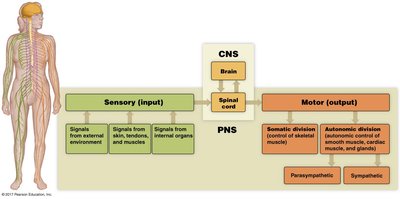
The nervous system is divided into two main parts: the Central Nervous System (CNS) and the Peripheral Nervous System (PNS).
Central Nervous System (CNS): Consists of the brain and spinal cord. It processes information and determines appropriate responses.
Peripheral Nervous System (PNS): Includes all neural tissue outside the CNS. It transmits sensory information to the CNS and carries out motor commands from the CNS to the body.
Types of Neurons
Sensory Neurons: Transmit signals from sensory receptors to the CNS.
Interneurons: Integrate information within the CNS.
Motor Neurons: Carry commands from the CNS to muscles and glands.
Neuroglial Cells
Schwann Cells (PNS): Produce myelin sheath, which insulates axons and speeds up impulse transmission.
Oligodendrocytes (CNS): Produce myelin in the CNS. Damage to these cells can lead to disorders such as Multiple Sclerosis.
Membrane Potential and the Sodium-Potassium Pump
Resting Membrane Potential
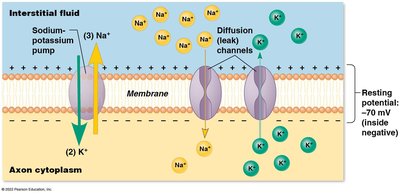
Neurons maintain a resting membrane potential, typically around -70 mV, due to the activity of the sodium-potassium pump and selective permeability of the membrane.
Sodium-Potassium Pump: Actively transports 3 Na+ ions out of the cell and 2 K+ ions into the cell, creating a net negative charge inside the cell.
Leak Channels: Allow passive movement of Na+ and K+, but the pump maintains the overall gradient.
Graded Potentials and Action Potentials
Graded Potentials
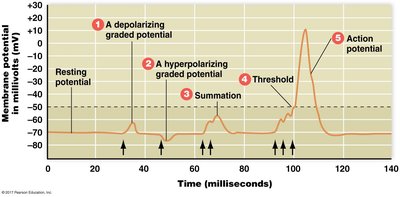
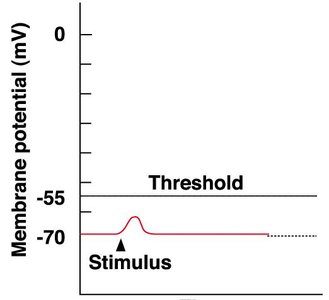
Graded potentials are small changes in membrane potential that occur in response to stimuli. They can be depolarizing or hyperpolarizing and may summate to reach the threshold for an action potential.
Depolarizing Graded Potential: Makes the inside of the cell less negative.
Hyperpolarizing Graded Potential: Makes the inside of the cell more negative.
Summation: Multiple graded potentials can add together.
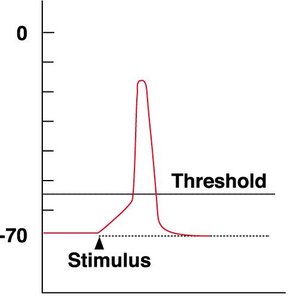
Threshold: The critical level (about -55 mV) that must be reached to trigger an action potential.
Action Potentials
An action potential is a rapid, temporary reversal of membrane potential that propagates along the axon. It only occurs if the threshold is reached.
All-or-None Principle: Action potentials either occur fully or not at all.
Constant Amplitude and Speed: Once initiated, the action potential travels at a constant rate and amplitude.
Phases of the Action Potential
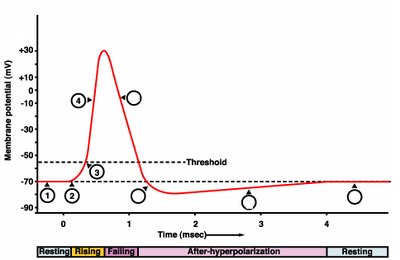
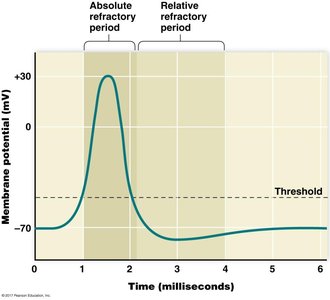
Resting State: Membrane at -70 mV.
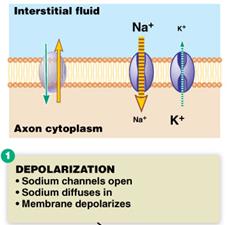
Depolarization: Na+ channels open, Na+ enters the cell, membrane potential rises to +30 mV.
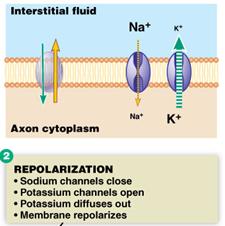
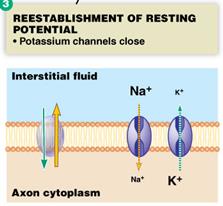
Repolarization: Na+ channels close, K+ channels open, K+ exits the cell, membrane potential returns toward -70 mV.
Hyperpolarization: K+ channels are slow to close, membrane potential temporarily becomes more negative than resting.
Restoration: Sodium-potassium pump restores resting potential.
Refractory Periods
Absolute Refractory Period: No new action potential can be generated.
Relative Refractory Period: A stronger-than-normal stimulus is required to initiate another action potential.
Synaptic Transmission
Structure and Function of the Synapse
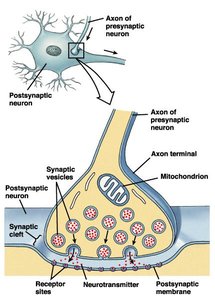
When an action potential reaches the axon terminal, it triggers the release of neurotransmitters into the synaptic cleft, allowing communication with the postsynaptic cell.
Presynaptic Neuron: Sends the signal.
Synaptic Cleft: The gap between neurons.
Postsynaptic Cell: Receives the signal.
Steps of Synaptic Transmission
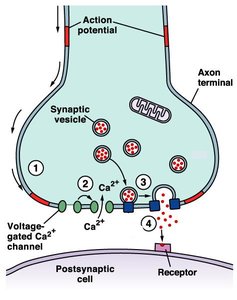
Action potential arrives at the axon terminal, opening voltage-gated Ca2+ channels.
Ca2+ enters the axon terminal, causing synaptic vesicles to fuse with the presynaptic membrane and release neurotransmitter.
Neurotransmitter diffuses across the synaptic cleft and binds to receptors on the postsynaptic membrane.
Binding opens ion channels, leading to a graded potential in the postsynaptic cell.
Neurotransmitters
Over 50 chemicals can act as neurotransmitters, each with specific effects.
Excitatory Neurotransmitters: Cause depolarization, increasing the likelihood of action potential generation.
Inhibitory Neurotransmitters: Cause hyperpolarization, decreasing the likelihood of action potential generation.
Neurotransmitter effects are short-lived; they are removed by reuptake, enzymatic destruction, or diffusion away from the synaptic cleft.
Post Synaptic Integration
A single action potential usually produces a small graded potential in the postsynaptic neuron.
To reach threshold, either the frequency of stimulation must increase or multiple presynaptic neurons must converge on the postsynaptic neuron.
Convergence: Many neurons synapse onto one neuron, integrating information.
Divergence: One neuron sends signals to multiple targets.
Summary Table: Key Features of the Nervous System
Feature | Description |
|---|---|
Central Nervous System (CNS) | Brain and spinal cord; processes and integrates information |
Peripheral Nervous System (PNS) | Sensory and motor neurons; transmits signals to and from CNS |
Resting Potential | -70 mV; maintained by sodium-potassium pump |
Action Potential | Rapid change in membrane potential; all-or-none response |
Synapse | Junction between neurons; site of neurotransmitter release |
Neurotransmitter | Chemical messenger; can be excitatory or inhibitory |
References
Johnson, Michael. (2017). Human Biology: Concepts & Current Issues (8th ed). Pearson Education Inc.
Johnson, Michael & S. Long (2021). Human Biology: Concepts & Current Issues (9th ed). Pearson Education Inc.
Silverthorn, Dee Unglaub. (2001). Human Physiology: An Integrated Approach (2nd ed). Prentice Hall.
