 Back
The Nervous System: Structure, Function, and Physiology
Study Guide - Smart Notes
 Tailored notes based on your materials, expanded with key definitions, examples, and context.
The Nervous System
Overview and Characteristics
The nervous system is responsible for receiving, integrating, and responding to both internal and external stimuli. It plays a critical role in maintaining homeostasis and can bring selected information to conscious awareness.
Receives information from sensory organs and internal receptors.
Integrates information to determine appropriate responses.
Responds rapidly (within tenths of a second) to stimuli.
Initiates muscle contraction, glandular secretion, and conscious thought.
Divisions of the Nervous System
Central Nervous System (CNS): Consists of the brain and spinal cord; responsible for integrating and processing information.
Peripheral Nervous System (PNS): Composed of nerves outside the CNS; transmits signals between the CNS and the rest of the body.
There are three main types of neurons:
Sensory neurons: Transmit sensory information to the CNS.
Interneurons: Connect neurons within the CNS.
Motor neurons: Transmit signals from the CNS to effectors (muscles/glands).
Neuroglial Cells
Neuroglial cells support and protect neurons. In the PNS, Schwann cells produce the myelin sheath, which:
Insulates axons, saving energy and speeding up impulse transmission (saltatory conduction).
Facilitates regeneration of damaged neurons in the PNS.
In the CNS, oligodendrocytes produce myelin. Damage to myelin in the CNS leads to disorders such as Multiple Sclerosis and Amyotrophic Lateral Sclerosis (ALS).
Neuron Physiology
The Sodium-Potassium Pump and Membrane Potential
The sodium-potassium pump is an active transport mechanism that maintains the resting membrane potential by moving ions across the cell membrane:
Moves 3 Na+ ions out of the cell and 2 K+ ions into the cell.
Results in a net loss of positive charge inside the cell, making the cytoplasm slightly negative compared to the outside.
This creates a membrane potential (resting potential), typically around -70 mV.
Graded Potentials
Graded potentials are small changes in membrane potential due to stimuli that alter Na+ and K+ concentrations. Types include:
Depolarizing graded potential: Makes the inside of the cell less negative.
Hyperpolarizing graded potential: Makes the inside of the cell more negative.
Summation: Combined effect of multiple graded potentials.
Threshold: The critical level (-55 mV) that must be reached to trigger an action potential.
Action Potentials
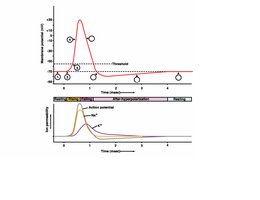
An action potential is a rapid, temporary reversal of membrane potential that travels along the axon. It only occurs if the stimulus is strong enough to reach threshold.
All-or-none: Action potentials either occur fully or not at all.
Self-propagating: Once initiated, the action potential travels the length of the axon.
Speed: Depends on axon diameter and myelination (larger diameter and myelinated axons conduct faster).
Phases of the Action Potential
Resting membrane potential: -70 mV
Stimulus (graded potential): Small depolarization
Threshold: -55 mV
Depolarization: Na+ channels open, Na+ enters, membrane potential rises to +30 mV
Repolarization: Na+ channels close, K+ channels open, K+ exits, membrane potential returns toward negative
Hyperpolarization: K+ channels close slowly, membrane potential drops below resting (-90 mV)
Restoration: Sodium-potassium pump restores resting potential (-70 mV)
Refractory Periods
Absolute refractory period: No new action potential can be generated (ensures one-way transmission).
Relative refractory period: A stronger-than-normal stimulus is required to initiate another action potential.
Synaptic Transmission
Steps of Synaptic Transmission
When an action potential reaches the axon terminal, it triggers the release of neurotransmitters into the synaptic cleft:
Action potential arrives at axon terminal and bulb.
Voltage-gated Ca2+ channels open; Ca2+ enters the axon bulb.
Ca2+ causes synaptic vesicles to fuse with the presynaptic membrane, releasing neurotransmitters into the synaptic cleft.
Neurotransmitters diffuse across the cleft and bind to receptors on the postsynaptic membrane.
Chemically-gated Na+ channels open, causing a graded depolarization in the postsynaptic cell.
Neurotransmitters
Over 50 chemicals can act as neurotransmitters.
Stored in vesicles within axon bulbs.
Can be excitatory (cause depolarization and promote action potentials) or inhibitory (cause hyperpolarization and inhibit action potentials).
Effects are short-lived; neurotransmitters are removed by reuptake, enzymatic destruction, or diffusion away from the synaptic cleft.
Post Synaptic Integration
A single action potential usually produces only a small graded potential in the postsynaptic neuron. To reach threshold and generate an action potential:
Presynaptic neurons must increase the frequency of stimulation.
Multiple neurons may synapse with the same postsynaptic neuron (convergence).
One neuron may send signals to many others (divergence).
Summary
The nervous system integrates information and produces rapid responses.
Divided into CNS and PNS, each with specialized roles.
The sodium-potassium pump maintains resting membrane potential, enabling action potentials.
Action potentials are all-or-none events that propagate along axons.
Synaptic transmission converts electrical signals to chemical signals, allowing communication between neurons and other cells.
References
Johnson, Michael. (2017) Human biology: Concepts & current issues (8th ed). Pearson Education Inc.
Johnson, Michael & S. Long (2021) Human biology: Concepts & current issues (9th ed). Pearson Education Inc.
Silverthorn, Dee Unglaub. (2001) Human physiology. An integrated approach (2nd ed). Prentice Hall
