Back
The Origin and Diversification of Eukaryotes
Study Guide - Smart Notes
 Tailored notes based on your materials, expanded with key definitions, examples, and context.
The Origin and Diversification of Eukaryotes
Introduction
The origin and diversification of eukaryotes marks a pivotal chapter in the history of life. Eukaryotes are organisms whose cells contain a nucleus and other membrane-bound organelles. This group includes protists, fungi, plants, and animals. Understanding their evolutionary history provides insight into the complexity and diversity of life on Earth.
Major Events in the History of Life
Timeline of Eukaryotic Evolution
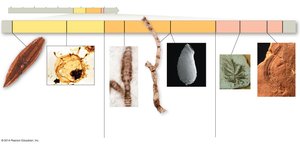
Life on Earth began with prokaryotes, but the emergence of eukaryotes over 1.8 billion years ago enabled the evolution of complex multicellular organisms. The fossil record and molecular evidence help reconstruct this timeline.
Prokaryotes dominated early life (bacteria and archaea).
First eukaryotes appeared about 1.8 billion years ago.
Multicellularity evolved independently in several eukaryotic lineages.
Major eukaryotic groups include plants, fungi, animals, and protists.
Concept 25.1: Eukaryotes Arose by Endosymbiosis
Endosymbiotic Theory
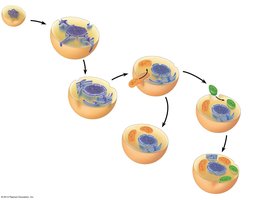
The endosymbiotic theory explains the origin of mitochondria and plastids (such as chloroplasts) in eukaryotic cells. According to this theory, these organelles originated as free-living prokaryotes that were engulfed by ancestral eukaryotic cells.
Mitochondria evolved from aerobic alpha-proteobacteria.
Plastids (e.g., chloroplasts) evolved from photosynthetic cyanobacteria.
Key evidence:
Inner membranes of mitochondria and plastids resemble prokaryotic membranes.
Organelles replicate by a process similar to binary fission.
Organelles contain their own circular DNA, similar to prokaryotes.
Ribosomes in these organelles are more similar to prokaryotic than eukaryotic ribosomes.
Concept 25.2: Evolution of Multicellularity
Independent Origins of Multicellularity
Multicellularity evolved multiple times in eukaryotes, leading to the rise of complex organisms such as plants, fungi, and animals. This transition required new mechanisms for cell adhesion and communication.
Multicellular lineages: Red algae, green algae, brown algae, plants, fungi, animals.
Cell adhesion and signaling: Proteins such as cadherins are involved in cell-to-cell adhesion in animals.
Example: The evolution of colonial algae (e.g., Volvox) demonstrates steps toward multicellularity.
Concept 25.3: Four Supergroups of Eukaryotes
Classification of Eukaryotes
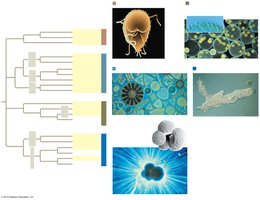
Modern classification divides eukaryotes into four major supergroups based on morphological and molecular data: Excavata, SAR clade, Archaeplastida, and Unikonta.
Supergroup | Main Groups | Key Features |
|---|---|---|
Excavata | Diplomonads, Parabasalids, Euglenozoans | Feeding groove, modified mitochondria, unique flagella |
SAR | Stramenopiles, Alveolates, Rhizarians | Diverse; includes diatoms, brown algae, ciliates, forams |
Archaeplastida | Red algae, Green algae, Land plants | Plastids from primary endosymbiosis |
Unikonta | Amoebozoans, Opisthokonts (fungi, animals) | Single flagellum (in some), amoeboid movement |
Excavata
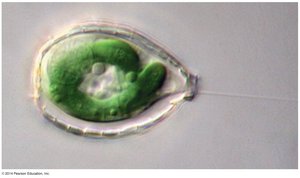
Key features: Cytoskeleton, some with feeding groove.
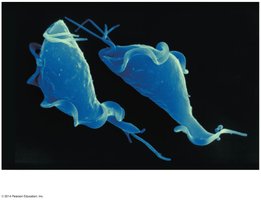
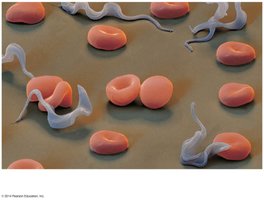
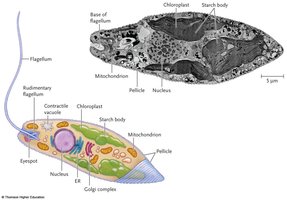
Examples: Euglena (free-living), Trichomonas (parasitic), Trypanosoma (causes sleeping sickness).
SAR Clade
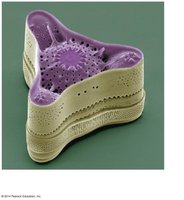
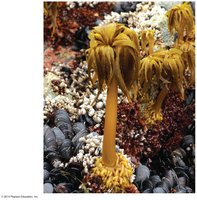
Stramenopiles: Diatoms (silica cell walls), brown algae (multicellular seaweeds).
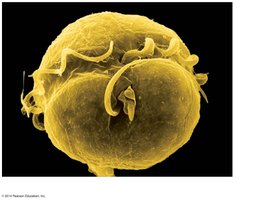
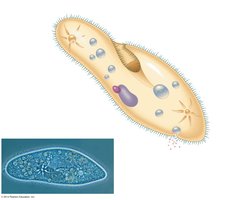
Alveolates: Dinoflagellates (red tides), ciliates (e.g., Paramecium).
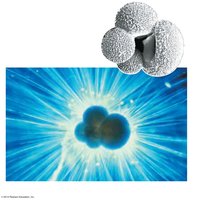
Rhizarians: Foraminiferans (porous shells), cercozoans (amoeboid/flagellated).
Archaeplastida
Includes: Red algae, green algae, land plants.
Key feature: Plastids from primary endosymbiosis with cyanobacteria.
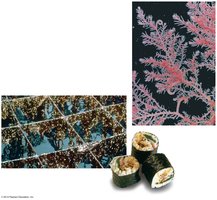
Red algae: Reddish due to phycoerythrin pigment, mostly multicellular.
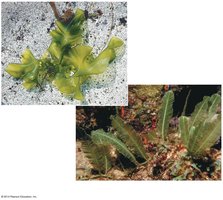
Green algae: Chlorophytes and charophytes; charophytes are closest relatives to land plants.
Unikonta
Includes: Amoebozoans (slime molds, gymnamoebas) and opisthokonts (fungi, animals, choanoflagellates).
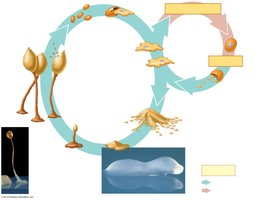
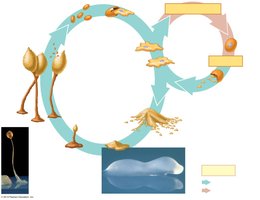
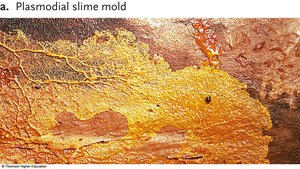
Slime molds: Exhibit both unicellular and multicellular stages; Dictyostelium is a model organism for studying multicellularity.
Structural and Functional Diversity in Protists
Protist Diversity
Protists are a paraphyletic group of mostly unicellular eukaryotes. They exhibit remarkable structural and functional diversity.
Habitat: Primarily aquatic.
Cellularity: Mostly unicellular, some multicellular lineages.
Nutritional modes: Photoautotrophs, heterotrophs, mixotrophs.
Reproduction: Both sexual and asexual reproduction.
Concept 25.4: Ecological and Health Roles of Single-Celled Eukaryotes
Ecological Importance
Single-celled eukaryotes, especially protists, play crucial roles in ecological communities as primary producers and as part of food webs.
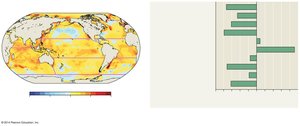
Photosynthetic protists contribute to about 30% of global photosynthesis.
Productivity in aquatic environments is often limited by nutrient availability.
Climate change affects the distribution and productivity of photosynthetic protists, impacting global carbon cycles and fisheries.
Effects on Human Health
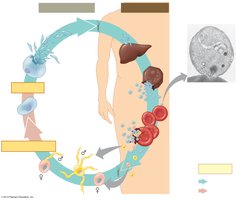
Malaria: Caused by the apicomplexan Plasmodium, transmitted by mosquitoes, and responsible for significant mortality worldwide.
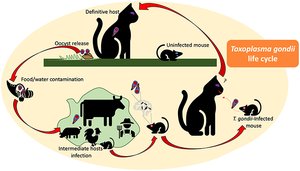
Toxoplasma gondii: Another apicomplexan, can alter host behavior (e.g., 'zombie mice') and is a concern for pregnant women due to risk of congenital infection.

Summary
Eukaryotes arose by endosymbiosis more than 1.8 billion years ago.
Multicellularity evolved independently in several eukaryotic lineages.
Four supergroups of eukaryotes are recognized: Excavata, SAR, Archaeplastida, and Unikonta.
Single-celled eukaryotes are ecologically and medically significant.