 Back
BackThe Origin and Evolution of Vertebrates
Study Guide - Smart Notes
 Tailored notes based on your materials, expanded with key definitions, examples, and context.
The Origin and Evolution of Vertebrates
Key Concepts in Vertebrate Evolution
Vertebrates are a diverse group of animals characterized by the presence of a backbone. Over evolutionary time, several key adaptations have arisen, leading to the vast diversity seen in modern vertebrates. This section explores the major evolutionary milestones in vertebrate history.
Vertebrates are chordates with a backbone.
Gnathostomes are vertebrates with jaws.
Mammals are amniotes that have hair and produce milk.

Overview: Half a Billion Years of Backbones
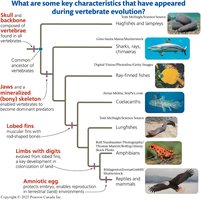
During the Cambrian period, approximately 530 million years ago, vertebrates emerged from a lineage of invertebrate animals. The evolution of the backbone was a pivotal event, enabling vertebrates to become one of the most successful animal groups on Earth.
Major Characteristics in Vertebrate Evolution
Key characteristics have appeared sequentially during vertebrate evolution, including the development of a backbone, jaws, lobed fins, limbs with digits, and the amniotic egg. These adaptations allowed vertebrates to exploit new ecological niches.
Vertebrates: Chordates with a Backbone
General Features of Vertebrates
There are about 60,000 species of vertebrates. All vertebrates possess a backbone, which protects the spinal cord and provides structural support.

Derived Characters of Vertebrates
Vertebrates are distinguished from other chordates by several derived features:
Two or more sets of Hox genes (compared to one in lancelets and tunicates).
Vertebrae enclosing a spinal cord.
An elaborate skull.
Fin rays in aquatic forms.
The Neural Crest
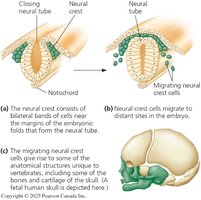
The neural crest is a collection of cells unique to vertebrates, appearing along the edges of the closing neural tube in the embryo. These cells migrate to form diverse structures, including teeth, bones and cartilage of the skull, certain neurons, and sensory capsules.
Gnathostomes: Vertebrates with Jaws
Introduction to Gnathostomes
Gnathostomes are jawed vertebrates, a group that includes sharks, ray-finned fishes, lobe-finned fishes, amphibians, reptiles (including birds), and mammals. Today, jawed vertebrates vastly outnumber jawless vertebrates.
Derived Characters of Gnathostomes
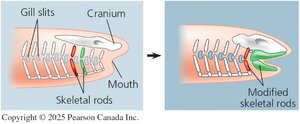
Gnathostomes are named for their jaws, which are hypothesized to have evolved from skeletal supports of the pharyngeal (gill) slits. Other derived features include:
Genome duplication, including Hox genes.
An enlarged forebrain (enhanced smell and vision).
Lateral line system in aquatic forms (sensitive to vibrations).
Fossil Gnathostomes
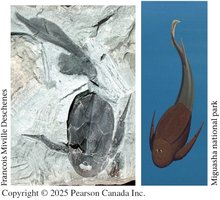
The earliest jawed vertebrates in the fossil record are placoderms, an extinct lineage of armored vertebrates that appeared about 450 million years ago. Another group, acanthodians, radiated during the Silurian and Devonian periods. Today, three lineages of jawed vertebrates survive: chondrichthyans, ray-finned fishes, and lobe-fins.
Chondrichthyans: Sharks, Rays, and Their Relatives
Characteristics of Chondrichthyans
Chondrichthyans (class Chondrichthyes) have skeletons composed primarily of cartilage. This group includes sharks, rays, skates, and a few species of ratfishes (chimaeras).
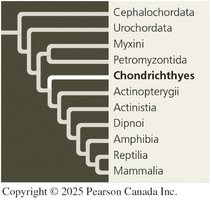
Diversity of Chondrichthyans
The largest and most diverse group of chondrichthyans includes sharks, rays, and skates. Ratfishes or chimaeras form a smaller subclass.
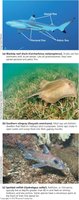
Sharks: Adaptations and Reproduction
Sharks are streamlined, swift swimmers. The largest species are suspension feeders, but most are carnivores. They have acute senses and a short digestive tract with a spiral valve to increase surface area. Shark reproduction varies:
Oviparous: Eggs hatch outside the mother’s body.
Ovoviviparous: Embryos develop within the uterus, nourished by egg yolk.
Viviparous: Embryos develop within the uterus, nourished via a yolk sac placenta from the mother’s blood.
Sharks are threatened by overfishing, with some populations declining by up to 95%.
Osteichthyans: Ray-Finned Fishes and Lobe-Fins
Introduction to Osteichthyans
Osteichthyans are gnathostomes with a bony endoskeleton. This group includes bony fishes and tetrapods. Most aquatic osteichthyans are informally called fishes.
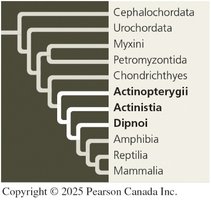
Ray-Finned Fishes (Actinopterygii)
Ray-finned fishes originated during the Silurian period and are the most familiar aquatic osteichthyans. Their fins, supported by long, flexible rays, are adapted for maneuvering and defense. Industrial fishing and habitat changes have caused population declines.
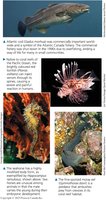
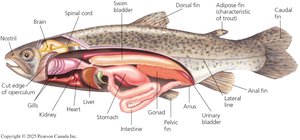
Anatomy of a Ray-Finned Fish
Most fishes breathe by drawing water over gills protected by an operculum. They control buoyancy with a swim bladder and possess a lateral line system. Most species are oviparous, but some have internal fertilization and birthing.
Lobe-Fins (Sarcopterygii)
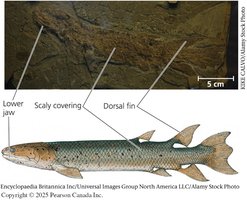
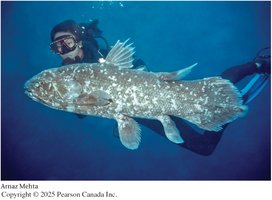
Lobe-fins originated in the Silurian period and are characterized by muscular pelvic and pectoral fins. Three lineages survive today: coelacanths, lungfishes, and tetrapods. Coelacanths were thought extinct until rediscovered in 1938. Lungfishes, found in the Southern Hemisphere, can breathe air. Tetrapods adapted to life on land.
Mammals: Amniotes with Hair and Milk
Introduction to Mammals
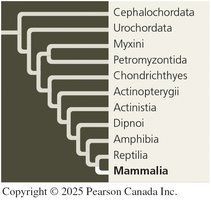
Mammals (class Mammalia) are represented by over 5,300 species. They are characterized by mammary glands, hair, a high metabolic rate, a large brain, differentiated teeth, and kidneys adapted for water conservation.
Adaptations to Dry Habitats
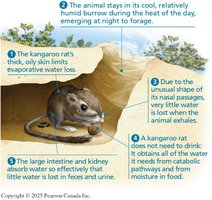
Some mammals, such as kangaroo rats, are highly adapted to arid environments. They conserve water through behavioral and physiological adaptations, including efficient kidneys and nocturnal activity.
Early Evolution of Mammals
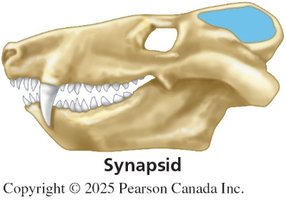
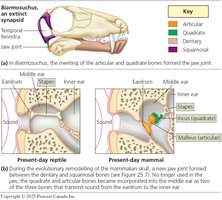
Mammals evolved from synapsids. During this transition, two bones from the jaw joint were incorporated into the mammalian middle ear, enhancing hearing capabilities.
Major Lineages of Mammals
By the early Cretaceous, three living lineages of mammals had emerged:
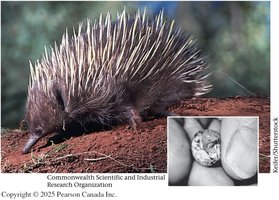
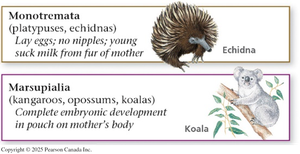
Monotremes: Egg-laying mammals (echidnas, platypus).
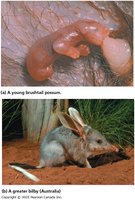
Marsupials: Embryos develop in a pouch (opossums, kangaroos, koalas).
Eutherians: Placental mammals with complex placentas.
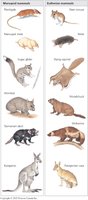
Convergent Evolution of Marsupials and Eutherians
In Australia, marsupials have evolved to resemble eutherians in other parts of the world, a phenomenon known as convergent evolution.
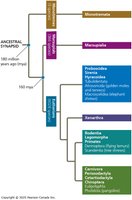
Mammalian Diversity
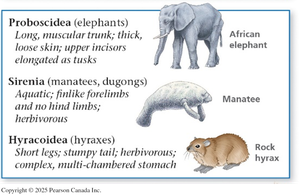
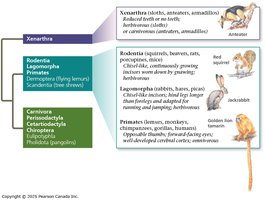
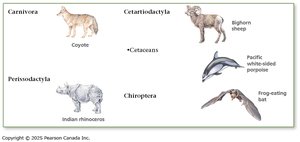
Mammals are classified into several orders, including Monotremata, Marsupialia, Proboscidea (elephants), Sirenia (manatees, dugongs), Hyracoidea (hyraxes), Xenarthra (sloths, anteaters, armadillos), Rodentia, Lagomorpha, Primates, Carnivora, Cetartiodactyla, Perissodactyla, and Chiroptera (bats).
Primates: An Overview
Introduction to Primates
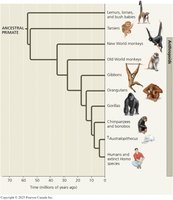
Primates include lemurs, tarsiers, monkeys, and apes (including humans). They are characterized by grasping hands and feet, flat nails, large brains, forward-facing eyes, complex social behavior, and, in some, a fully opposable thumb.
Groups of Living Primates
There are three main groups of living primates:
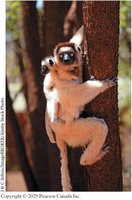
Lemurs, lorises, and bush babies
Tarsiers
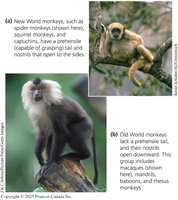
Anthropoids (monkeys and apes)
Primate Phylogeny and Evolution
The oldest known anthropoid fossils are about 45 million years old. New World monkeys (South America) and Old World monkeys (Africa and Asia) diverged about 25 million years ago. Apes diverged from Old World monkeys 20–25 million years ago.

Summary Table: Major Vertebrate Groups and Key Features
Group | Key Features | Examples |
|---|---|---|
Chondrichthyes | Cartilaginous skeleton, jaws, paired fins | Sharks, rays, skates |
Actinopterygii | Bony skeleton, ray-finned | Trout, cod, seahorse |
Sarcopterygii | Lobed fins, bony skeleton | Coelacanths, lungfishes, tetrapods |
Mammalia | Hair, mammary glands, endothermy | Humans, whales, bats |
Primates | Grasping hands, large brain, social behavior | Lemurs, monkeys, apes |
