Back
BackThe Origin and Evolution of Vertebrates: Chordates, Vertebrates, and Mammals
Study Guide - Smart Notes
 Tailored notes based on your materials, expanded with key definitions, examples, and context.
Chordates and Their Key Characteristics
Overview of Chordates
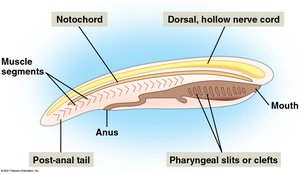
Chordates (phylum Chordata) are bilaterian animals within the clade Deuterostomia. This group includes all vertebrates and two groups of invertebrates: urochordates and cephalochordates. All chordates share a set of derived characters, which may be present only during embryonic development.
Notochord: A flexible, longitudinal rod located between the digestive tube and nerve cord, providing skeletal support.
Dorsal, hollow nerve cord: Develops from ectoderm and forms the central nervous system (brain and spinal cord).
Pharyngeal slits or clefts: Grooves in the pharynx that function in suspension feeding, gas exchange, or develop into structures of the head and neck in tetrapods.
Muscular, post-anal tail: A tail extending posterior to the anus, containing skeletal elements and muscles, often reduced in adults.
Major Groups of Chordates
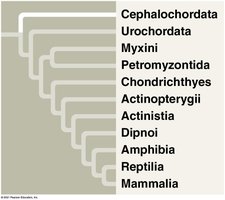
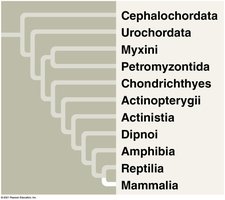
Cephalochordata (Lancelets): Marine suspension feeders retaining all chordate features as adults.
Urochordata (Tunicates): Larvae display chordate traits; adults are sessile filter feeders.
Vertebrates: Chordates with a backbone, including jawless and jawed vertebrates.
Early Chordate Evolution
Lancelets and Tunicates
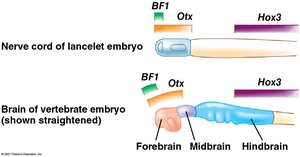
Lancelets are considered to resemble ancestral chordates, retaining all key traits into adulthood. Their nerve cord has a slightly swollen anterior tip, but not a true brain. Tunicates are more closely related to vertebrates and display chordate features mainly during their brief larval stage.
Vertebrates: Chordates with a Backbone
Derived Characters of Vertebrates
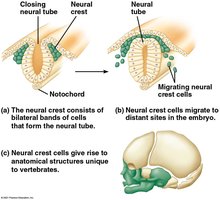
Vertebrates are distinguished by two or more sets of Hox genes, a backbone composed of vertebrae, and a neural crest. The neural crest is a group of cells unique to vertebrates that migrate and give rise to diverse structures, including parts of the skull, teeth, and sensory organs.
Jawless Vertebrates: Hagfishes and Lampreys
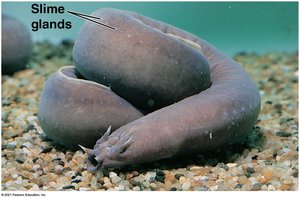
Hagfishes (Myxini): Jawless, with reduced vertebrae, a cartilaginous skull, and slime glands for defense.
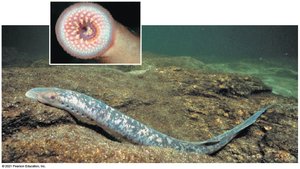
Lampreys (Petromyzontida): Jawless, with a notochord and cartilaginous skeleton; some are parasitic.
Gnathostomes: Jawed Vertebrates
Evolution of Jaws
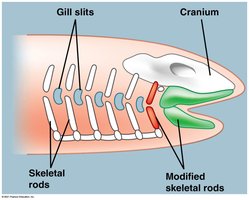
Gnathostomes are vertebrates with jaws, which likely evolved from skeletal rods supporting pharyngeal slits. This innovation allowed for more efficient predation and diversification.
Major Lineages of Gnathostomes
Chondrichthyans: Cartilaginous fishes such as sharks and rays.
Ray-finned fishes (Actinopterygii): The largest group of vertebrates, with bony skeletons and diverse fin structures.
Lobe-finned fishes (Sarcopterygii): Fishes with rod-shaped bones in their fins; ancestors of tetrapods.
Tetrapods: Gnathostomes with Limbs
Transition to Land
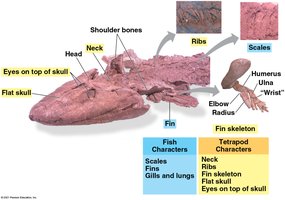
Tetrapods evolved from lobe-finned fishes, developing limbs with digits, a neck, and other adaptations for terrestrial life. The fossil Tiktaalik displays both fish and tetrapod characteristics, illustrating this evolutionary transition.
Amniotes: Tetrapods with a Terrestrially Adapted Egg
Amniotic Egg and Adaptations
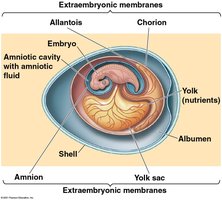
Amniotes include reptiles (including birds) and mammals. The amniotic egg, with its four extraembryonic membranes (amnion, chorion, yolk sac, allantois), allowed for reproduction independent of water and enabled the colonization of diverse terrestrial environments.
Reptiles and Their Evolution
Major Groups and Adaptations
Reptiles: Include tuataras, lizards, snakes, turtles, crocodilians, and birds. Most are ectothermic, except birds, which are endothermic.
Adaptations: Keratinized scales, internal fertilization, and shelled eggs for terrestrial life.

Mammals: Amniotes with Hair and Milk
Derived Characters of Mammals
Mammary glands: Produce milk to nourish young.
Hair and subcutaneous fat: Provide insulation.
Kidneys: Conserve water.
Endothermy: Maintain a high metabolic rate.
Specialized teeth: Adapted for different diets.
Major Lineages of Mammals
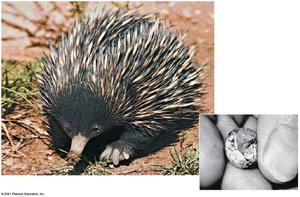
Monotremes: Egg-laying mammals (e.g., platypus, echidnas).
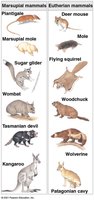
Marsupials: Mammals with a pouch; young complete development in the marsupium.
Eutherians: Placental mammals; young complete development in the uterus.
Primates and Human Evolution
Derived Characters of Primates
Grasping hands and feet with flat nails and fingerprints.
Large brain and forward-facing eyes for depth perception.
Complex social behavior and well-developed parental care.
Human Evolution
Humans (genus Homo) are distinguished by upright posture, bipedal locomotion, large brains, language, and tool use. Human and chimpanzee genomes are 99% identical, with differences largely due to regulatory gene expression.