 Back
The Origin and Evolution of Vertebrates: Chordates and Their Characteristics
Study Guide - Smart Notes
 Tailored notes based on your materials, expanded with key definitions, examples, and context.
Conquest of the Waters: The First Chordates
Introduction to Chordates
The phylum Chordata represents a major evolutionary lineage within the animal kingdom, characterized by a set of unique anatomical features. Chordates first appeared during the Early Cambrian period, approximately 540–550 million years ago, and have since diversified into over 81,000 species, including all vertebrates and several groups of invertebrates.
Origin: Early Cambrian Period (~540–550 mya)
Diversity: Includes fish, amphibians, reptiles, birds, mammals, and invertebrate chordates
Habitat: Initially marine; later colonized land with the evolution of limbs (~365 mya)
Phylogenetic Context and Evolutionary Relationships
Chordates in the Animal Kingdom
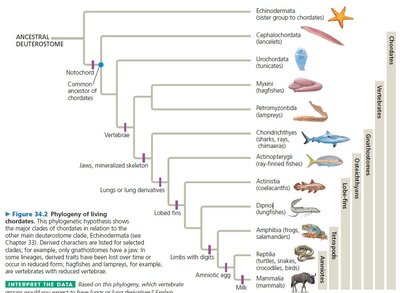
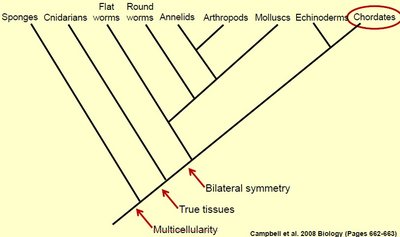
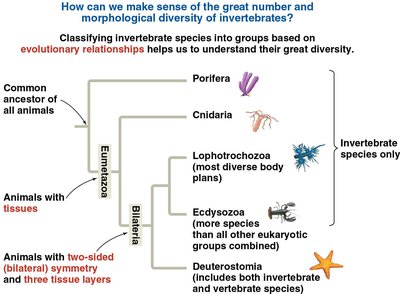
Chordates are part of the deuterostome lineage, sharing a close evolutionary relationship with echinoderms. The group is defined by several key features that distinguish them from other animal phyla.
Bilateral symmetry
Cephalization (development of a head region)
Segmentation
Coelomate body plan (true body cavity)
Closed circulatory system
Major Chordate Subphyla
Cephalochordata – Lancelets (e.g., Branchiostoma)
Urochordata (Tunicata) – Sea squirts and salps (e.g., Pyura)
Vertebrata – Fish, amphibians, reptiles, birds, mammals
Cephalochordates and tunicates are collectively known as protochordates and are invertebrates, lacking a vertebral column.
Defining Characteristics of Chordates
Four Key Features
All chordates possess the following four characteristics at some stage in their life cycle, which provide evidence for their common ancestry:
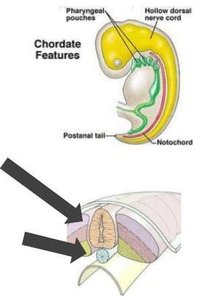
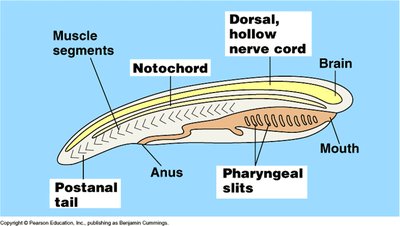
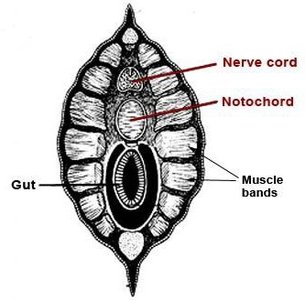
Notochord – A flexible, rod-shaped structure that provides skeletal support.
Dorsal, hollow nerve cord – Develops into the central nervous system (brain and spinal cord in vertebrates).
Pharyngeal slits or clefts – Openings in the pharynx that function in filter feeding or gas exchange.
Post-anal tail – A tail that extends beyond the anus, containing skeletal elements and muscles.
Notochord
The notochord is a defining feature of chordates, serving as a flexible support structure located between the digestive tube and the nerve cord. In most vertebrates, it is replaced by a vertebral column during development, but remnants persist as intervertebral discs in humans.
Structure: Large, fluid-filled cells encased in stiff tissue
Function: Provides support and a site for muscle attachment
Fate in vertebrates: Mostly replaced by vertebrae; remnants form intervertebral discs
Dorsal, Hollow Nerve Cord
This tube of nervous tissue is unique to chordates and develops from a plate of ectoderm that rolls into a tube dorsal to the notochord. In vertebrates, it forms the brain and spinal cord.
Location: Dorsal to the notochord
Development: From ectodermal tissue
Contrast: Other phyla have solid, ventral nerve cords
Pharyngeal Slits or Clefts
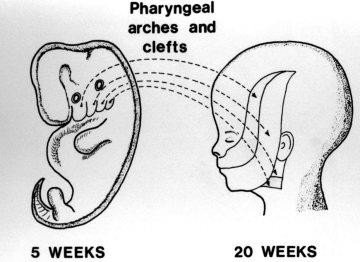
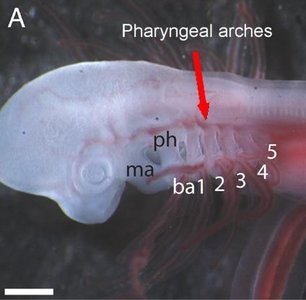
Pharyngeal slits are openings in the pharynx that allow water entering the mouth to exit without passing through the digestive tract. In aquatic chordates, these become gill slits for respiration; in tetrapods, they develop into structures of the ear, head, and neck.
Function in fish: Respiration (gills)
Function in invertebrate chordates: Suspension feeding
Function in tetrapods: Develop into parts of the ear and throat
Post-Anal Tail
The post-anal tail is a muscular extension of the body that extends beyond the anus. It contains skeletal elements and muscles, aiding in locomotion for many aquatic species. In humans and other great apes, it is reduced to the coccyx (tailbone).
Function: Locomotion (swimming, balance)
Fate in humans: Reduced to coccyx
Chordate Subphyla: Structure and Function
Cephalochordata (Lancelets)
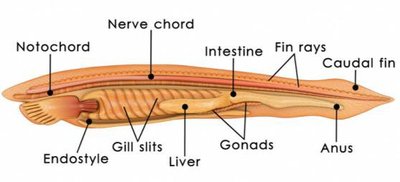
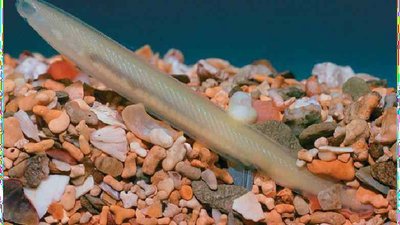
Lancelets are the most basal group of chordates, retaining all four chordate features throughout life. They are small, marine, invertebrate filter feeders that burrow into sand with only their heads exposed.
Body plan: Elongated, fish-like, with segmented muscles
Feeding: Cilia draw water into the mouth; food particles are trapped in mucus and transported to the intestine
Reproduction: Separate sexes, external fertilization
Urochordata (Tunicates/Sea Squirts)
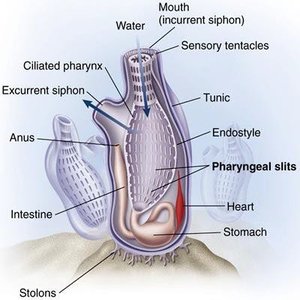
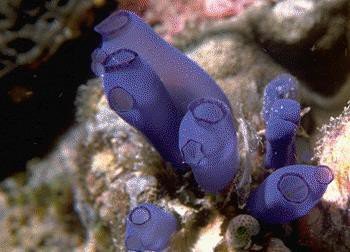
Tunicates, or sea squirts, are marine invertebrate chordates. Their larvae possess all chordate features, but adults are sessile and retain only the pharyngeal slits. The adult body is covered by a tunic made of tunicin, and they feed by filtering water through their pharynx.
Larval stage: Free-swimming, with notochord and tail
Adult stage: Sessile, solitary or colonial, with only pharyngeal slits retained
Feeding: Water enters through the incurrent siphon, passes through pharyngeal slits, and exits via the excurrent siphon
Vertebrata (Vertebrates)
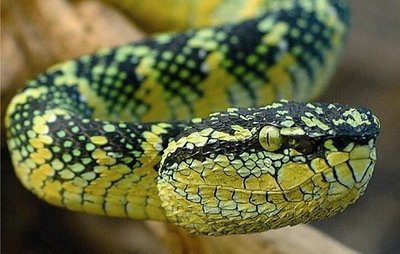
Vertebrates are chordates with a backbone. They possess a more complex nervous system and an internal skeleton, which allows for greater size and mobility. Vertebrates include fish, amphibians, reptiles, birds, and mammals.
Key features: Vertebral column, cranium (skull), complex organ systems
Evolutionary advantages: Efficient predation, advanced sensory systems, diverse modes of locomotion
Comparisons and Evolutionary Evidence
Invertebrates vs. Vertebrates
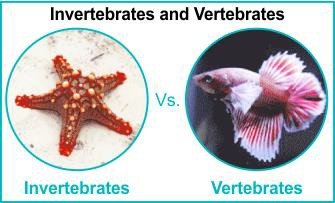
Chordates can be divided into invertebrate chordates (lancelets and tunicates) and vertebrates. Invertebrate chordates lack a backbone but retain the four chordate features, while vertebrates possess a backbone and all chordate characteristics at some stage.
Feature | Invertebrate Chordates | Vertebrates |
|---|---|---|
Backbone | Absent | Present |
Notochord | Present | Replaced by vertebral column |
Dorsal nerve cord | Present | Develops into brain and spinal cord |
Pharyngeal slits | Present | Modified in adults |
Post-anal tail | Present | Present (may be reduced) |
Embryological Evidence
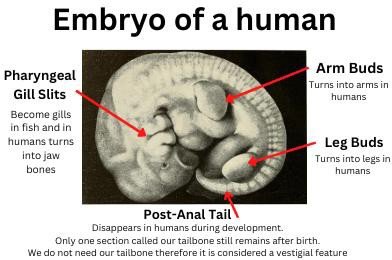
Many chordate features are evident during embryonic development in all vertebrates, including humans. For example, the notochord, dorsal nerve cord, pharyngeal slits, and post-anal tail are present in early embryos but may be modified or lost in adults.
Summary Table: Chordate Features and Fate in Humans
Chordate Feature | Fate in Humans |
|---|---|
Nerve cord | Spinal cord |
Notochord | Cartilage between vertebrae |
Pharyngeal slits | Vestigial embryonic structures; parts of ear, head, neck |
Post-anal tail | Coccyx (tailbone) |
Conclusion
The phylum Chordata is defined by a unique set of anatomical features that appear during development and provide evidence for common ancestry among diverse animal groups. The evolutionary innovations of the notochord, dorsal nerve cord, pharyngeal slits, and post-anal tail have enabled chordates to diversify into a wide range of ecological niches, culminating in the evolution of vertebrates and the conquest of land.
