 Back
The Origin and Evolution of Vertebrates: Study Notes
Study Guide - Smart Notes
 Tailored notes based on your materials, expanded with key definitions, examples, and context.
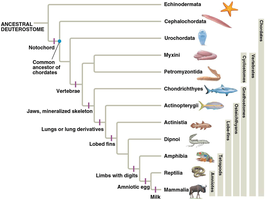
The Origin and Evolution of Vertebrates
Chordates: Fundamental Characteristics
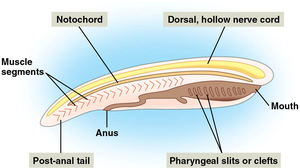
Chordates are a diverse group of bilaterian animals within the clade Deuterostomia. All chordates share four key derived characters, which may only be present during early development. These features are essential for understanding the evolutionary relationships among vertebrates and their invertebrate relatives.
Notochord: A flexible, longitudinal rod located between the digestive tube and nerve cord, providing skeletal support.
Dorsal, hollow nerve cord: Formed from ectoderm, this structure develops into the central nervous system (brain and spinal cord).
Pharyngeal slits or clefts: Openings in the pharynx that allow water to exit the body, bypassing the digestive tract; these are important for filter feeding and gas exchange.
Muscular, post-anal tail: A tail extending beyond the anus, containing skeletal elements and muscles for propulsion.
Chordate Subphyla: Cephalochordata and Urochordata
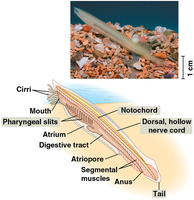
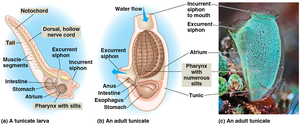
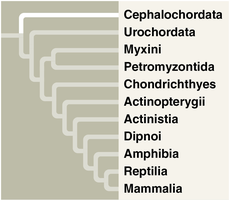
Chordates include both vertebrates and two invertebrate subphyla: Cephalochordata (lancelets) and Urochordata (tunicates). These groups retain key chordate features and provide insight into vertebrate evolution.
Cephalochordata (Lancelets): Marine suspension feeders that retain chordate characteristics throughout life. They swim using a mechanism similar to fishes.
Urochordata (Tunicates): More closely related to vertebrates than lancelets. Chordate features are most prominent in the larval stage, which uses tail muscles and notochord for swimming before settling for metamorphosis.
Vertebrates: Defining Features and Early Evolution
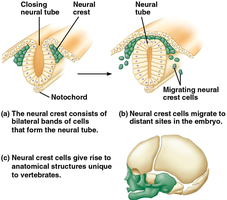
Vertebrates are chordates with a backbone, representing over 60,000 species. Their skeletal and nervous systems allow for efficient predation and complex behaviors. Vertebrates possess two or more sets of Hox genes, enabling advanced nervous system and skeletal innovations. The neural crest, unique to vertebrates, gives rise to diverse anatomical structures.
Neural crest: Bilateral bands of cells that migrate and differentiate into teeth, bones, cartilage, neurons, and sensory capsules.
Early vertebrates: Fossils from the Cambrian explosion (530 mya) document the transition to vertebrates, including Haikouella and Myllokunmingia.
Jawless Vertebrates: Hagfishes and Lampreys
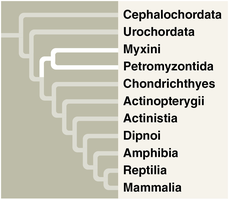
Hagfishes (Class Myxini) and lampreys (Class Petromyzontida) are the only living vertebrates lacking jaws and a backbone, but they possess rudimentary vertebrae. These jawless vertebrates retain the notochord and have specialized adaptations for feeding and survival.
Hagfishes: Jawless, with a cartilaginous skull, eyes, ears, and tooth-like keratin structures.
Lampreys: Jawless, with reduced vertebrae and a cartilaginous skeleton; larvae are aquatic and feed in streams for years.
Gnathostomes: Evolution of Jaws
Gnathostomes are vertebrates with hinged jaws, often equipped with teeth for gripping and slicing food. Jaws likely evolved from skeletal rods supporting pharyngeal slits. Gnathostomes include sharks, ray-finned fishes, lobe-finned fishes, amphibians, reptiles (including birds), and mammals.
Key features: Genome duplication (four sets of Hox genes), enlarged forebrain, enhanced senses, and lateral line system in aquatic species.
Divergence: By 420 mya, jawed vertebrates had diverged into Chondrichthyans, ray-finned fishes, and lobe-finned fishes.
Class Chondrichthyes: Sharks, Rays, and Relatives
Chondrichthyans have a skeleton composed primarily of cartilage, with traces of bone in scales, teeth, and some vertebrae. Sharks are streamlined, fast swimmers, but maneuver poorly. Oil in the liver aids buoyancy, and continual swimming is necessary for gas exchange.
Feeding: Largest sharks and rays are suspension feeders; most sharks are carnivores with sharp teeth.
Reproduction: Internal fertilization; embryos develop via oviparous, ovoviviparous, or viviparous methods.
Ray-Finned and Lobe-Finned Fishes
Osteichthyans are vertebrates with a bony endoskeleton. Ray-finned fishes have gills protected by an operculum and a swim bladder for buoyancy. Lobe-finned fishes possess rod-shaped bones in their fins, enabling movement across substrates.
Ray-finned fishes: Most species are oviparous with external fertilization; skin covered by bony scales and mucus.
Lobe-finned fishes: Three surviving lineages: coelacanths, lungfishes, and tetrapods.
Tetrapods: Adaptations for Life on Land
Tetrapods evolved numerous modifications for terrestrial life, including four limbs with digits, a neck, fusion of the pelvic girdle to the backbone, loss of gills (except in some aquatic species), and ears for detecting airborne sounds. Tiktaalik is a fossil species with both fish and tetrapod traits.
Key adaptations: Limbs with digits, neck mobility, robust pelvis, and lungs for breathing air.
Tiktaalik: Shares features with both fish (fins, gills, scales) and tetrapods (ribs, neck, limb bones).
Class Amphibia
Amphibians are represented by three clades: Urodela (salamanders), Anura (frogs and toads), and Apoda (caecilians). Amphibians exhibit diverse life cycles and adaptations for both aquatic and terrestrial environments.
Urodela: Tailed amphibians; some aquatic, others terrestrial.
Anura: Tail-less adults with powerful hind legs; aquatic larvae (tadpoles).
Apoda: Legless, nearly blind burrowers.
Paedomorphosis: Retention of larval features in sexually mature adults, common in aquatic species.
Amniotes: Terrestrial Adaptations
Amniotes are tetrapods with a terrestrially adapted egg, including reptiles (birds) and mammals. The amniotic egg contains four extraembryonic membranes that protect the embryo and reduce dependence on water for reproduction.
Amnion: Fluid-filled sac that cushions the embryo.
Other membranes: Function in gas exchange, nutrient transfer, and waste storage.
Eggshell: Present in most reptiles and some mammals; slows dehydration.
Reptiles: Diversity and Evolution
Reptiles include squamates (lizards and snakes), birds, turtles, and crocodilians. They share derived characters such as keratinized scales, internal fertilization, and shelled eggs. Most reptiles are ectothermic, while birds are endothermic.
Diapsids: Early reptiles with two skull holes for jaw muscle attachment; include turtles, lepidosaurs, and archosaurs.
Birds: Archosaurs with adaptations for flight, including feathers, air-filled bones, and efficient metabolism.
Turtles: Boxlike shell fused to vertebrae, clavicles, and ribs.
Crocodilians: Aquatic lineage dating back to the Triassic.
Birds: Adaptations for Flight
Birds have evolved extensive adaptations for flight, including lightweight bodies, feathers, and efficient respiratory and circulatory systems. Flight benefits hunting, migration, and predator avoidance. Birds display complex behaviors and internal fertilization.
Flightless birds: Ratites (ostrich, rhea, kiwi, cassowary, emu) and penguins.
Adaptations: Toothless beaks, air-filled bones, large pectoral muscles, and brooding behavior.
Mammals: Distinctive Features and Evolution
Mammals are amniotes with hair and mammary glands. They are endothermic, have a high metabolic rate, and display extensive parental care. Mammals are classified into monotremes, marsupials, and eutherians.
Monotremes: Egg-laying mammals; milk secreted from skin glands.
Marsupials: Live young born early; development continues in a pouch.
Eutherians: Placental mammals with complex placenta and longer pregnancies.
Synapsids: Mammalian lineage distinguished by a single temporal fenestra; jaw bones incorporated into the middle ear.
Summary Table: Major Vertebrate Groups
Group | Key Features |
|---|---|
Cephalochordata | Marine, retain chordate traits throughout life |
Urochordata | Larval chordate traits, adult filter feeders |
Myxini | Jawless, cartilaginous skull |
Petromyzontida | Jawless, reduced vertebrae |
Chondrichthyes | Cartilaginous skeleton, internal fertilization |
Actinopterygii | Bony skeleton, operculum, swim bladder |
Actinistia | Lobe-finned, coelacanths |
Dipnoi | Lungfishes |
Amphibia | Three clades, aquatic and terrestrial life cycles |
Reptilia | Scales, shelled eggs, ectothermy/endothermy |
Mammalia | Hair, mammary glands, endothermy |
Additional info: These notes expand on brief points from the original material, providing definitions, examples, and context for each major vertebrate group and evolutionary adaptation. Images included are directly relevant to the explanation of chordate and vertebrate evolution, anatomy, and phylogeny.
