 Back
The Origin and Evolution of Vertebrates
Study Guide - Smart Notes
 Tailored notes based on your materials, expanded with key definitions, examples, and context.
The Origin and Evolution of Vertebrates
Introduction
Vertebrates are a diverse group of animals characterized by the presence of a backbone. This group includes some of the largest and most complex animals on Earth, as well as many smaller species. The evolutionary history of vertebrates is marked by the appearance of key anatomical and physiological innovations that have enabled their diversification and adaptation to a wide range of environments.
Chordates: The Foundation of Vertebrates
Defining Characteristics of Chordates
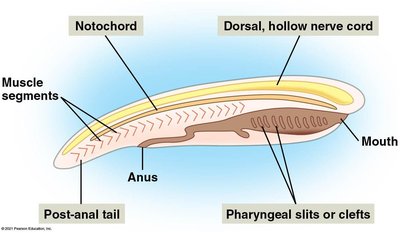
Chordates (phylum Chordata) are bilaterian animals within the clade Deuterostomia. All chordates share a set of derived characters, although these may only be present during embryonic development. The four key characteristics are:
Notochord: A flexible, rod-shaped structure that provides skeletal support.
Dorsal, hollow nerve cord: Develops into the central nervous system (brain and spinal cord).
Pharyngeal slits or clefts: Openings in the pharynx that function in filter-feeding, gas exchange, or develop into structures of the head and neck in tetrapods.
Muscular, post-anal tail: A tail that extends beyond the anus, containing skeletal elements and muscles.
Major Groups of Chordates
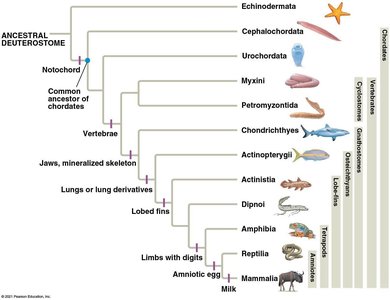
Chordates include all vertebrates and two groups of invertebrates: urochordates (tunicates) and cephalochordates (lancelets).
Cephalochordata: Lancelets
Structure and Function
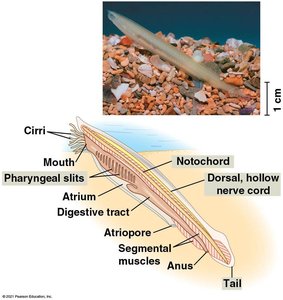
Lancelets are small, blade-shaped marine animals that retain all key chordate features throughout life. They are suspension feeders, using pharyngeal slits to filter food particles from water.
Body Plan: Includes a notochord, dorsal nerve cord, pharyngeal slits, and post-anal tail.
Movement: Swim using segmental muscles arranged along the body.
Urochordata: Tunicates
Life Cycle and Adaptations
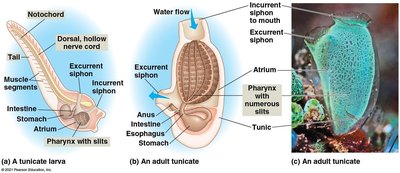
Tunicates, or sea squirts, are more closely related to vertebrates than lancelets. Chordate features are most evident in the larval stage, which is free-swimming. Adults are sessile filter feeders, drawing water through an incurrent siphon and expelling it through an excurrent siphon.
Larval Stage: Exhibits all chordate features, used for dispersal.
Adult Stage: Specialized for filter feeding; loses most chordate traits except pharyngeal slits.
Early Chordate Evolution
Genetic and Developmental Insights
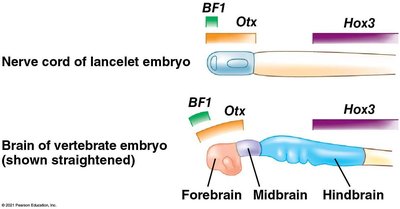
Comparative studies show that the basic body plan and genetic control of development in lancelets and tunicates are similar to those in vertebrates. Hox genes play a crucial role in patterning the nervous system and other structures.
Vertebrates: Chordates with a Backbone
Derived Characters of Vertebrates
Vertebrates are distinguished from other chordates by several derived features:
Vertebrae: Series of bones or cartilage that enclose the spinal cord, forming the backbone.
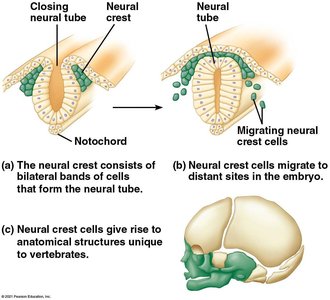
Neural Crest: A unique group of embryonic cells that give rise to diverse structures, including parts of the skull, teeth, and peripheral nerves.
Increased Genetic Complexity: Multiple sets of Hox genes enable greater anatomical complexity.
Jawless Vertebrates: Hagfishes and Lampreys
Hagfishes (Myxini)
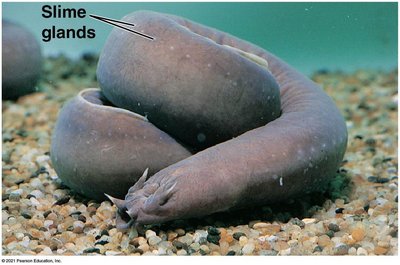
Hagfishes are jawless, marine vertebrates with a cartilaginous skull and reduced vertebrae. They retain the notochord as adults and are known for producing slime as a defense mechanism.
Feeding: Scavengers, feeding on dead or dying animals.
Defense: Slime glands secrete mucus to deter predators.
Lampreys (Petromyzontida)
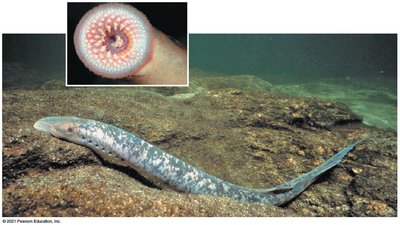
Lampreys are jawless vertebrates with a notochord and rudimentary vertebrae. Many are parasitic, attaching to other fish and feeding on their blood.
Life Cycle: Larvae are filter feeders; adults may be parasitic or non-parasitic.
Evolution of Early Vertebrates
Fossil Evidence
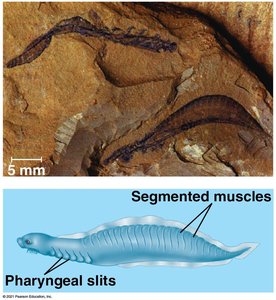
Fossils from the Cambrian period, such as Haikouella and Myllokunmingia, document the transition from invertebrate chordates to vertebrates. These early vertebrates developed a head with sensory organs and a skull, enabling more complex behaviors.
Gnathostomes: Jawed Vertebrates
Key Innovations
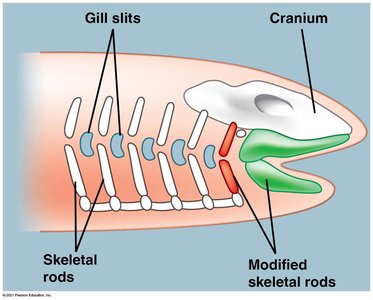
Gnathostomes are vertebrates with jaws, which evolved from modifications of skeletal rods supporting the pharyngeal slits. This group includes sharks, ray-finned fishes, lobe-finned fishes, amphibians, reptiles, and mammals.
Jaws and Teeth: Enabled new feeding strategies and ecological roles.
Paired Fins: Improved swimming control and maneuverability.
Genome Duplication: Four sets of Hox genes allowed for increased complexity.
Lateral Line System: Sensory system for detecting water movements (in aquatic species).
Major Lineages of Vertebrates
Phylogenetic Relationships
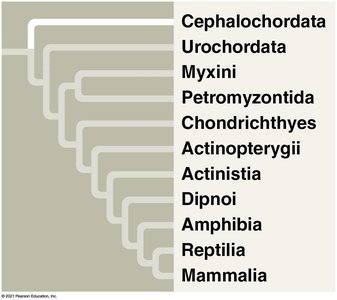
The vertebrate lineage diversified into several major groups, each with unique adaptations. The following table summarizes the main groups and their distinguishing features:
Group | Key Features |
|---|---|
Cephalochordata | Lancelets; retain all chordate features as adults |
Urochordata | Tunicates; chordate features in larvae |
Myxini | Hagfishes; jawless, slime-producing |
Petromyzontida | Lampreys; jawless, some parasitic |
Chondrichthyes | Sharks, rays; cartilaginous skeleton |
Actinopterygii | Ray-finned fishes; bony skeleton, swim bladder |
Actinistia | Coelacanths; lobe-finned fishes |
Dipnoi | Lungfishes; lungs and gills |
Amphibia | Frogs, salamanders; dual life stages |
Reptilia | Lizards, snakes, turtles, birds; amniotic egg |
Mammalia | Mammals; hair, mammary glands |
Summary Table: Key Innovations in Vertebrate Evolution
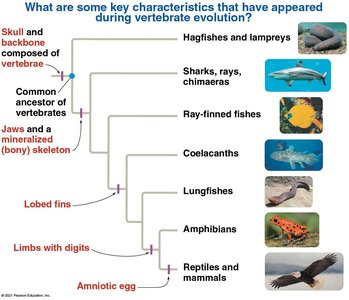
Innovation | Group First Appearing |
|---|---|
Backbone (vertebrae) | Vertebrates |
Jaws, mineralized skeleton | Gnathostomes |
Lobed fins | Lobe-finned fishes |
Limbs with digits | Tetrapods |
Amniotic egg | Amniotes (reptiles, mammals) |
Conclusion
The origin and evolution of vertebrates is a story of increasing complexity and adaptation. From the basic chordate body plan, vertebrates have diversified into a vast array of forms, occupying nearly every ecological niche on Earth. Key innovations such as the backbone, jaws, limbs, and amniotic egg have enabled vertebrates to become one of the most successful animal groups in evolutionary history.
