 Back
The Origin and Evolution of Vertebrates
Study Guide - Smart Notes
 Tailored notes based on your materials, expanded with key definitions, examples, and context.
The Origin and Evolution of Vertebrates
Introduction to Chordates and Vertebrates
The phylum Chordata includes a diverse group of animals, ranging from simple invertebrate chordates to complex vertebrates. Vertebrates are animals with a backbone, and their evolutionary history is marked by significant innovations that have enabled them to become one of the most successful animal groups on Earth.
Chordates are bilaterian animals within the clade Deuterostomia.
All vertebrates are chordates, but not all chordates are vertebrates.
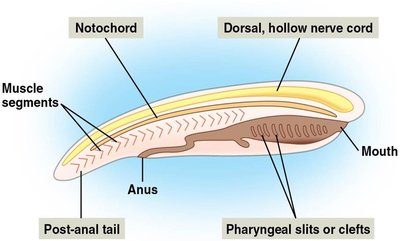
Chordates are defined by four key characteristics: notochord, dorsal hollow nerve cord, pharyngeal slits or clefts, and a muscular post-anal tail.
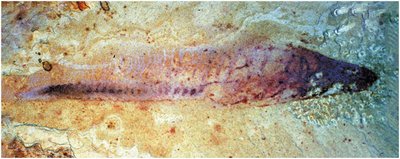
Major Clades within Deuterostomia
Deuterostomia is a major clade of animals that includes Echinodermata, Hemichordata, and Chordata. Chordates are further divided into three subphyla: Cephalochordata, Urochordata (Tunicata), and Vertebrata.
Cephalochordata: Lancelets (invertebrates)
Urochordata/Tunicata: Tunicates (invertebrates)
Vertebrata: Vertebrates (animals with a backbone)

Key Characteristics of Chordates
All chordates share a set of derived characters, although some species may only exhibit these traits during embryonic development.
Notochord: A flexible, rod-shaped structure that provides skeletal support.
Dorsal, hollow nerve cord: Develops into the central nervous system (brain and spinal cord).
Pharyngeal slits or clefts: Openings in the pharynx that function in filter-feeding, gas exchange, or develop into parts of the ear, head, and neck in tetrapods.
Muscular, post-anal tail: Tail that extends beyond the anus, containing muscle and skeletal elements.
Phylogeny and Evolution of Chordates
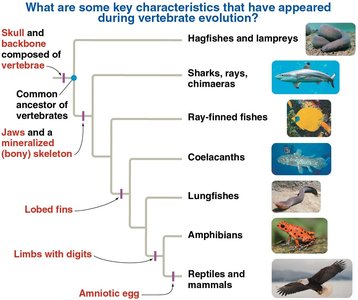
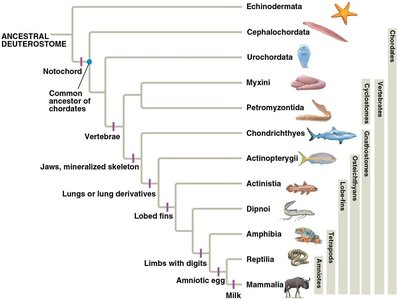
The evolutionary history of chordates is marked by the appearance of key characteristics and the diversification of major clades. Phylogenetic trees illustrate the relationships among these groups and the derived traits that define them.
Summary of Major Chordate Clades
The following table summarizes the major clades within chordates, their key characteristics, and examples:
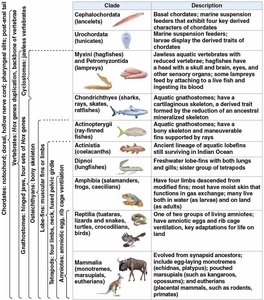
Clade | Description |
|---|---|
Cephalochordata (lancelets) | Basal chordates; marine suspension feeders that exhibit four key derived characters of chordates. |
Urochordata (tunicates) | Marine suspension feeders; larvae display the derived traits of chordates. |
Myxini (hagfishes) and Petromyzontida (lampreys) | Jawless aquatic vertebrates with reduced vertebrae; hagfishes have slime glands, lampreys are often parasitic. |
Chondrichthyes (sharks, rays, skates, ratfishes) | Aquatic gnathostomes; have a cartilaginous skeleton, a derived trait formed by the loss of bone. |
Actinopterygii (ray-finned fishes) | Aquatic gnathostomes; fins supported by rays of bone. |
Actinistia (coelacanths) and Dipnoi (lungfishes) | Lobe-finned fishes; have muscular fins supported by rod-shaped bones. |
Amphibia (salamanders, frogs, caecilians) | Have four limbs descended from modified fins; moist skin for gas exchange; lay eggs in water. |
Reptilia (tuataras, lizards, snakes, turtles, crocodilians, birds) | Amniotes with waterproof scales or feathers; most lay shelled eggs on land. |
Mammalia (monotremes, marsupials, eutherians) | Amniotes with hair and mammary glands; produce milk for offspring. |
Invertebrate Chordates: Lancelets and Tunicates
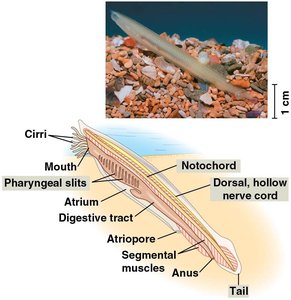
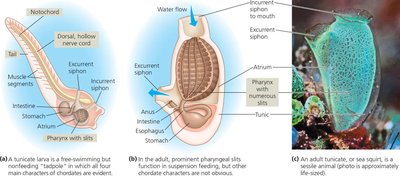
Lancelets (subphylum Cephalochordata) and tunicates (subphylum Urochordata) are invertebrate chordates that provide insight into the early evolution of chordate features.
Lancelets: Marine suspension feeders that retain all chordate characteristics as adults.
Tunicates: Larvae display chordate traits; adults are sessile filter feeders (sea squirts).
Early Chordate Evolution and Developmental Genes
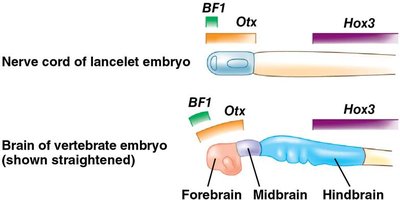
Comparative studies of developmental genes (such as Hox genes) in lancelets, tunicates, and vertebrates reveal evolutionary relationships and the origins of complex structures in vertebrates.
Hox genes organize the vertebrate brain and are expressed in the nerve cord tip of lancelets.
Genes associated with vertebrate organs (heart, thyroid) are found in tunicates and vertebrates, but not in non-chordate invertebrates.
The neural crest, a group of embryonic cells unique to vertebrates, may have evolved from similar cells in tunicates.
Derived Characters of Vertebrates
Vertebrates are distinguished from other chordates by several derived traits, including multiple sets of Hox genes, a skeletal system, and a complex nervous system. These adaptations have enabled vertebrates to efficiently capture food and evade predators.
Vertebrae enclosing a spinal cord
An elaborate skull
Fin rays in aquatic forms
Neural crest cells that give rise to unique anatomical structures
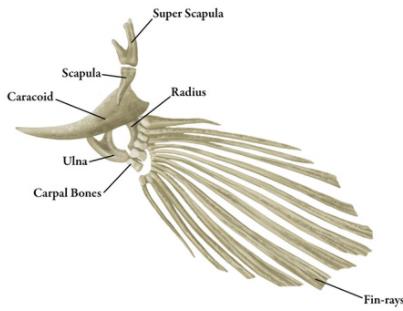
Jawless Vertebrates: Hagfishes and Lampreys
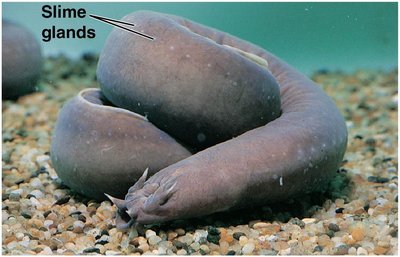
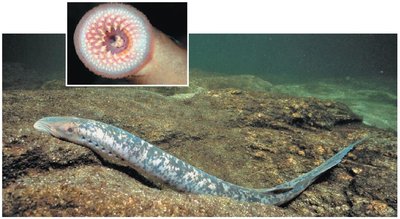
Hagfishes (Myxini) and lampreys (Petromyzontida) are the only living vertebrates that lack jaws. They are known as agnathans and possess rudimentary vertebrae and a cartilaginous skeleton.
Hagfishes: Marine scavengers with slime glands for defense.
Lampreys: Some are parasitic; possess a toothed, funnel-like mouth.
Gnathostomes: Vertebrates with Jaws
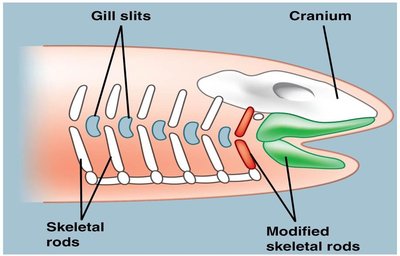
Gnathostomes are vertebrates that possess jaws, a major evolutionary innovation that allowed for new feeding strategies and diversification. Jaws likely evolved from skeletal rods supporting pharyngeal slits.
Include sharks, rays, ray-finned fishes, lobe-finned fishes, amphibians, reptiles (including birds), and mammals.
Jaws and paired fins enabled more efficient predation and locomotion.
Major Groups of Gnathostomes
Chondrichthyans: Cartilaginous fishes (sharks, rays, skates, ratfish) with skeletons primarily of cartilage.
Osteichthyans: Bony fishes and tetrapods with a skeleton made of bone (calcium phosphate matrix).
Ray-finned fishes (Actinopterygii): The most diverse group of vertebrates, with fins supported by bony rays.
Lobe-finned fishes (Sarcopterygii): Possess rod-shaped bones in their fins; include coelacanths, lungfishes, and tetrapods.
Tetrapods: Vertebrates with Limbs
Tetrapods are gnathostomes that evolved limbs with digits, enabling the colonization of land. The transition from lobe-finned fishes to tetrapods is exemplified by fossils such as Tiktaalik, which display both fish and tetrapod characteristics.
Four limbs with digits
Neck for independent head movement
Fusion of pelvic girdle to backbone
Absence of gills (except in some aquatic species)
Ears for detecting airborne sounds
Amphibians
Amphibians are represented by salamanders, frogs, and caecilians. They typically have a dual life cycle, with aquatic larvae and terrestrial adults. Most require moist environments for reproduction and gas exchange.
Eggs lack a shell and must be laid in water or moist environments.
Fertilization is usually external.
Many amphibians have moist skin that aids in gas exchange.
Amniotes: Tetrapods with a Terrestrially Adapted Egg
Amniotes are tetrapods that produce an amniotic egg, which contains membranes that protect the embryo and allow reproduction away from water. This adaptation enabled the exploitation of a wide range of terrestrial habitats.
Includes reptiles (including birds) and mammals.
Amniotic egg contains four extraembryonic membranes: amnion, chorion, yolk sac, and allantois.
Reptiles and Birds
Reptiles are amniotes with waterproof scales or feathers and lay shelled eggs on land. Most are ectothermic, but birds are endothermic and have evolved numerous adaptations for flight, including feathers, lightweight bones, and high metabolic rates.
Birds descended from small theropod dinosaurs.
Flight adaptations include wings, feathers, and a high metabolic rate.
Mammals
Mammals are amniotes characterized by hair, mammary glands, and a high metabolic rate. They are divided into three major lineages: monotremes (egg-laying), marsupials (pouched), and eutherians (placental).
Monotremes: Egg-laying mammals (e.g., platypus, echidnas).
Marsupials: Young develop in a pouch (e.g., kangaroos, opossums).
Eutherians: Placental mammals with complex development.
Primates and Human Evolution
Primates are mammals with adaptations for grasping, large brains, and complex social behaviors. Humans (Homo sapiens) are distinguished by bipedal locomotion, large brains, language, and tool use. The hominin lineage includes modern humans and their extinct relatives.
Earliest hominins appeared about 6.5 million years ago.
Bipedality evolved before large brains and tool use.
Homo sapiens originated in Africa about 200,000 years ago.
