 Back
BackThe Origin and Evolution of Vertebrates
Study Guide - Smart Notes
 Tailored notes based on your materials, expanded with key definitions, examples, and context.
Vertebrates: Origin and Evolution
Introduction to Vertebrates
Vertebrates are a diverse and highly successful group of animals within the phylum Chordata. Their evolutionary history is marked by the development of key anatomical features, such as a backbone, jaws, limbs, and adaptations for terrestrial life. This chapter explores the major evolutionary transitions and characteristics that define vertebrates and their relatives.
Chordates and Their Key Characteristics
Phylum Chordata
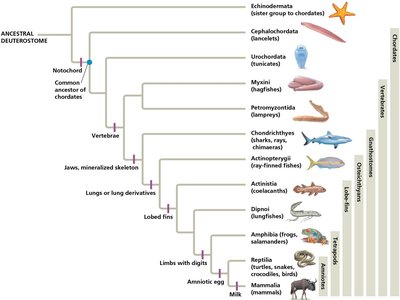
Chordates are bilaterian animals within the Deuterostomia clade. The name 'Chordata' is derived from the presence of a notochord, a flexible rod that provides support. Chordates include all vertebrates and two groups of invertebrates: urochordates (tunicates) and cephalochordates (lancelets).
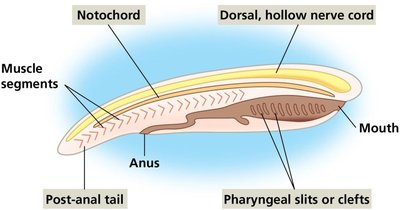
Notochord: A longitudinal, flexible rod located between the digestive tube and nerve cord, providing skeletal support and a site for muscle attachment.
Dorsal, hollow nerve cord: Develops from ectoderm and forms the central nervous system (brain and spinal cord).
Pharyngeal slits or clefts: Grooves in the pharynx that may develop into slits for suspension feeding, gas exchange, or structures in the head and neck.
Muscular, post-anal tail: A tail extending posterior to the anus, containing skeletal elements and muscles, often reduced in adults.
Phylogeny of Living Chordates
The evolutionary relationships among chordates are depicted in a phylogenetic tree, showing the divergence of major groups and the acquisition of key traits.
Invertebrate Chordates
Lancelets (Cephalochordata)
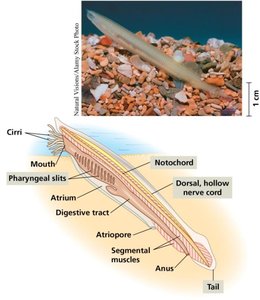
Lancelets are the most basal living chordates. Both larvae and adults retain all four chordate characteristics. They are marine suspension feeders and serve as a model for the ancestral chordate body plan.
Example: Branchiostoma (lancelet)
Tunicates (Urochordata)
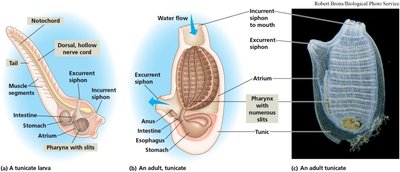
Tunicates are more closely related to vertebrates than lancelets. They exhibit chordate features primarily during their brief larval stage. Adults are sessile filter feeders, drawing water through an incurrent siphon and expelling it through an excurrent siphon.
Example: Sea squirt (Ciona)
Vertebrates: Chordates with a Backbone
General Features
Vertebrates possess a backbone composed of vertebrae, a more complex nervous system, and an advanced skeletal structure. These adaptations have enabled vertebrates to efficiently capture food and evade predators.
Jawless Vertebrates: Hagfishes and Lampreys
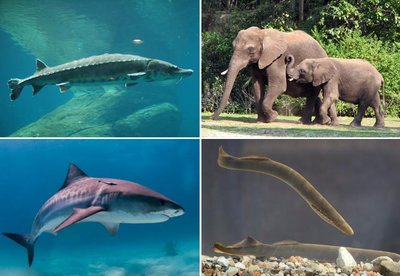
The earliest vertebrates lacked jaws. Today, only two lineages of jawless vertebrates remain: hagfishes and lampreys. Both have rudimentary vertebrae and are classified as vertebrates based on phylogenetic evidence.
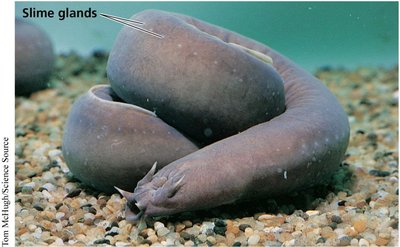
Hagfishes: Marine scavengers with a cartilaginous skull, reduced vertebrae, and slime glands for defense.
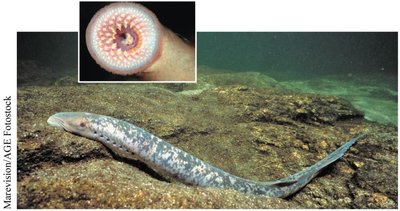
Lampreys: Parasitic or free-living, with a cartilage skeleton and rudimentary vertebrae. Many are invasive in freshwater systems.
Gnathostomes: Vertebrates with Jaws
Evolution of Jaws
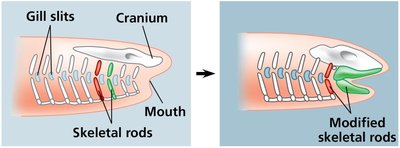
Gnathostomes are vertebrates with hinged jaws, which likely evolved from skeletal supports of pharyngeal slits. This innovation allowed for new feeding strategies and greater diversification.
Includes sharks, ray-finned and lobe-finned fishes, amphibians, reptiles (including birds), and mammals.
Chondrichthyans (Cartilaginous Fishes)
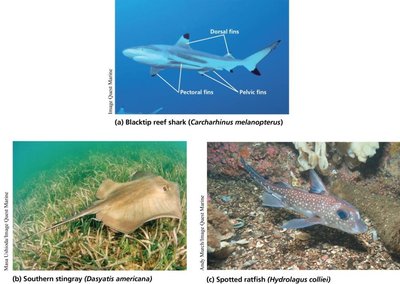
Chondrichthyans have skeletons made primarily of cartilage. This group includes sharks, rays, skates, and ratfishes (chimaeras).
Sharks: Streamlined, swift swimmers; most are carnivores, but some are suspension feeders. They lack a swim bladder and must swim to avoid sinking.
Reproduction: Internal fertilization with oviparous, ovoviviparous, and viviparous strategies.
Osteichthyans: Bony Fishes and Tetrapods
Ray-Finned Fishes
Ray-finned fishes are the largest group of vertebrates. They have fins supported by long, flexible rays and a bony endoskeleton. Most species are oviparous with external fertilization.
Control buoyancy with a swim bladder.
Use a lateral line system to detect water movements.
Lobe-Finned Fishes
Lobe-finned fishes have rod-shaped bones surrounded by muscle in their fins. Three lineages survive today: coelacanths, lungfishes, and tetrapods. Lungfishes can breathe air using lungs.
Example: Coelacanth (Latimeria), lungfishes, and tetrapods.
Tetrapods: Vertebrates with Limbs and Digits
Key Adaptations
Tetrapods evolved from lobe-finned fishes, developing limbs with digits, a neck, fusion of the pelvic girdle to the backbone, and ears for detecting airborne sounds. Most lack gills as adults.
Example: Tiktaalik, a transitional fossil with both fish and tetrapod features.
Amphibians
General Features
Amphibians include salamanders, frogs, and caecilians. They typically have a "dual life"—aquatic larvae and terrestrial adults. Most require moist environments for reproduction and gas exchange.
Salamanders: Have tails; some are aquatic, others terrestrial.
Frogs: Lack tails, have powerful hind legs; "toads" are frogs with leathery skin.
Amniotes: Adaptations for Terrestrial Life
Amniotic Egg
Amniotes include reptiles (including birds) and mammals. The amniotic egg, with its extraembryonic membranes, is a key adaptation for terrestrial reproduction. Other adaptations include impermeable skin and rib cage ventilation of the lungs.
Reptiles
General Features
Reptiles include lizards, snakes, turtles, crocodilians, and birds. Most are ectothermic, relying on external heat sources, except birds, which are endothermic. Reptiles have scales and lay shelled eggs on land.
Turtles: Have a boxlike shell fused to the skeleton; some are aquatic, others terrestrial.
Lizards and Snakes: Snakes are legless lizards with adaptations for predation.
Crocodilians: Aquatic archosaurs with a lineage dating to the Triassic.
Birds: Adapted for flight with feathers, lightweight skeletons, and other modifications.
Mammals
Key Characteristics
Mammals are amniotes with hair and mammary glands that produce milk. They are endothermic, have a large brain, and differentiated teeth. Three major lineages exist: monotremes (egg-laying), marsupials (pouched), and eutherians (placental).
Monotremes: Egg-laying mammals (e.g., platypus, echidna).
Marsupials: Young complete development in a pouch (e.g., kangaroo, koala).
Eutherians: Placental mammals; young develop fully in the uterus.
Primates and Human Evolution
Primates
Primates include lemurs, tarsiers, monkeys, and apes (including humans). They are characterized by grasping hands and feet, large brains, and complex social behaviors.
Derived Characters of Humans
Humans are distinguished from other apes by upright posture, bipedal locomotion, large brains, language, and tool use. Human evolution is not a linear progression but a branching process with many extinct relatives.
Summary Table: Major Vertebrate Groups and Key Features
Group | Key Features | Examples |
|---|---|---|
Cephalochordata | All chordate features as adults | Lancelets |
Urochordata | Chordate features in larvae | Tunicates |
Myxini | Jawless, slime glands | Hagfishes |
Petromyzontida | Jawless, parasitic | Lampreys |
Chondrichthyes | Cartilaginous skeleton | Sharks, rays |
Actinopterygii | Ray-finned, bony skeleton | Trout, cod |
Actinistia/Dipnoi | Lobe-finned, lungs/gills | Coelacanths, lungfishes |
Amphibia | Dual life, moist skin | Frogs, salamanders |
Reptilia | Scales, shelled eggs | Lizards, snakes, birds |
Mammalia | Hair, milk, endothermy | Humans, whales |
