 Back
The Origin of Life: Early Earth and the Emergence of Living Systems
Study Guide - Smart Notes
 Tailored notes based on your materials, expanded with key definitions, examples, and context.
The Origin of Life on Earth
Key Events in the Evolution of Earth
The origin of life is a central question in biology, involving the transition from nonliving chemical systems to living organisms. Understanding the timeline and environmental context of early Earth is essential for grasping how life began.
Earth formed approximately 4.6 billion years ago (BYA), with a hostile environment lacking free oxygen.
Prokaryotic life appeared about 1 billion years after Earth's formation.
Eukaryotic cells evolved another 1.5 billion years later.
Multicellular life emerged after an additional ~1 billion years.
Early Earth’s Environment
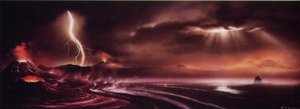
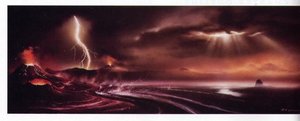
Early Earth was characterized by a toxic atmosphere and abundant energy sources, but lacked free oxygen. The chemical environment set the stage for the origin of life.
Atmosphere contained CO2, H2O, CO, H2, NH3, H2S, CH4.
Energy sources included lightning, volcanic activity, and radiation (cosmic, UV).
Disproving Spontaneous Generation
Historical Experiments
For centuries, people believed in spontaneous generation—the idea that life could arise from nonliving matter. This was disproven through key experiments:
Francesco Redi (1668): Showed that maggots do not spontaneously form on meat; they appear only when flies can access the meat.
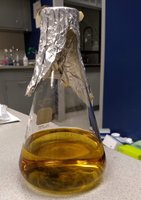
Louis Pasteur & John Tyndall (1800s): Demonstrated that microorganisms do not grow in sterilized broth unless exposed to air, disproving spontaneous generation for microbes.

Theories on the Origin of Life
Primordial Soup Theory
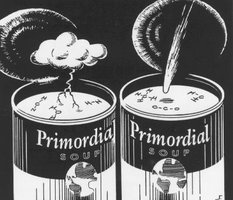
The Primordial Soup Theory suggests that life began in a "soup" of organic molecules formed near Earth's surface. This idea was independently proposed by Alexander Oparin and J.B.S. Haldane in the 1920s.
Organic molecules such as simple sugars, amino acids, and nucleotide bases could form from basic raw materials.
These molecules, called prebiotics, accumulated and provided the building blocks for life.
The Miller-Urey Experiment (1953)
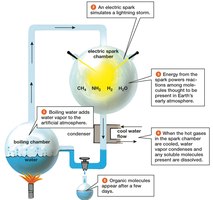
Stanley Miller and Harold Urey simulated early Earth conditions to test the Primordial Soup Theory. Their experiment demonstrated that biologically important molecules can form naturally under prebiotic conditions.
Produced amino acids, sugars, lipids, and nucleic acid parts (but not complete nucleotides).
Showed that the evolution of matter toward life is a natural consequence of environmental conditions.
Limitations of the Primordial Soup Theory
Organic molecules would be very dilute and vulnerable to destruction in open water.
Small ponds could be disrupted by environmental events.
Hydrothermal Vent Hypothesis (Iron-Sulfur World Hypothesis)
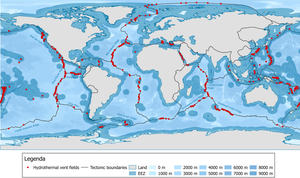
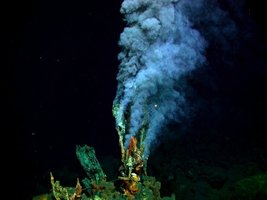
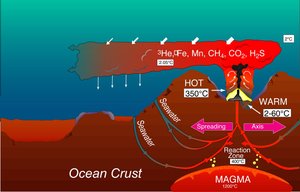
The Iron-Sulfur World Hypothesis (also called the "Primordial Pizza Hypothesis") was proposed by Günter Wächtershäuser in the 1990s. It suggests that life originated at hydrothermal vents on the ocean floor, where minerals catalyzed the formation of complex organic molecules.
Prebiotics were synthesized on clay surfaces near hydrothermal vents.
Iron and sulfur compounds facilitated the formation of RNA and other complex molecules.
Hydrothermal vents provided thermal energy and concentrated reactants, promoting chemical reactions.
Formation of Protocells
Biological molecules accumulated in cell-sized enclosures, forming protocells. These were not fully living cells but had some properties of life.
Vesicles: Simple hollow spheres composed of lipids and proteins, formed spontaneously in water.
Simulations show that agitating water with proteins and lipids leads to vesicle formation.
Protocells provided a compartment for further chemical evolution.
The RNA World Hypothesis
Significance of RNA
RNA is likely the first self-replicating informational molecule. It is structurally similar to DNA but easier to synthesize and can catalyze chemical reactions.
RNA can act as both genetic material and a catalyst (ribozyme).
DNA replication requires complex enzymes, which are themselves coded by DNA—a paradox for the origin of life.
RNA can catalyze its own replication and other metabolic reactions.
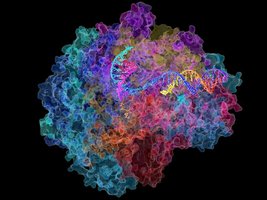
Ribozymes
Ribozymes are RNA molecules that catalyze metabolic reactions. Discovered by Thomas Cech and Sidney Altman in the 1980s, ribozymes can:
Cut other RNAs
Make new RNAs
Splice RNA fragments together
Attach amino acids to growing proteins
From Protocells to Living Cells
The transition from protocell to living cell was gradual, with no sharp boundary. Early cells likely had some, but not all, characteristics of modern life.
Protocells had components of life but lacked complete self-maintenance (autopoiesis) and all six tenets of life.
Energy and Metabolism in Early Life
Autotrophs vs. Heterotrophs
Autotrophs: Organisms that synthesize their own required molecules using external energy sources (e.g., sunlight, geothermal energy). Earliest life forms were likely autotrophic.
Heterotrophs: Organisms that obtain molecules needed for nourishment from the environment.
Anaerobic vs. Aerobic Metabolism
Anaerobic: Do not use oxygen in metabolic processes (earliest metabolism).
Aerobic: Use oxygen in metabolic processes (evolved later as oxygen accumulated in the atmosphere).
Summary of the Origin of Life
Life most likely evolved as a result of the natural evolution of matter under early Earth conditions.
Spontaneous generation was disproven by Redi and Pasteur.
The Primordial Soup Theory and Iron-Sulfur World Hypothesis provide plausible scenarios for the chemical origins of life.
Protocells and the RNA World Hypothesis explain the transition from chemistry to biology.
Early evolution of metabolism led to increasing complexity and diversity of life.
