 Back
BackThe Origin of Species: Mechanisms and Concepts of Speciation
Study Guide - Smart Notes
 Tailored notes based on your materials, expanded with key definitions, examples, and context.
Chapter 14: The Origin of Species
Introduction to Speciation
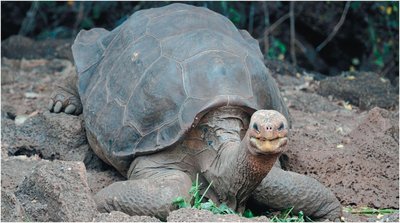
The study of speciation explores how new species arise and the mechanisms that maintain biological diversity. The Galápagos Islands, with their unique flora and fauna, provide a classic example of speciation in action. The extinction of Lonesome George, the last of his giant tortoise species, highlights the importance of understanding what defines a species and how new species originate.
Defining Species
14.1 The Origin of Species and Biological Diversity
Microevolution: Refers to changes in the gene pool of a population from one generation to the next. These changes may involve allele frequencies due to mechanisms such as natural selection, genetic drift, and mutation.
Speciation: The process by which one species splits into two or more distinct species. Speciation is responsible for both the unity and diversity of life on Earth.
Key Difference: Microevolution involves changes within a population, while speciation results in the formation of new species.
14.2 Species Concepts
Defining a species is complex, and several concepts are used in biology:
Biological Species Concept: Defines a species as a group of populations whose members can interbreed in nature and produce fertile offspring, but do not successfully interbreed with other such groups. This concept emphasizes reproductive isolation.
Morphological Species Concept: Identifies species based on observable physical traits. Useful for classifying asexual organisms and fossils.
Ecological Species Concept: Defines species by their ecological niche, focusing on unique adaptations to particular roles in a community.
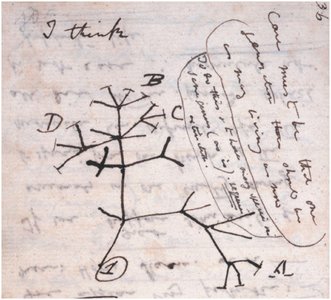
Phylogenetic Species Concept: Defines a species as the smallest group of individuals sharing a common ancestor, forming one branch on the tree of life.
Reproductive Barriers and the Maintenance of Species
14.3 Reproductive Barriers
Reproductive barriers prevent gene flow between species and maintain species boundaries. These barriers are categorized as:
Prezygotic Barriers: Prevent mating or fertilization between species.
Postzygotic Barriers: Operate after hybrid zygotes are formed, reducing hybrid viability or fertility.

Types of Reproductive Barriers
Barrier Type | Example/Description |
|---|---|
Habitat Isolation | Species live in different environments and rarely encounter each other. |
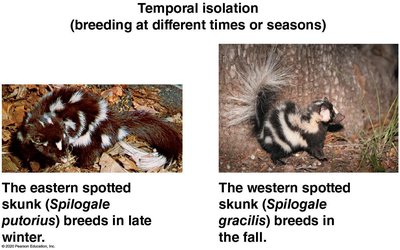
Temporal Isolation | Species breed at different times or seasons. |
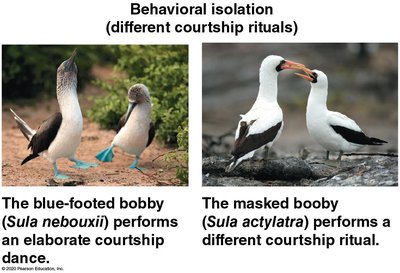
Behavioral Isolation | Species have different courtship rituals. |
Mechanical Isolation | Physical differences prevent mating. |
Gametic Isolation | Gametes are incompatible and cannot fuse. |
Reduced Hybrid Viability | Hybrids fail to develop or are frail. |
Reduced Hybrid Fertility | Hybrids are sterile (e.g., mule). |
Hybrid Breakdown | Hybrids are fertile but their offspring are weak or sterile. |

Examples of Prezygotic Barriers
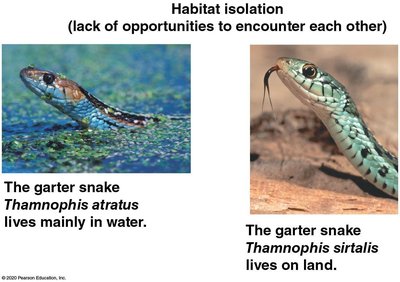
Habitat Isolation: The garter snake Thamnophis atratus lives mainly in water, while Thamnophis sirtalis lives on land.
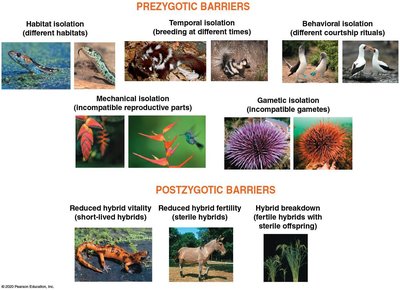
Temporal Isolation: The eastern spotted skunk (Spilogale putorius) breeds in late winter, while the western spotted skunk (Spilogale gracilis) breeds in the fall.
Behavioral Isolation: The blue-footed booby (Sula nebouxii) and the masked booby (Sula dactylatra) have different courtship rituals.
Mechanical Isolation: Heliconia pogonantha is pollinated by hummingbirds with long, curved bills, while Heliconia latispatha is pollinated by hummingbirds with short, straight bills.
Mechanisms of Speciation
14.4 Allopatric Speciation
Allopatric speciation occurs when populations are geographically separated, leading to genetic divergence due to natural selection, mutation, or genetic drift. Over time, these populations may become distinct species.
14.5 Evolution of Reproductive Barriers
Different environments can lead to the evolution of reproductive barriers as populations adapt to unique ecological conditions.
Examples include fruit flies adapting to different food sources and monkey flowers evolving different pollinator preferences.
14.6 Sympatric Speciation
Sympatric speciation occurs without geographic isolation. Mechanisms include:
Polyploidy: Duplication of chromosome number, common in plants.
Habitat Differentiation: Subpopulations exploit different resources or habitats.
Sexual Selection: Mate choice leads to reproductive isolation.
14.7 Sexual Selection and Speciation
Sexual selection can drive speciation, as seen in the rapid diversification of cichlid fish in Lake Victoria. Differences in mate choice and coloration can lead to reproductive isolation and the formation of new species.
14.8 Adaptive Radiation on Islands
Adaptive radiation is the evolution of many diverse species from a common ancestor, often occurring on isolated islands. Repeated isolation, speciation, and recolonization events promote the emergence of unique species.
14.9 Evolution in Darwin’s Finches
Long-term field studies of Darwin’s finches have documented how natural selection acts on heritable traits such as beak size, leading to speciation. These studies provide direct evidence of evolution in action.
14.10 Hybrid Zones
Hybrid zones are regions where closely related species meet and produce hybrid offspring. These zones provide natural laboratories for studying reproductive isolation and the dynamics of speciation.
14.11 Tempo of Speciation
Punctuated Equilibria: Species change most as they arise from ancestral species, then remain relatively unchanged.
Gradual Model: Species diverge gradually over long periods.
The time between speciation events can range from thousands to millions of years.
Summary Table: Species Concepts and Barriers
Species Concept | Definition | Advantages | Disadvantages |
|---|---|---|---|
Biological | Interbreeding populations producing fertile offspring | Emphasizes gene flow and reproductive isolation | Not applicable to asexual organisms or fossils |
Morphological | Based on physical traits | Applicable to fossils and asexual organisms | Subjective; may overlook genetic differences |
Ecological | Based on ecological niche | Considers adaptation to environment | Difficult to define niches precisely |
Phylogenetic | Smallest group sharing a common ancestor | Based on evolutionary history | Requires detailed genetic data |
Key Takeaways
Speciation is central to understanding biological diversity.
Multiple species concepts exist, each with strengths and limitations.
Reproductive barriers maintain species boundaries and can evolve through various mechanisms.
Speciation can occur via geographic isolation (allopatric) or within the same area (sympatric).
Hybrid zones and field studies provide valuable insights into the process of speciation.
The tempo of speciation can be rapid (punctuated) or gradual, depending on evolutionary pressures.
