 Back
The Origin of Species: Mechanisms and Patterns of Speciation
Study Guide - Smart Notes
 Tailored notes based on your materials, expanded with key definitions, examples, and context.
Chapter 24: The Origin of Species
Introduction to Speciation
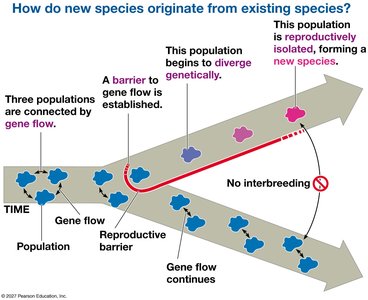
Speciation is the evolutionary process by which one species splits into two or more distinct species. This process is central to understanding the diversity and unity of life on Earth. Speciation forms a conceptual bridge between microevolution (changes in allele frequencies within populations) and macroevolution (broad evolutionary changes above the species level).

The Biological Species Concept
Definition and Importance
The biological species concept defines a species as a group of populations whose members have the potential to interbreed in nature and produce viable, fertile offspring, but do not produce viable, fertile offspring with members of other such groups. Gene flow between populations holds a species together genetically.
Species: Latin for "kind" or "appearance"; often confirmed by physiological, biochemical, and DNA sequence comparisons.
Gene flow: The transfer of alleles or genes from one population to another, maintaining genetic cohesion within a species.

Reproductive Isolation
Reproductive isolation consists of biological barriers that impede members of two species from interbreeding and producing viable, fertile offspring. These barriers limit the formation of hybrids (offspring from interspecific mating) and can be classified as prezygotic or postzygotic, depending on whether they act before or after fertilization.

Prezygotic Barriers
Habitat Isolation: Species occupy different habitats and rarely encounter each other (e.g., apple maggot flies vs. blueberry maggot flies).
Temporal Isolation: Species breed at different times (e.g., western vs. eastern spotted skunks).
Behavioral Isolation: Unique courtship rituals or behaviors prevent mating (e.g., blue-footed boobies).
Mechanical Isolation: Morphological differences prevent successful mating (e.g., snails with incompatible shell coiling).
Gametic Isolation: Sperm of one species cannot fertilize eggs of another (e.g., sea urchin species with incompatible gamete proteins).




Postzygotic Barriers
Reduced Hybrid Viability: Hybrid offspring have impaired development or survival (e.g., Ensatina salamander hybrids).
Reduced Hybrid Fertility: Hybrids are sterile (e.g., mule, the offspring of a horse and donkey).
Hybrid Breakdown: First-generation hybrids are viable and fertile, but their offspring are feeble or sterile (e.g., certain rice hybrids).
Limitations of the Biological Species Concept
Cannot be applied to fossils or asexual organisms (e.g., prokaryotes).
Gene flow can occur between distinct species (e.g., grizzly and polar bears producing "grolar bears").
Other Species Concepts
Morphological Species Concept: Distinguishes species by structural features; applies to sexual and asexual species but is subjective.
Ecological Species Concept: Defines species by ecological niche; applies to sexual and asexual species and emphasizes ecological roles.
Other concepts exist, and their usefulness depends on the research context.
Modes of Speciation
Allopatric Speciation
In allopatric speciation, gene flow is interrupted when a population is divided into geographically isolated subpopulations. Over time, genetic divergence leads to reproductive isolation.
Geographic barriers (e.g., lakes, mountains) can separate populations.
Genetic divergence occurs via mutation, natural selection, and genetic drift.
Reproductive isolation may arise as a by-product of genetic divergence.
Sympatric Speciation
In sympatric speciation, new species arise within the same geographic area. This process is less common and typically involves reduced gene flow due to polyploidy, sexual selection, or habitat differentiation.
Polyploidy: Extra sets of chromosomes lead to instant speciation, common in plants.
Sexual Selection: Mate choice based on traits (e.g., coloration in cichlids) can drive reproductive isolation.
Habitat Differentiation: Use of different resources or habitats reduces gene flow (e.g., maggot flies on hawthorn vs. apple trees).


Hybrid Zones and Speciation Outcomes
Hybrid Zones
A hybrid zone is a geographic region where members of different species meet and produce hybrid offspring. These zones reveal factors that cause reproductive isolation and can have several outcomes:
Reinforcement: Strengthening of reproductive barriers; hybrids are less fit, so selection favors prezygotic barriers.
Fusion: Weakening of reproductive barriers; gene flow increases, and species may merge.
Stability: Continued production of hybrids; parent species remain distinct.
The Tempo and Genetics of Speciation
Rates of Speciation
Speciation can occur rapidly or slowly, depending on environmental and genetic factors. The fossil record shows both punctuated equilibria (sudden changes) and gradual patterns. The interval between speciation events can range from thousands to millions of years.
Genetics of Speciation
Reproductive isolation may result from changes in one gene or many genes. For example, a single gene can affect shell coiling in snails, leading to mechanical isolation, while multiple genes can influence flower color and pollinator preference in plants, reducing gene flow and promoting speciation.
From Speciation to Macroevolution
Speciation adds new branches to the tree of life, while extinction removes them. Over long periods, repeated speciation and extinction events produce the broad patterns of macroevolution observed in the history of life.
Key Equations and Concepts:
Microevolution: Changes in allele frequencies within populations.
Macroevolution: Broad evolutionary changes at and above the species level.
Summary Table: Types of Reproductive Barriers
Barrier Type | Mechanism | Example |
|---|---|---|
Habitat Isolation | Different habitats | Apple vs. blueberry maggot flies |
Temporal Isolation | Different breeding times | Western vs. eastern spotted skunks |
Behavioral Isolation | Unique courtship rituals | Blue-footed boobies |
Mechanical Isolation | Morphological differences | Snails with incompatible shells |
Gametic Isolation | Incompatible gametes | Sea urchin species |
Reduced Hybrid Viability | Impaired hybrid development | Ensatina salamander hybrids |
Reduced Hybrid Fertility | Sterile hybrids | Mule (horse × donkey) |
Hybrid Breakdown | Feeble/sterile next generation | Rice hybrids |
Additional info: The study of speciation integrates genetics, ecology, and evolutionary biology, and is fundamental for understanding biodiversity and the evolutionary history of life.
