 Back
BackThe Process of Science: Scientific Inquiry and Experimental Design
Study Guide - Smart Notes
 Tailored notes based on your materials, expanded with key definitions, examples, and context.
The Process of Science
What is Science?
Science is derived from the Latin word meaning "to know" and represents a systematic approach to understanding natural phenomena. Scientific inquiry is the search for information and explanations about the natural world, relying on observation, hypothesis formation, and experimentation.
Science: A method of acquiring knowledge about the natural world through observation and experimentation.
Inquiry: The process of seeking information and explanations for natural phenomena.
Observation: The act of noticing and describing events or processes in a careful, orderly way.
Data: Recorded observations; can be qualitative (descriptions) or quantitative (numerical measurements).
Qualitative Data: Descriptive information, such as behaviors or characteristics.
Quantitative Data: Numerical measurements, often organized into tables or graphs.
Example: Jane Goodall's research on chimpanzee behavior involved collecting qualitative data through direct observation and recording her findings in notebooks.
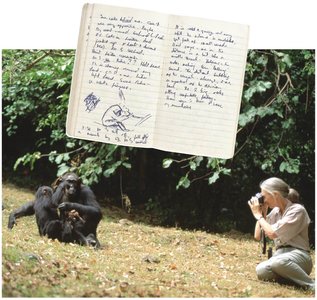
Elements of Scientific Inquiry
Hypothesis Formation and Testing
A hypothesis is a proposed explanation for a set of observations. It leads to predictions that can be tested through experiments. Scientific experiments are designed to test hypotheses in a controlled manner, often resulting in multiple hypotheses from initial observations.
Hypothesis: A testable statement that explains observations.
Prediction: A specific outcome expected if the hypothesis is correct.
Experiment: A scientific test used to validate or refute a hypothesis.
Testability: A good hypothesis must be testable through experimentation.
Example: A hypothesis that ghosts manipulate a desk lamp is not testable and therefore not scientific.

Hypothesis-Based Science
Experimental Design
Hypothesis-based science involves carefully planned experiments that extrapolate specific results from a general statement (the hypothesis). Experimental design is crucial for testing predictions and involves identifying variables and establishing control and experimental groups.
Variables: Factors that can change during an experiment.
Independent Variable: The factor that is changed or manipulated in the experiment (e.g., amount of water).
Dependent Variable: The factor that is measured in response to changes in the independent variable (e.g., fraction of seeds that sprout).
Standardized (Constant) Variables: Factors kept the same between experimental and control groups to ensure a fair test.
Control Group: The group that does not receive the experimental treatment; used for comparison.
Experimental Group: The group(s) that receive the treatment being tested.
Level of Treatment: The values set for the independent variable (e.g., different amounts of fertilizer).
Replication: Repeating the experiment multiple times to ensure consistency and reliability of results.
Example: In an experiment testing the effect of water on seed sprouting, the independent variable is the amount of water, the dependent variable is the fraction of seeds that sprout, and identical pots and seed numbers are standardized variables.
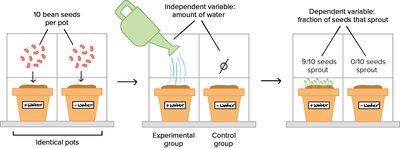
Summary Table: Types of Variables in Experiments
Variable Type | Definition | Example |
|---|---|---|
Independent Variable | Changed by the experimenter | Amount of water |
Dependent Variable | Measured outcome | Fraction of seeds sprouting |
Standardized Variable | Kept constant | Number of seeds, pot size |
Controlled Experiments
Structure and Importance
Controlled experiments are designed to isolate the effect of the independent variable by comparing an experimental group to a control group. This structure allows scientists to determine causality and ensures that results are due to the variable being tested.
Control Group: Receives no treatment or standard treatment.
Experimental Group: Receives the treatment or variable being tested.
Replication: Essential for verifying results and reducing the impact of random variation.
Example: Testing different fertilizer amounts on plant growth by comparing treated and untreated groups.
Additional info: Replication and standardization are fundamental to scientific reliability, allowing results to be generalized and reducing bias.
