 Back
Ch 34: The Respiratory System: Structure, Function, and Gas Exchange
Study Guide - Smart Notes
 Tailored notes based on your materials, expanded with key definitions, examples, and context.
The Respiratory System
Overview and Functions
The respiratory system is essential for gas exchange, homeostatic regulation of body pH, protection from inhaled pathogens, and vocalization. It enables the uptake of oxygen (O2) from the atmosphere and the removal of carbon dioxide (CO2) produced by cellular respiration.
Gas Exchange: Facilitates the movement of O2 into the blood and CO2 out of the blood.
pH Regulation: Maintains acid-base balance by controlling CO2 levels.
Protection: Filters out pathogens and particulates via mucus and cilia.
Vocalization: Air movement across vocal cords produces sound.
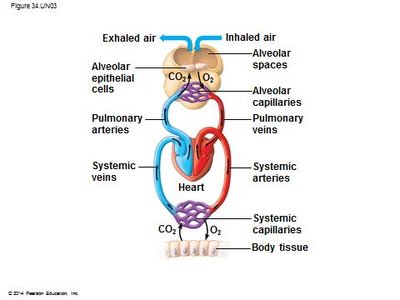
External and Cellular Respiration
Respiration involves several steps:
External Respiration: Exchange of gases between the atmosphere and the blood in the lungs.
Transport: Movement of gases in the blood between the lungs and tissues.
Internal (Cellular) Respiration: Exchange of gases between blood and body cells, where O2 is used for ATP production and CO2 is produced as a waste product.
Types of Respiratory Systems/Organs
Adaptations for Gas Exchange
All respiratory organs share key features to maximize gas exchange:
Moist surfaces for gas dissolution and diffusion
Large surface area
Extensive blood flow
Thin, delicate structures
Gills
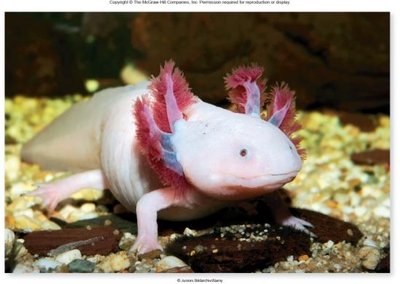
Gills are specialized extensions of tissue found in aquatic animals, increasing surface area for diffusion. They are external in immature fish and amphibians, and internal in bony fishes.
External Gills: Not enclosed, must be moved constantly, easily damaged.
Internal Gills: Protected by body structures, as in bony fishes.
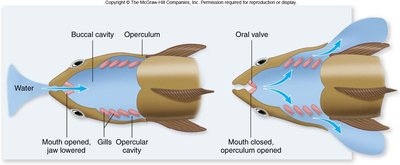
Countercurrent Exchange in Gills
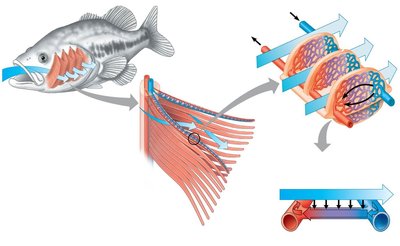
Bony fish gills use a countercurrent exchange system, where water and blood flow in opposite directions, maximizing O2 uptake.
Water enters the mouth, passes over gill filaments, and exits via the operculum.
Blood flows through lamellae in the opposite direction to water flow, maintaining a gradient for O2 diffusion.
Lungs
Lungs evolved in terrestrial animals to facilitate gas exchange in air. They are internal, sac-like structures with a large surface area due to branching and alveoli.
Amphibian Lungs: Simple sacs; frogs use positive pressure breathing (force air into lungs).
Reptile and Mammal Lungs: More complex; use negative pressure breathing (expand thoracic cavity to draw air in).
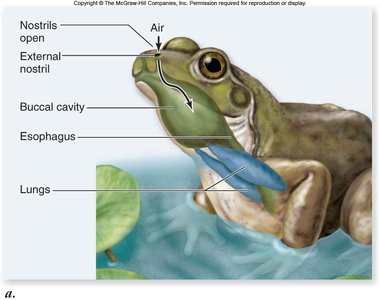
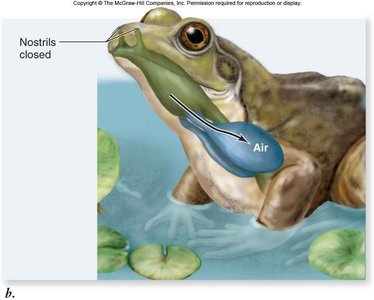
Mammalian Lungs
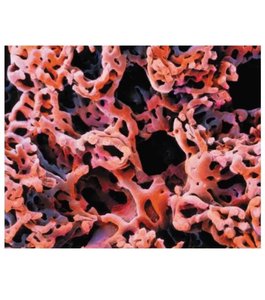
Mammalian lungs contain millions of alveoli, which are the primary sites of gas exchange. Air travels through the nasal cavity, pharynx, larynx, trachea, bronchi, and bronchioles to reach the alveoli.
Alveoli are surrounded by capillaries for efficient gas exchange.
Cilia and mucus in airways trap and remove particles ("mucus escalator").
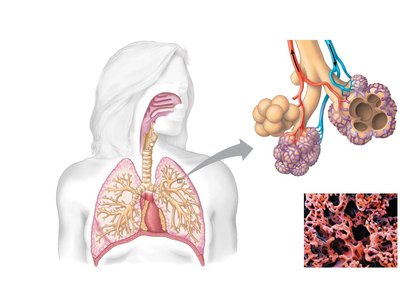
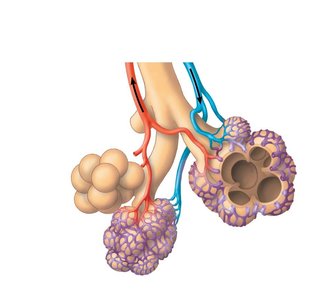
Lung Structure and Function
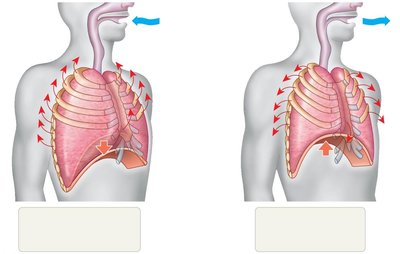
The lungs are covered by the visceral pleural membrane, while the thoracic cavity is lined by the parietal pleural membrane. The pleural cavity between them contains fluid, allowing the lungs to move with the thoracic wall.
Inhalation: External intercostal muscles and diaphragm contract, increasing thoracic volume and creating negative pressure to draw air in.
Exhalation: Muscles relax, thoracic volume decreases, and air is expelled.
Control of Respiration
Neural Regulation
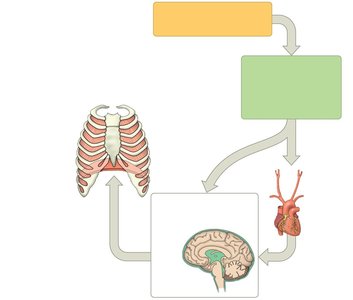
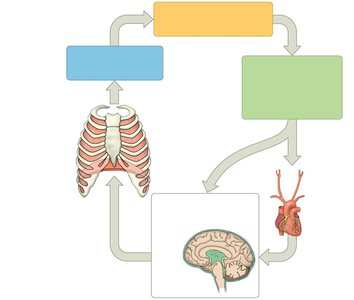
Breathing is controlled by neural circuits in the medulla oblongata, which respond to changes in blood pH (related to CO2 levels). The medulla adjusts the rate and depth of breathing to meet metabolic demands.
CO2 increase lowers blood pH, stimulating the medulla to increase ventilation.
Carotid and aortic bodies act as sensors for blood pH and CO2 levels.
Principles Governing Gas Exchange
Gas Levels in the Blood
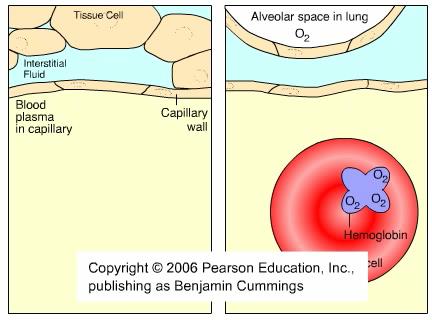
Oxygen and carbon dioxide are transported in the blood between the lungs and tissues. The majority of O2 is carried by hemoglobin in red blood cells, while CO2 is transported as bicarbonate ions, dissolved in plasma, or bound to hemoglobin.
Hemoglobin and Gas Transport
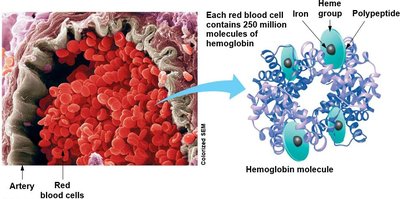
Hemoglobin is a protein with four polypeptide chains, each containing a heme group that binds O2. It loads O2 in the lungs and unloads it in tissues where it is needed.
Each red blood cell contains about 250 million hemoglobin molecules.
Hemoglobin increases the O2-carrying capacity of blood.
CO2 and O2 Transport Mechanisms
Gas exchange at the tissue and lung level involves the following steps:
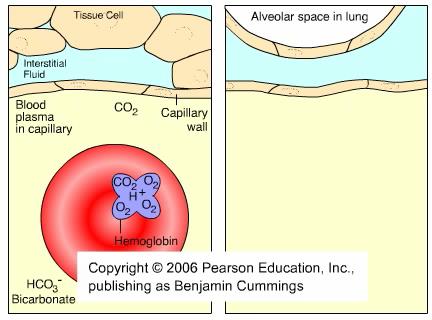
CO2 produced by tissues diffuses into blood, is converted to bicarbonate (HCO3-), and transported to the lungs.
In the lungs, bicarbonate is converted back to CO2 for exhalation.
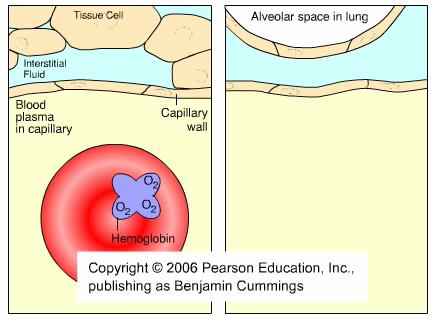
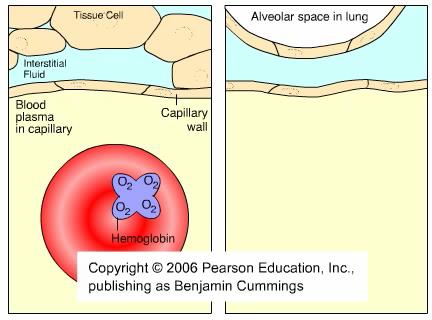
O2 diffuses from alveoli into blood, binds to hemoglobin, and is delivered to tissues.
The Bohr Shift
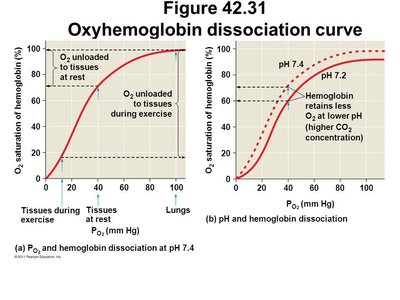
The Bohr shift describes how hemoglobin's affinity for O2 decreases at lower pH (higher CO2 concentration), facilitating O2 unloading in active tissues.
At lower pH, the oxyhemoglobin dissociation curve shifts right, meaning more O2 is released at a given partial pressure.
Summary Table: Comparison of Gills and Lungs
Feature | Gills | Lungs |
|---|---|---|
Environment | Aquatic | Terrestrial |
Structure | Filamentous, external or internal | Branched, internal sacs with alveoli |
Ventilation | Water flow, countercurrent exchange | Air flow, negative pressure (except amphibians) |
Gas Exchange Surface | Lamellae | Alveoli |
