 Back
The Rise of Animal Diversity: Evolution, Body Plans, and Major Animal Groups
Study Guide - Smart Notes
 Tailored notes based on your materials, expanded with key definitions, examples, and context.
The Rise of Animal Diversity
Key Characteristics in Animal Evolution
Animal evolution has produced a wide array of structural and functional adaptations. These characteristics define major animal groups and their evolutionary history.
Tissues: Specialized groups of cells functioning as a unit.
Bilateral symmetry: Two-sided body plan with three tissue layers.
Vertebrae: Skull and backbone composed of vertebrae.
Jaws and mineralized skeleton: Adaptations for feeding and support.
Limbs with digits: Key for movement on land.
Amniotic egg: Adaptation for reproduction on land.
Most animals share mobility, specialized muscle and nerve cells, and a complete digestive tract. Animals likely evolved from single-celled eukaryotes similar to modern choanoflagellates. Over 1.3 million animal species have been named, with estimates reaching 8 million.
Early-Diverging Animal Groups
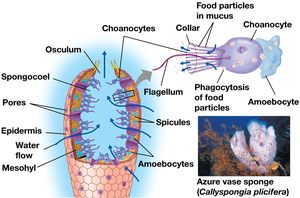
Sponges (phylum Porifera) and cnidarians diverged early in animal evolution. Sponges lack true tissues and are filter feeders, using specialized cells called choanocytes to capture food particles.
Tissues: Groups of similar cells functioning together.
Choanocytes: Cells lining the central cavity, resembling choanoflagellates.
Amoebocytes: Mobile cells that distribute nutrients.
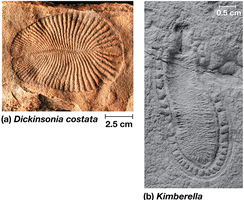
Fossil steroids and DNA evidence suggest animals arose 700–770 million years ago. The earliest animal fossils are from the Ediacaran biota (~560 million years ago).
Cnidarians and Eumetazoans
Cnidarians (hydrozoans, jellies, sea anemones) are eumetazoans with true tissues. Their basic morphology is a sac with a central digestive cavity (gastrovascular cavity). They have simple muscles and nerves, but no brain, and a noncentralized nerve net for detecting stimuli.
Gastrovascular cavity: Functions as both mouth and anus.
Nerve net: Coordinates responses and movements.
The Cambrian Explosion and Animal Diversity
The Cambrian explosion (~541 million years ago) saw the emergence of most extant animal phyla, including the first hard, mineralized skeletons. Bilaterians, with a complete digestive tract and two-sided form, became dominant. Large predators and defensive adaptations appeared, leading to the decline of soft-bodied Ediacaran biota.
Hypotheses for Cambrian diversification: Predator-prey adaptations, increased oxygen, and genetic innovations (Hox genes).
Animal Body Plans: Symmetry, Tissues, and Body Cavities
Animal body plans are defined by symmetry, tissue organization, and body cavities.
Symmetry
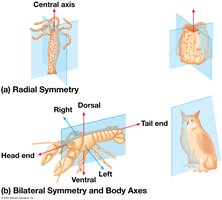
Radial symmetry: Body arranged around a central axis; any slice produces mirror images. Common in cnidarians and some sponges.
Bilateral symmetry: Body has head-tail and dorsal-ventral axes; only one slice produces mirror-image halves. Sensory organs are concentrated at the head end.
Tissues and Germ Layers
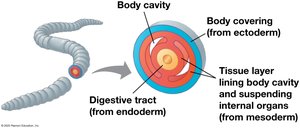
Ectoderm: Outer layer; forms covering and nervous system.
Endoderm: Inner layer; forms digestive tract lining and some organs.
Mesoderm: Middle layer; forms muscles and most organs (present in bilaterians).
Body Cavities (Coelom)
Most bilaterians have a coelom, a fluid- or air-filled space between the digestive tract and body wall. Functions include cushioning organs, acting as a hydrostatic skeleton, and allowing organ movement.
Diversification of Animal Groups
Most animal phyla were established 500 million years ago. Bilaterian invertebrates account for 95% of known animal species and are classified into three major clades:
Lophotrochozoa
Ecdysozoa
Deuterostomia
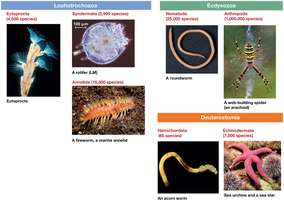
Arthropod Diversity and Body Plan
Arthropods are the most diverse animal phylum, with a segmented body, hard exoskeleton, and jointed appendages. Their body plan dates to the Cambrian explosion, evolving into specialized regions for feeding, movement, and other functions. Changes in Hox gene regulation contributed to this complexity.
Chordates and Vertebrate Origins
Vertebrates are members of the phylum Chordata, characterized by:
Notochord: Flexible rod for support.
Dorsal, hollow nerve cord: Develops into brain and spinal cord.
Pharyngeal slits: Functions in feeding, respiration, or head structures.
Muscular tail: Extends posterior to the anus.
Lancelets retain all chordate traits into adulthood; tunicates display them only in larval stages.
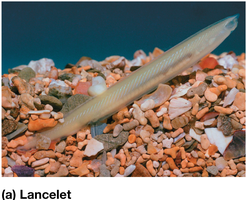
Vertebrate Evolution
Vertebrates originated about 500 million years ago, with early jawless forms (cyclostomes: hagfishes and lampreys). Jawed vertebrates (gnathostomes) evolved paired fins, tails, and jaws, leading to greater success in predation and feeding.
Major vertebrate groups: Hagfishes, lampreys, sharks, ray-finned fishes, lobe-finned fishes, amphibians, reptiles, mammals.
Colonization of Land by Arthropods and Vertebrates
Terrestrial lineages arose in arthropods (millipedes, spiders, crabs, insects) and vertebrates. Arthropod appendages are jointed and paired, modified for various functions. The cuticle (exoskeleton) prevents desiccation and provides support and protection. Gas exchange organs vary: gills in aquatic species, tracheal systems in terrestrial insects.
Summary Table: Key Animal Groups and Characteristics
Group | Key Characteristics | Examples |
|---|---|---|
Porifera (Sponges) | No true tissues, filter feeders | Azure vase sponge |
Cnidaria | Radial symmetry, gastrovascular cavity | Jellyfish, sea anemones |
Bilaterians | Bilateral symmetry, three germ layers, coelom | Flatworms, arthropods, chordates |
Arthropoda | Segmented body, exoskeleton, jointed appendages | Insects, spiders, crabs |
Chordata | Notochord, dorsal nerve cord, pharyngeal slits, tail | Lancelets, vertebrates |
Additional info: The notes expand on brief points with academic context, definitions, and examples to provide a self-contained study guide suitable for exam preparation.
