 Back
The Rise of Animal Diversity: Evolutionary History, Body Plans, and Major Animal Groups
Study Guide - Smart Notes
 Tailored notes based on your materials, expanded with key definitions, examples, and context.
The Rise of Animal Diversity
Evolutionary History of Animals
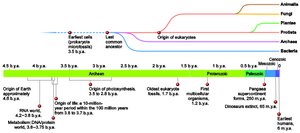
The evolutionary history of animals spans over 700 million years, beginning with the earliest multicellular organisms and culminating in the vast diversity seen today. Key events include the emergence of the Ediacaran biota, the Cambrian explosion, and the radiation of both aquatic and terrestrial animals.
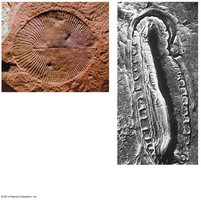
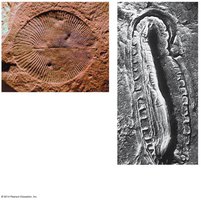
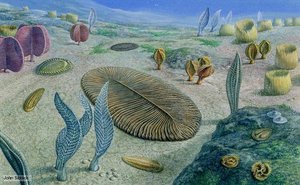
Ediacaran Period: Earliest known animal fossils, such as Dickinsonia and Kimberella, date back to about 560 million years ago.
Cambrian Explosion: Occurred 535–525 million years ago, marking the rapid diversification of animal body plans and the appearance of most major animal groups.
Terrestrial Radiation: Animals began colonizing land, leading to further diversification.
Major Groups: Animals are classified into eight major groups, including seven invertebrate and one vertebrate group.
Major Events in Animal Evolution
Animal evolution is characterized by several major events, including the origin of multicellularity, the development of tissues, and the emergence of complex body plans.
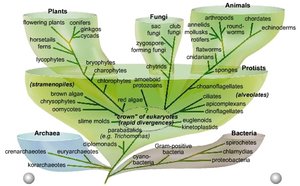
Origin of Multicellularity: Animals evolved from a common ancestor shared with choanoflagellates.
Development of Tissues: True tissues (eumetazoans) are a derived trait, distinguishing most animal groups from sponges.
Body Plan Diversification: The Cambrian explosion led to the emergence of diverse body plans, including bilateral and radial symmetry.
Animal Body Plans
Symmetry
Animal body plans are categorized by symmetry, which influences their lifestyle and movement.
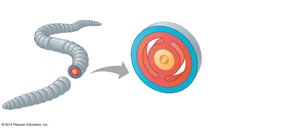
Radial Symmetry: Body parts arranged around a central axis; common in sessile or planktonic animals like cnidarians.
Bilateral Symmetry: Body has left and right sides; associated with active movement and centralized nervous systems.
Tissues
Tissues are collections of specialized cells separated by membranous layers. Most animals have three germ layers: ectoderm, mesoderm, and endoderm, which give rise to all tissues and organs.
Ectoderm: Forms the body covering.
Mesoderm: Forms muscles and most internal organs.
Endoderm: Forms the digestive tract.
Body Cavities
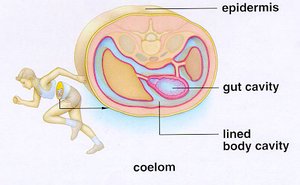
Most bilaterians possess a coelom, a fluid- or air-filled space between the digestive tract and the body wall. The coelom cushions organs, acts as a hydrostatic skeleton, and allows organ movement.
Coelom: True body cavity lined by mesoderm.
Pseudocoelom: Body cavity partially lined by mesoderm.
Acoelomate: No body cavity.
Early-Diverging Animal Groups
Sponges (Porifera)
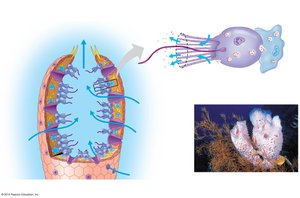
Sponges are among the earliest-diverging animal groups. They lack true tissues and symmetry, but possess specialized cells for feeding and structure.
Choanocytes: Flagellated cells that create water flow and capture food particles.
Amoebocytes: Cells involved in digestion and structure.
Spicules: Structural elements providing support.
Cnidarians
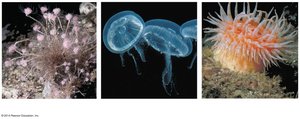
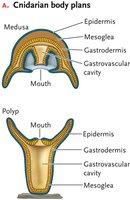
Cnidarians are eumetazoans with radial symmetry and true tissues. They include hydrozoans, jellies, and sea anemones, and possess a basic body plan with a gastrovascular cavity.
Body Forms: Medusa (free-swimming) and polyp (sessile).
Gastrovascular Cavity: Central digestive compartment with a single opening.
Nerve Net: Noncentralized nervous system.
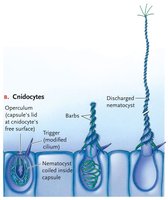
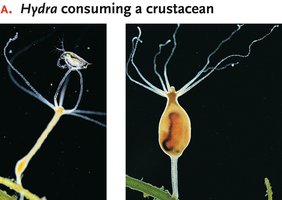
Carnivorous: Use tentacles and specialized cells (cnidocytes) to capture prey.
The Cambrian Explosion and Bilaterian Radiation
Cambrian Explosion
The Cambrian explosion marks the earliest fossil appearance of many major animal groups, including the first hard, mineralized skeletons. Most fossils from this period are bilaterians, which have a complete digestive tract and bilateral symmetry.
Adaptive Radiation: Driven by new predator-prey relationships, increased atmospheric oxygen, and the evolution of Hox genes.
Bilaterians: Animals with bilateral symmetry and three germ layers.
Diversification in Aquatic Environments
Early Cambrian oceans were populated by diverse invertebrates and aquatic vertebrates, each with unique body plans and adaptations.
Invertebrates: Account for 95% of known animal species.
Major Clades: Lophotrochozoa, Ecdysozoa, Deuterostomia.
Clade | Example Species | Key Features |
|---|---|---|
Lophotrochozoa | Ectoprocts, Molluscs, Annelids | Trochophore larvae, lophophore feeding structure |
Ecdysozoa | Nematodes, Arthropods | Molting of exoskeleton (ecdysis) |
Deuterostomia | Hemichordates, Echinoderms, Chordates | Deuterostome development, radial cleavage |
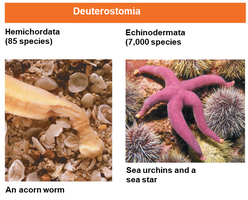
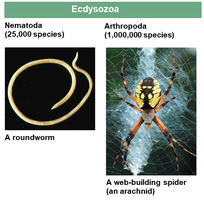
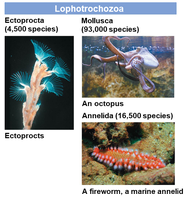
Arthropods: The Most Successful Animals
Arthropod Characteristics
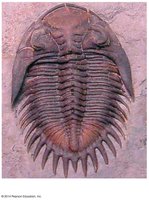
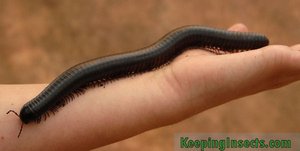
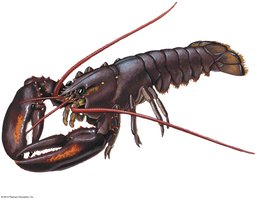
Arthropods are the most diverse and successful animal group, with adaptations that enabled them to colonize land and occupy various ecological niches.
Body Plan: Segmented body, hard exoskeleton (cuticle), jointed appendages.
Exoskeleton: Made of chitin and protein, provides structural support, protection, and resistance to desiccation.
Specialized Appendages: Adapted for walking, feeding, sensory reception, defense, and reproduction.
Gas Exchange: Terrestrial arthropods have spiracles and tracheal tubes.
The Rise of Vertebrates
Chordates and Early Vertebrates
Chordates are bilateral animals within Deuterostomia, characterized by four key features: notochord, dorsal hollow nerve cord, pharyngeal slits, and post-anal tail. Early vertebrates had a backbone and a well-defined head.
Notochord: Flexible rod providing support.
Dorsal Hollow Nerve Cord: Develops into the central nervous system.
Pharyngeal Slits: Used for feeding or respiration.
Post-anal Tail: Extension of the body beyond the anus.
Vertebrate Evolution
Vertebrates evolved during the Cambrian explosion, with jawless forms preceding jawed vertebrates (gnathostomes). Jawed vertebrates are more efficient predators and include most modern fish and tetrapods.
Colonization of Land by Vertebrates
Some lobed-finned fish evolved limbs and feet, leading to the emergence of tetrapods. The transition fossil Tiktaalik exhibits both fish and tetrapod characteristics.
Tetrapods: Vertebrates with limbs and digits.
Amphibians: First vertebrates to colonize land, including salamanders, frogs, and caecilians.
Terrestrial Adaptations in Amniotes
Amniotes
Amniotes include reptiles, birds, and mammals, distinguished by the amniotic egg, which contains membranes that protect the embryo.
Amniotic Egg: Contains amnion, chorion, and allantois membranes.
Reptiles: Waterproof scales, shelled eggs, thermoregulation (mostly ectothermic).
Birds: Endothermic, capable of flight.
Mammals: Mammary glands, hair, fat layer, high metabolic rate, differentiated teeth.
Mammalian Diversity
Mammals evolved about 180 million years ago and diversified into three lineages: monotremes (egg-laying), marsupials (pouch), and eutherians (placental).
Human Evolution
Humans and Apes
Humans (Homo sapiens) are primates within the ape group. Distinctive traits include upright posture, bipedal locomotion, large brains, language, symbolic thought, artistic expression, and tool use.
Summary
Animals originated more than 700 million years ago, diversified in aquatic environments, and several groups adapted to terrestrial life. Animal evolution has transformed ecosystems and altered the course of evolution.
