 Back
The Role of Biology in Psychology: Nervous System Structure and Function
Study Guide - Smart Notes
 Tailored notes based on your materials, expanded with key definitions, examples, and context.
The Role of Biology in Psychology
Introduction
Understanding the biological basis of behavior is essential in both biology and psychology. The nervous system, composed of specialized cells and complex structures, underlies all mental processes and behaviors. This section explores the organization, function, and communication mechanisms of the nervous system, as well as the major brain regions and their roles in regulating behavior and cognition.
The Nervous System
Overview and Organization
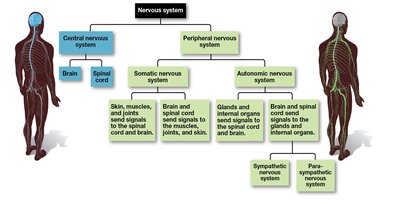
The nervous system is a network of cells that coordinates sensory input, information processing, and behavioral responses. It is divided into two main parts: the central nervous system (CNS) and the peripheral nervous system (PNS).
Central Nervous System (CNS): Consists of the brain and spinal cord; responsible for processing information and directing responses.
Peripheral Nervous System (PNS): Connects the CNS to the rest of the body and is subdivided into the somatic and autonomic nervous systems.
Somatic Nervous System: Controls voluntary movements and transmits sensory information.
Autonomic Nervous System: Regulates involuntary functions (e.g., heart rate, digestion) and is further divided into the sympathetic and parasympathetic systems.
Neurons: Structure and Function
The Basic Unit of the Nervous System
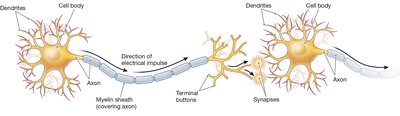
Neurons are specialized cells that receive, integrate, and transmit information throughout the nervous system. They form complex networks that enable communication within the body.
Dendrites: Receive signals from other neurons.
Cell Body (Soma): Integrates incoming signals and generates outgoing signals.
Axon: Conducts electrical impulses away from the cell body.
Myelin Sheath: Insulates the axon and speeds up signal transmission.
Terminal Buttons: Release neurotransmitters into the synapse.
Synapse: The junction where communication occurs between neurons.
Neural Communication
Neural communication involves both electrical and chemical processes. The transmission of information occurs in four main phases:
Transmission Phase: Neurons pass signals to receiving neurons.
Reception Phase: Neurons receive signals from neighboring neurons.
Integration Phase: Neurons assess incoming signals and determine if an action potential will be generated.
Conduction Phase: If the threshold is reached, an action potential is fired along the axon.
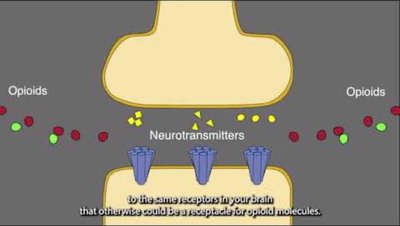
Neurons communicate via neurotransmitters, which are chemical messengers released into the synapse and bind to specific receptors on the postsynaptic neuron.
Neurotransmitters and Their Functions
Major Neurotransmitters
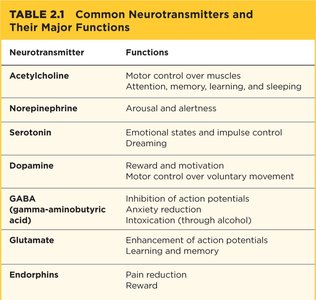
Neurotransmitters play critical roles in regulating mental activity and behavior. Each neurotransmitter has specific functions and effects on the nervous system.
Neurotransmitter | Functions |
|---|---|
Acetylcholine | Motor control over muscles; attention, memory, learning, and sleeping |
Norepinephrine | Arousal and alertness |
Serotonin | Emotional states and impulse control; dreaming |
Dopamine | Reward and motivation; motor control over voluntary movement |
GABA (gamma-aminobutyric acid) | Inhibition of action potentials; anxiety reduction; intoxication (through alcohol) |
Glutamate | Enhancement of action potentials; learning and memory |
Endorphins | Pain reduction; reward |
Drugs and Neurotransmitter Function
Certain drugs can alter neurotransmitter activity:
Agonists: Enhance the action of neurotransmitters (e.g., nicotine acts as an agonist for acetylcholine).
Antagonists: Inhibit the action of neurotransmitters (e.g., naloxone acts as an antagonist for endorphins).


Major Divisions of the Brain
Three Main Brain Divisions
The brain is divided into three main regions, each with specialized functions:
Hindbrain: Controls survival functions and movement.
Midbrain: Involved in movement and the production of dopamine.
Forebrain: Responsible for motivation, emotion, and complex thought.
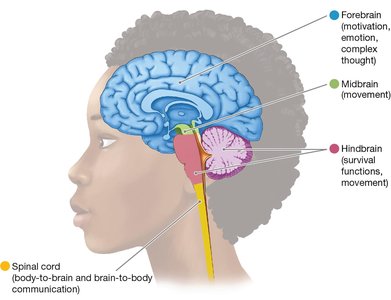
Hindbrain Structures
Medulla: Regulates heart rate and breathing.
Pons: Controls sleep, arousal, and left-right body coordination.
Cerebellum: Essential for coordinated movement and balance.
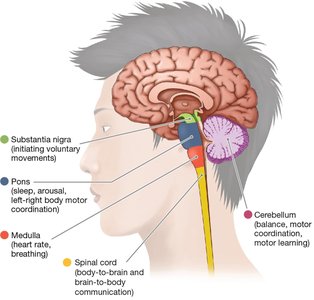
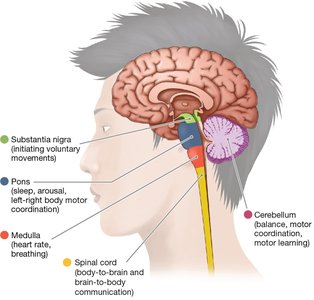
Midbrain Structure
Substantia Nigra: Critical for dopamine production; degeneration leads to Parkinson’s disease.
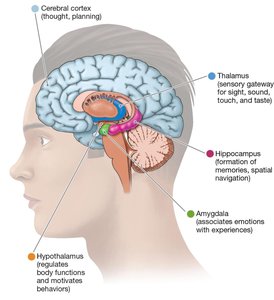
Forebrain Structures
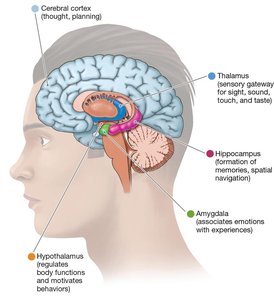
Thalamus: Sensory gateway; organizes and relays information to the cortex.
Hypothalamus: Regulates hunger, temperature, sleep, and motivational behaviors.
Hippocampus: Involved in memory formation and spatial navigation.
Amygdala: Detects threats and is associated with emotional responses.
The Cerebral Cortex
Structure and Function
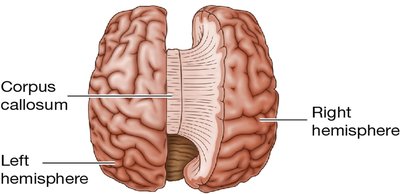
The cerebral cortex is the outer layer of the forebrain and is responsible for complex mental activities such as thought, planning, and perception. It is divided into two hemispheres (left and right) connected by the corpus callosum.
Gyri: Ridges on the cortex surface.
Sulci: Grooves between the gyri.
Lobes of the Cerebral Cortex
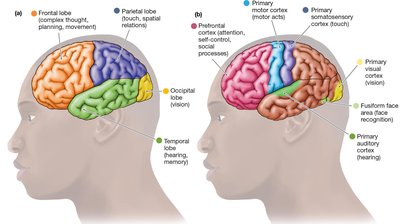
Frontal Lobe: Planning, movement, and complex thought.
Parietal Lobe: Touch and spatial relations.
Occipital Lobe: Vision.
Temporal Lobe: Hearing and memory.
Summary Table: Brain Regions and Functions
Brain Region | Main Function(s) |
|---|---|
Hindbrain (Medulla, Pons, Cerebellum) | Survival functions, movement, coordination |
Midbrain (Substantia Nigra) | Dopamine production, movement regulation |
Forebrain (Thalamus, Hypothalamus, Hippocampus, Amygdala, Cortex) | Sensory processing, motivation, emotion, memory, complex thought |
Additional info: The study of the nervous system and its components is foundational for understanding both biological and psychological processes. This knowledge is essential for fields such as neuroscience, psychology, and medicine.
