 Back
The Scientific Method and Experimental Design in Biology
Study Guide - Smart Notes
 Tailored notes based on your materials, expanded with key definitions, examples, and context.
The Scientific Method
Overview of the Scientific Method
The scientific method is a systematic approach used by scientists to investigate natural phenomena, develop explanations, and test hypotheses. It is foundational to all biological research and ensures that findings are reliable and reproducible.
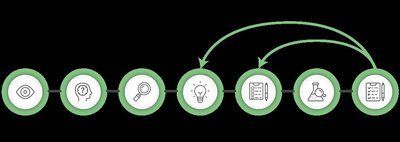
Observation: Gathering information about the natural world.
Question: Formulating a question based on observations.
Hypothesis: Proposing a testable explanation for the observed phenomena.
Prediction: Making a logical prediction based on the hypothesis.
Experiment: Designing and conducting controlled tests to evaluate the prediction.
Data Collection: Recording qualitative and quantitative data from experiments.
Analysis: Using statistics to determine the significance of results.
Conclusion: Drawing conclusions and revising hypotheses as needed.
Example of the Scientific Method
Observation: Desk lamp doesn't work.
Question: Why doesn't the desk lamp work?
Hypotheses: Bulb is burnt out (Hypothesis 1) or bulb is improperly screwed in (Hypothesis 2).
Prediction: Replacing or reinstalling the bulb will fix the problem.
Test: Replace or reinstall the bulb.
Result: Lamp works (hypothesis supported) or doesn't work (hypothesis not supported).
Hypotheses and Theories
Hypothesis
A hypothesis is a proposed explanation for a set of observations, based on available data and guided by inductive reasoning. It must be testable and lead to predictions that can be evaluated through further observation or experimentation.
Testable: Must be able to be tested by experiments or additional observations.
Rational: Based on prior knowledge and logical reasoning.
Predictive: Should allow for predictions that can be measured.
Scientific Theory
A scientific theory is a well-substantiated explanation for a broad range of phenomena, supported by a large body of evidence. Theories are explanatory, predictive, and open to revision as new data emerges.
Evidence-Based: Built upon systematic observations, measurements, and verified experiments.
Explanatory and Predictive: Explains why something happens and predicts new outcomes.
Open to Revision: Can be modified if new, reliable data emerges.
Examples of Scientific Theories:
Theory of Evolution: Explains how species change over generations through natural selection.
Germ Theory: Explains that microscopic organisms cause specific diseases.
Cell Theory: States that the cell is the basic unit of all living organisms.
Scientific Laws
Scientific laws describe how the world behaves under certain conditions, often expressed mathematically. Unlike theories, laws do not explain why phenomena occur; they simply state the relationship.
Descriptive: State what happens, not why.
Theories: Provide mechanisms that explain laws and other observations.
Experimental Design
Variables in Experiments
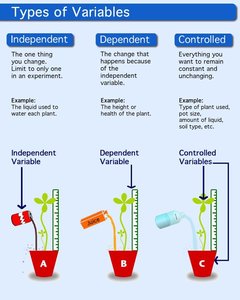
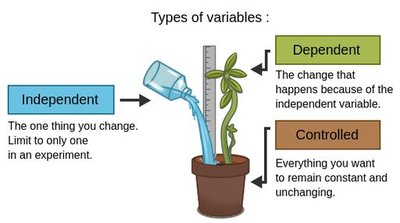
Controlled experiments are designed to test hypotheses by manipulating variables. There are three main types of variables:
Independent Variable: The factor that is changed or manipulated by the scientist.
Dependent Variable: The factor that is measured; it changes in response to the independent variable.
Controlled Variables: Factors kept constant to ensure that changes in the dependent variable are due to the independent variable.
Examples of Variables
Example 1: Testing if giving teachers gifts affects homework assigned.
Independent Variable (IV): Giving a teacher gifts or not
Dependent Variable (DV): How much homework is assigned
Example 2: Testing if plant food affects the number of blooms on orchids.
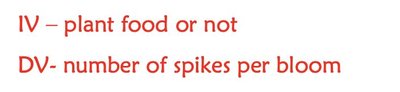
Independent Variable (IV): Plant food or not
Dependent Variable (DV): Number of spikes per bloom
Data Collection and Analysis
Types of Data
Data are recorded observations that form the basis of scientific inquiry.
Qualitative Data: Descriptions or characteristics that are not numerical (e.g., behavior, color).
Quantitative Data: Numerical measurements (e.g., frequency, duration, size).
Example: Jane Goodall's research on chimpanzee behavior included both qualitative descriptions and quantitative measurements. 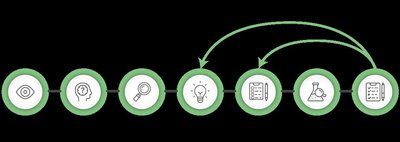
Statistical Analysis
Scientists use statistics to analyze data and determine whether results are significant or due to random chance.
Significance Testing: Determines if observed differences are likely to be real.
Data Organization: Data are often presented in tables and graphs for clarity.
Summary Table: Types of Variables
Variable Type | Description | Example |
|---|---|---|
Independent Variable | The factor changed by the scientist | Type of liquid used to water plants |
Dependent Variable | The factor measured in response | Health or growth of the plant |
Controlled Variables | Factors kept constant | Type of plant, pot size, soil type |
Conclusion
Understanding the scientific method and experimental design is essential for studying biology. These principles ensure that scientific investigations are logical, reproducible, and yield meaningful results. Key Takeaways:
Science relies on testable hypotheses, controlled experiments, and careful data analysis.
Scientific theories are robust explanations supported by evidence and open to revision.
Controlled variables are crucial for reliable experiments.
