 Back
BackThe Scientific Method and The Chemistry of Living Things: Foundations of Human Biology
Study Guide - Smart Notes
 Tailored notes based on your materials, expanded with key definitions, examples, and context.
The Scientific Method in Human Biology
Overview of the Scientific Method
The scientific method is a systematic approach used to acquire knowledge about the natural world. It is fundamental to all scientific inquiry, including human biology, and ensures that conclusions are based on evidence rather than bias or speculation.
Science is both the body of knowledge about the natural world and the process used to obtain that knowledge.
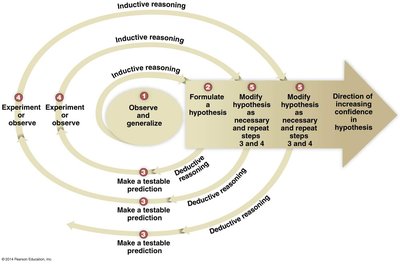
The scientific method involves making observations, forming hypotheses, making predictions, conducting experiments, and revising hypotheses as needed.
Steps of the Scientific Method
1. Observe & Generalize: Use inductive reasoning to make generalizations from specific observations. For example, if Drug X lowers blood pressure in rats, cats, and dogs, one might generalize that it lowers blood pressure in all mammals.
2. Formulate a Hypothesis: Develop an educated guess or statement about the natural world based on observations. Example: "Drug X is a safe and effective treatment for high blood pressure in humans."
3. Make a Testable Prediction: Use deductive reasoning to make specific predictions that can be tested, often in "if...then" format. Example: "If Drug X is effective, then 10mg/day will lower blood pressure in people within one month."
4. Experiment or Observe: Design and conduct experiments to test predictions. Gather and analyze data to determine if the prediction is supported.
5. Modify & Repeat: If results do not support the hypothesis, modify it and repeat the process. Confidence in a hypothesis increases with repeated, consistent results.
Experimental Design
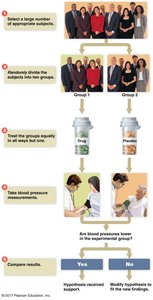
Controlled experiments are essential for testing hypotheses. They involve manipulating one variable (independent variable) while keeping others constant, and measuring the effect on another variable (dependent variable).
Independent Variable: The factor intentionally changed (e.g., drug dose).
Dependent Variable: The outcome measured (e.g., blood pressure).
Control Group: Does not receive the experimental treatment; used for comparison.
Placebo: A "false treatment" used to control for the power of suggestion, often in blind studies where subjects do not know which group they are in.
Reporting and Evaluating Scientific Results
Results are published in peer-reviewed journals for credibility and transparency.
Other sources include science magazines, books, and reputable websites (e.g., .edu, .gov, .org).
Critical thinking is essential: always question the source, evidence, and possible biases.
Data Interpretation and Critical Thinking
Facts vs. Conclusions: Facts are verifiable; conclusions are judgments based on facts.
Correlation vs. Causation: Correlation does not imply causation; further investigation is needed to establish cause-effect relationships.
Theory (in science): A broad hypothesis that has been extensively tested and supported, explaining a wide range of facts with high reliability.
The Chemistry of Living Things
Importance of Water to Life
Water is the most essential molecule for life, making up about 60% of human body weight. It is involved in numerous biological processes and is critical for survival.
Acts as an excellent solvent for many biological molecules.
Remains liquid at body temperature, facilitating transport and chemical reactions.
Helps regulate body temperature through heat absorption and evaporation.
Participates in essential chemical reactions, such as synthesis and hydrolysis of biomolecules.
Water Chemistry and Properties
Polarity: Water is a polar molecule, with a slightly positive hydrogen end and a slightly negative oxygen end due to unequal electron sharing.
Hydrogen Bonds: Weak attractions between water molecules, important for water's unique properties.
Water as a Biological Solvent
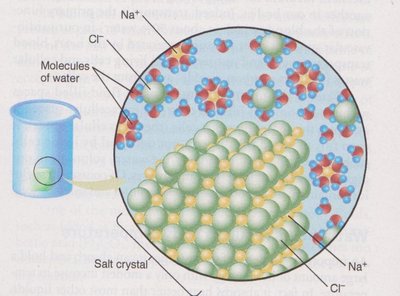
Water dissolves many substances, especially those that are also polar (hydrophilic). Non-polar substances (hydrophobic) do not dissolve well in water.
Example: Table salt (NaCl) dissolves in water as water molecules surround and separate Na+ and Cl- ions, preventing them from re-forming a crystal.
Water in the Human Body
Main component of intracellular (within cells) and intercellular (between cells) fluids.
Essential for transporting solutes and maintaining homeostasis.
Regulates body temperature by absorbing excess heat and enabling cooling through sweat evaporation.
Water in Chemical Reactions
Dehydration Synthesis: Formation of carbohydrates, lipids, and proteins by removing water.
Hydrolysis: Breakdown of these molecules by adding water.
Hydrogen Ions and pH
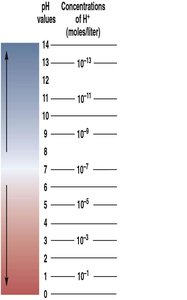
The concentration of hydrogen ions (H+) in a solution determines its pH, which is crucial for biological processes.
Acids: Molecules that donate H+ ions.
Bases: Molecules that accept H+ ions.
pH Scale: Measures H+ concentration; lower pH means higher acidity.
pH Regulation in the Body
Body fluids must maintain a stable pH (e.g., blood pH ≈ 7.4).
Buffers help regulate pH by accepting or donating H+ ions as needed.
The bicarbonate buffer system is especially important in blood:
(bicarbonate ion) accepts H+ when blood is too acidic. (carbonic acid) donates H+ when blood is too alkaline.
Application: Importance of Clean Water
Access to clean, safe drinking water is critical for health and survival.
Contaminated water can lead to serious health issues, as seen in communities with long-term boil water advisories.
References: Johnson, M.D. (2017, 2021). Human Biology: Concepts and Current Issues. Pearson Education Inc.; Global News Institute for Investigative Journalism (2021); Stefanovich, O. (2023).
