 Back
BackThe Scientific Method and the Chemistry of Living Things
Study Guide - Smart Notes
 Tailored notes based on your materials, expanded with key definitions, examples, and context.
The Scientific Method
Overview of the Scientific Method
The scientific method is a systematic approach used to acquire knowledge about the natural world. It involves making observations, forming hypotheses, testing predictions, and refining ideas based on evidence. This process aims to minimize bias and ensure reliable results.
Observation & Generalization: Scientists observe phenomena and use inductive reasoning to make generalizations. For example, if Drug X lowers blood pressure in rats, cats, and dogs, one might generalize that it lowers blood pressure in all mammals.
Formulate a Hypothesis: A hypothesis is an educated guess or statement about the natural world, based on observations. It should be testable and lead to predictions.
Testable Prediction: Predictions are specific statements, often in "if...then" format, that can be tested through experiments. They use deductive reasoning to apply general principles to specific cases.
Experiment or Observe: Experiments are carefully designed to test predictions. Data is collected and analyzed to determine if the prediction holds true.
Modify & Repeat: If results do not support the hypothesis, it is modified and retested. Repetition increases confidence in findings.
Designing Controlled Experiments
Controlled experiments are essential for isolating the effects of a single variable. They involve:
Independent Variable: The factor intentionally changed (e.g., drug dose).
Dependent Variable: The outcome measured (e.g., blood pressure).
Control Group: Receives no treatment or a placebo, serving as a baseline for comparison.
Blind Studies: Participants do not know which group they are in, reducing bias.
Reporting and Evaluating Scientific Findings
Peer-Reviewed Journals: Most reliable sources, as findings are evaluated by experts before publication.
Science Magazines & Books: Summarize research for a general audience, often written by experts.
News Outlets: May lack depth or context; verify with primary sources.
Credible Internet Sources: Prefer sites ending in .edu, .gov, or .org, especially from universities or professional organizations.
Critical Thinking in Science
Question sources and motives behind information.
Seek evidence and multiple credible sources.
Distinguish between anecdotes and scientific evidence.
Understand the difference between facts (verifiable information) and conclusions (judgments based on facts).
Recognize that correlation does not imply causation.
Scientific Theories
In science, a theory is a broad, well-supported explanation for a range of phenomena. It is the highest status a hypothesis can achieve, reflecting extensive testing and validation.
The Chemistry of Living Things
The Importance of Water
Water is the most essential molecule for life, making up about 60% of human body weight. It is involved in numerous biological processes and is critical for survival.
Solvent Properties: Water dissolves many substances, facilitating chemical reactions and transport of molecules.
Liquid at Body Temperature: Allows for efficient transport and regulation of body temperature.
Heat Absorption: Water can absorb and hold heat, helping regulate body temperature through processes like sweating and evaporation.
Chemical Reactions: Water participates in synthesis (dehydration synthesis) and breakdown (hydrolysis) of biomolecules.
Water Chemistry
Polarity: Water is a polar molecule, with a slightly positive hydrogen end and a slightly negative oxygen end. This allows it to form hydrogen bonds with other molecules.
Solubility: Polar and charged substances (hydrophilic) dissolve easily in water, while non-polar substances (hydrophobic) do not.
Case Study: Neskantaga First Nation
The Neskantaga First Nation has experienced a boil water advisory for over 28 years, highlighting the importance of access to clean, safe drinking water for health and well-being.
Hydrogen Ions and pH
The concentration of hydrogen ions (H+) in a solution determines its pH. The pH scale ranges from 0 (most acidic) to 14 (most basic), with 7 being neutral. Small changes in pH can significantly affect biological processes.
Acids: Substances that donate hydrogen ions.
Bases: Substances that accept hydrogen ions.
pH in the Body: Blood pH is tightly regulated around 7.4. Deviations can disrupt cellular functions and threaten homeostasis.
Buffers: Systems that help maintain stable pH, such as the bicarbonate buffer system in blood.
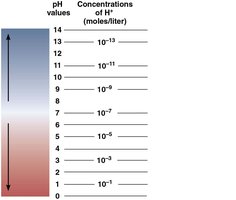
pH Scale and Biological Relevance
The pH scale is logarithmic; each unit change represents a tenfold change in hydrogen ion concentration. For example, a solution with pH 6 has ten times more H+ ions than a solution with pH 7.
Formula: The pH of a solution is calculated as:
Examples: Human blood (pH 7.4), stomach acid (pH 1-2), and household bleach (pH 13-14).
Regulation of pH in the Body
Buffers are crucial for maintaining pH balance. The main buffer in blood is the bicarbonate system:
Bicarbonate ions (HCO3-): Accept H+ when blood is too acidic.
Carbonic acid (H2CO3): Donates H+ when blood is too alkaline.
These reactions help keep blood pH within a narrow, healthy range.
Summary Table: Properties of Water and Their Biological Importance
Property | Biological Importance |
|---|---|
Solvent | Dissolves nutrients and waste for transport |
Liquid at body temperature | Facilitates circulation and chemical reactions |
Heat absorption | Regulates body temperature |
Participates in reactions | Essential for synthesis and breakdown of biomolecules |
Additional info: The above notes expand on the original lecture content with definitions, examples, and academic context to ensure a comprehensive understanding suitable for college-level biology students.
