 Back
The Structure and Function of Cells: Foundations of Life
Study Guide - Smart Notes
 Tailored notes based on your materials, expanded with key definitions, examples, and context.
Cell Theory
Foundational Principles of Biology
The cell theory is a central concept in biology, stating that all living things are composed of cells, the cell is the smallest unit exhibiting all characteristics of life, and all cells arise from preexisting cells. This theory underpins our understanding of biological structure and function.
All living organisms are made up of one or more cells.
The cell is the basic unit of structure and function in living things.
All cells arise only from preexisting cells by division.
Classification of Cells
Prokaryotic vs. Eukaryotic Cells
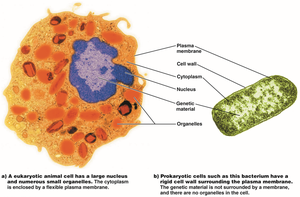
Cells are classified based on their internal organization into two main types: prokaryotic and eukaryotic cells. Both types possess a plasma membrane, but differ in complexity and compartmentalization.
Prokaryotic cells: Lack membrane-bound organelles and a nucleus; genetic material is free in the cytoplasm. Found in Bacteria and Archaea.
Eukaryotic cells: Have a nucleus and various membrane-bound organelles. Found in plants, animals, fungi, and protists.
Eukaryotic Cell Structure
Compartmentalization and Organelles
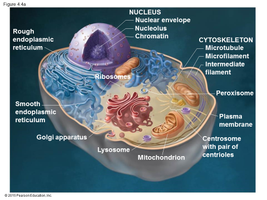
Eukaryotic cells are highly organized, with internal membranes dividing the cell into functional compartments called organelles. Each organelle performs specialized tasks essential for cell survival and function.
Nucleus: Contains genetic material (DNA) and controls cellular activities.
Cytoplasm: The region between the plasma membrane and nucleus, containing cytosol and organelles.
Organelles: Structures such as mitochondria, endoplasmic reticulum, Golgi apparatus, lysosomes, and peroxisomes.
Prokaryotic Cell Structure
Simplicity and Efficiency
Prokaryotic cells are structurally simpler than eukaryotic cells. They lack a nucleus and membrane-bound organelles, but still carry out all necessary life functions.
Plasma membrane: Encloses the cell and regulates movement of substances.
Cell wall: Provides structural support and protection.
Cytoplasm: Contains enzymes and genetic material.
Genetic material: Located in a region called the nucleoid, not surrounded by a membrane.
Cell Structure Reflects Function
Specialization in Multicellular Organisms
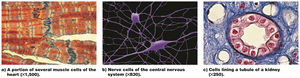
Although eukaryotic cells share many features, their structure varies according to their specialized functions. For example, muscle cells contain many mitochondria for energy, while nerve cells are elongated for signal transmission.
Muscle cells: Abundant mitochondria for contraction energy.
Nerve cells: Long extensions for transmitting impulses.
Kidney tubule cells: Specialized for absorption and secretion.
Cell Size and Efficiency
Surface Area-to-Volume Ratio
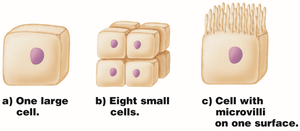
Cells remain small to maximize efficiency in nutrient uptake and waste removal. As a cell grows, its volume increases faster than its surface area, reducing efficiency. Microvilli increase surface area for absorption.
High surface-to-volume ratio: Promotes efficient exchange of materials.
Microvilli: Projections that further increase surface area.
Visualizing Cells
Microscopy Techniques
Cells are too small to be seen with the naked eye. Microscopes are essential tools for studying cell structure and function.
Light microscope: Can view living cells, magnifies up to ~1000x.
Transmission electron microscope (TEM): Reveals internal structures, magnifies up to 100,000x or more.
Scanning electron microscope (SEM): Provides 3D images of cell surfaces.
Internal Structures and Their Functions
Major Organelles and Their Roles
Nucleus: Information center, contains DNA, controls cell activities.
Ribosomes: Sites of protein synthesis; can be free in cytoplasm or bound to rough ER.
Endoplasmic reticulum (ER): Rough ER synthesizes proteins; smooth ER synthesizes lipids and detoxifies chemicals.
Golgi apparatus: Refines, packages, and ships cellular products.
Vesicles: Membrane-bound containers for storage and transport (e.g., lysosomes, peroxisomes).
Mitochondria: Site of cellular respiration, produces ATP (energy).
Cytoskeleton: Provides structural support, enables movement (microtubules, microfilaments).
Cilia and flagella: Specialized for movement.
Centrioles: Important in cell division.
The Plasma Membrane
Structure and Function
The plasma membrane separates the cell from its environment and regulates the movement of substances. It is selectively permeable and composed of a phospholipid bilayer with embedded proteins and cholesterol.
Phospholipid bilayer: Hydrophilic heads face outward, hydrophobic tails face inward.
Proteins: Serve as channels, transporters, and receptors.
Cholesterol: Adds mechanical strength and flexibility.
Fluid mosaic model: Components drift laterally, allowing flexibility.
Transport Across the Plasma Membrane
Passive and Active Mechanisms
Cells use various mechanisms to move substances across the plasma membrane, including passive and active transport.
Passive transport: Does not require energy; includes diffusion, osmosis, and facilitated diffusion.
Active transport: Requires energy (ATP); moves substances against their concentration gradient (e.g., sodium-potassium pump).
Bulk transport: Endocytosis and exocytosis move large molecules via vesicles.
Diffusion and Osmosis
Diffusion: Movement of molecules from high to low concentration until equilibrium is reached.
Osmosis: Diffusion of water across a selectively permeable membrane from low to high solute concentration.
Osmotic pressure: Pressure required to prevent osmosis.
Facilitated and Active Transport
Facilitated diffusion: Transport proteins help move specific molecules across the membrane.
Active transport: Transport proteins (pumps) move substances against their gradient using ATP.
Example equation (sodium-potassium pump):
Cell Volume and Tonicity
Isotonic, Hypertonic, and Hypotonic Solutions
The relative concentration of solutes inside and outside the cell (tonicity) affects cell volume and function.
Isotonic: Equal solute concentrations; cell volume remains stable.
Hypertonic: Higher solute concentration outside; cell loses water and shrinks.
Hypotonic: Lower solute concentration outside; cell gains water and may burst.
Summary Table: Comparison of Prokaryotic and Eukaryotic Cells
Feature | Prokaryotic Cells | Eukaryotic Cells |
|---|---|---|
Nucleus | Absent | Present |
Membrane-bound organelles | Absent | Present |
Cell size | Generally smaller | Generally larger |
Domains | Bacteria, Archaea | Eukarya (plants, animals, fungi, protists) |
Key Terms
Organelle: Specialized structure within a cell that performs a specific function.
Cytosol: The fluid portion of the cytoplasm.
Selective permeability: Property of the plasma membrane that allows some substances to cross more easily than others.
ATP (adenosine triphosphate): Main energy currency of the cell.
Tonicity: The ability of a surrounding solution to cause a cell to gain or lose water.
