 Back
The Structure and Function of Large Biological Molecules: Carbohydrates
Study Guide - Smart Notes
 Tailored notes based on your materials, expanded with key definitions, examples, and context.
Macromolecules: Polymers and Monomers
Definition and Overview
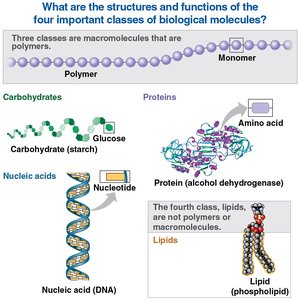
Macromolecules are large, complex molecules essential for life, including carbohydrates, proteins, and nucleic acids. These macromolecules are polymers, which are long chains made from repeating units called monomers, connected by covalent bonds. Lipids, while important biological molecules, are not polymers.
Polymer: A long molecule consisting of many similar or identical monomers linked together.
Monomer: The basic building block of a polymer; small molecules that can join together to form larger structures.
Examples: Glucose (monomer of starch), amino acids (monomers of proteins), nucleotides (monomers of nucleic acids).
Synthesis and Breakdown of Polymers
Dehydration and Hydrolysis Reactions
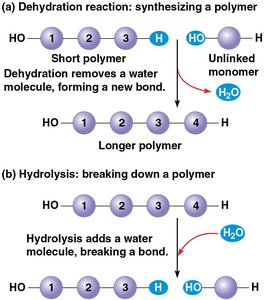
Cells assemble and disassemble polymers using two main chemical reactions: dehydration synthesis and hydrolysis. These reactions are catalyzed by enzymes, which speed up the process.
Dehydration Reaction: Joins monomers by removing a water molecule, forming a covalent bond. Energy is required for this process.
Hydrolysis Reaction: Breaks polymers into monomers by adding a water molecule, releasing energy.
Example: Digestion involves hydrolysis to break down food polymers into monomers.
Carbohydrates: Structure and Function
Types of Carbohydrates
Carbohydrates are organic molecules that serve as fuel and building material. They include simple sugars (monosaccharides), double sugars (disaccharides), and complex carbohydrates (polysaccharides).
Monosaccharides: The simplest carbohydrates, also known as simple sugars (e.g., glucose, fructose, ribose).
Disaccharides: Formed by joining two monosaccharides via a glycosidic bond (e.g., maltose, sucrose, lactose).
Polysaccharides: Polymers of many monosaccharides, serving storage or structural functions (e.g., starch, glycogen, cellulose, chitin).
Monosaccharides: Structure and Classification
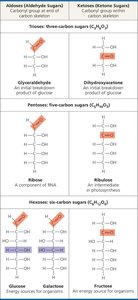
Monosaccharides have the general formula and are classified by the location of their carbonyl group (aldose or ketose) and the number of carbon atoms (triose, pentose, hexose).
Functional Groups: Carbonyl group (>C=O) and multiple hydroxyl groups (–OH).
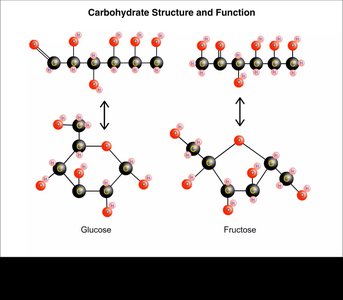
Isomers: Monosaccharides can have the same formula but different structures (e.g., glucose and galactose).
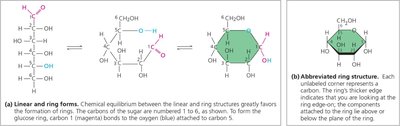
Ring Formation: Most sugars form rings in aqueous solution.
Disaccharides: Formation and Examples
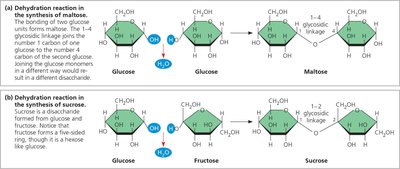
Disaccharides are formed by a dehydration reaction between two monosaccharides, resulting in a glycosidic linkage. Common examples include maltose, sucrose, and lactose.
Maltose: Two glucose molecules joined by a 1–4 glycosidic bond.
Sucrose: Glucose and fructose joined by a 1–2 glycosidic bond.
Lactose: Glucose and galactose joined by a glycosidic bond.
Polysaccharides: Storage and Structural Functions
Polysaccharides are large polymers of monosaccharides, serving as energy storage or structural support. Their function depends on the types of monomers and the linkages between them.
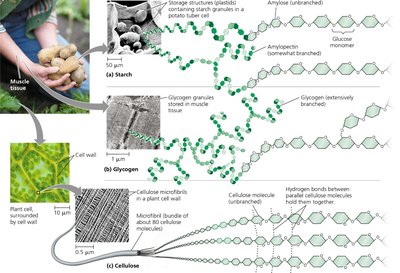
Starch: Storage polysaccharide in plants, composed of glucose monomers. Exists as amylose (unbranched) and amylopectin (branched).
Glycogen: Storage polysaccharide in animals, highly branched, stored in liver and muscles.
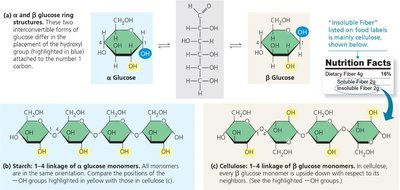
Cellulose: Structural polysaccharide in plant cell walls, composed of β-glucose monomers, forming straight, unbranched chains.
Chitin: Structural polysaccharide in arthropod exoskeletons and fungal cell walls, similar to cellulose but with nitrogen-containing appendages.
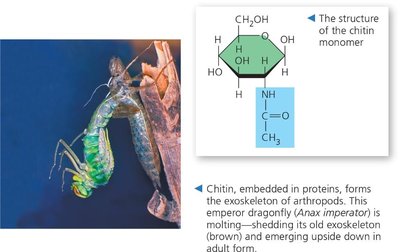
Comparison of Storage and Structural Polysaccharides
The properties and digestibility of polysaccharides depend on their structure and the type of glycosidic linkages.
Polysaccharide | Monomer | Linkage | Function | Branching | Digestibility |
|---|---|---|---|---|---|
Starch (Amylose) | α-glucose | 1–4 | Storage (plants) | Unbranched | Digestible by humans |
Starch (Amylopectin) | α-glucose | 1–4, 1–6 | Storage (plants) | Branched | Digestible by humans |
Glycogen | α-glucose | 1–4, 1–6 | Storage (animals) | Highly branched | Digestible by humans |
Cellulose | β-glucose | 1–4 | Structure (plants) | Unbranched | Not digestible by humans |
Chitin | Glucose (with N appendage) | β-1–4 | Structure (arthropods, fungi) | Unbranched | Not digestible by humans |
Key Terms and Concepts
Glycosidic Linkage: Covalent bond joining two monosaccharides.
Dehydration Reaction: Removes water to join monomers.
Hydrolysis: Adds water to break polymers into monomers.
Monosaccharide: Simple sugar, basic unit of carbohydrates.
Disaccharide: Two monosaccharides joined by glycosidic bond.
Polysaccharide: Polymer of many monosaccharides.
Starch: Plant storage polysaccharide.
Glycogen: Animal storage polysaccharide.
Cellulose: Plant structural polysaccharide.
Chitin: Structural polysaccharide in arthropods and fungi.
Sample Exam Questions
Polymers are made of monomer subunits joined by covalent bonds.
Monomers are joined together to form polymers by dehydration reaction.
Polymers are broken down to form monomers by hydrolysis reaction.
Energy is required in dehydration reaction; energy is released in hydrolysis reaction.
The bond that joins two monosaccharides is a glycosidic bond.
Lactose is a disaccharide.
A polysaccharide containing unbranched β glucose molecules and not digestible by humans is cellulose.
The most highly branched polysaccharide is glycogen.
The nitrogen-containing polysaccharide is chitin.
The unbranched form of starch is amylose.
