 Back
The Structure and Function of Large Biological Molecules
Study Guide - Smart Notes
 Tailored notes based on your materials, expanded with key definitions, examples, and context.
The Structure and Function of Large Biological Molecules
Introduction to Macromolecules
Large biological molecules, or macromolecules, are essential for life and include carbohydrates, proteins, nucleic acids, and lipids. Most macromolecules are polymers, long chains built from repeating units called monomers. The diversity of life arises from the arrangement of a small set of universal monomers into complex polymers.
Polymer: A long molecule consisting of many similar or identical building blocks (monomers) linked by covalent bonds.
Monomer: The repeating unit that serves as the building block of a polymer.
Three of the four classes of biological molecules—carbohydrates, proteins, and nucleic acids—are true polymers; lipids are not.
Polymer Synthesis and Breakdown
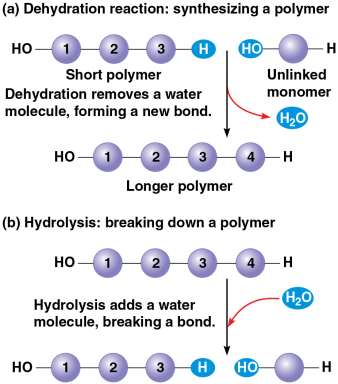
Cells assemble and disassemble polymers through dehydration and hydrolysis reactions, processes managed by enzymes.
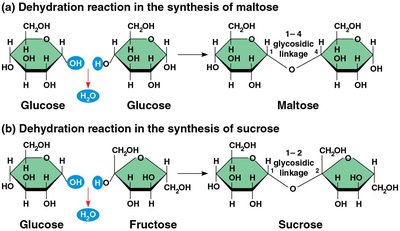
Dehydration Reaction: Monomers are joined by the removal of a water molecule, forming a new covalent bond.
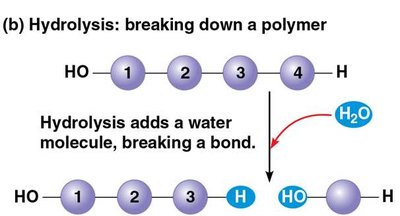
Hydrolysis: Polymers are broken down by the addition of a water molecule, breaking the covalent bond between monomers.
Carbohydrates
Structure and Function of Carbohydrates
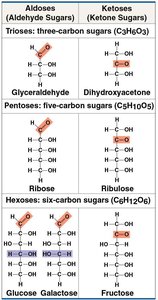
Carbohydrates serve as immediate fuel for cells and as structural materials. They are composed of monosaccharides (simple sugars), disaccharides, and polysaccharides.
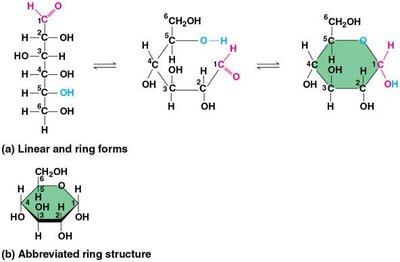
Monosaccharides: The simplest carbohydrates, typically with the formula (e.g., glucose, C6H12O6).
Disaccharides: Two monosaccharides joined by a glycosidic linkage (e.g., sucrose, maltose).
Polysaccharides: Polymers of many monosaccharides, serving storage (starch, glycogen) or structural (cellulose, chitin) roles.
Glycosidic Linkages and Disaccharide Synthesis
Monosaccharides are joined by dehydration reactions to form disaccharides and polysaccharides. The covalent bond formed is called a glycosidic linkage.
Glycosidic Linkage: A covalent bond formed between two monosaccharides by a dehydration reaction.
Storage Polysaccharides: Starch and Glycogen
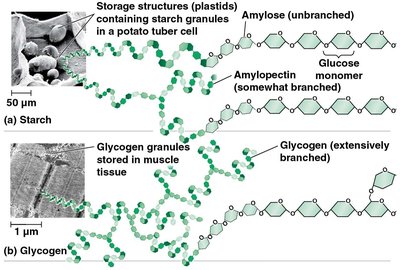
Plants and animals store energy in polysaccharides. Plants use starch, while animals use glycogen.
Starch: A storage polysaccharide in plants, composed of α-glucose monomers, often helical and unbranched or slightly branched.
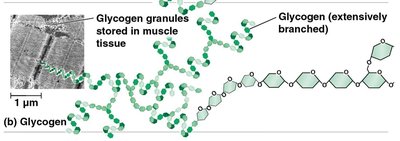
Glycogen: A highly branched storage polysaccharide in animals, stored mainly in liver and muscle cells for rapid energy release.
Structural Polysaccharides: Cellulose and Chitin
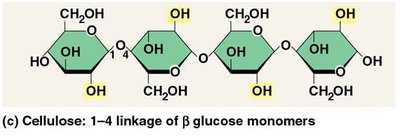
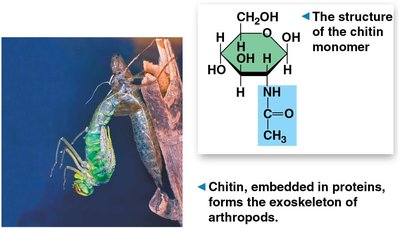
Some polysaccharides serve structural roles. Cellulose forms plant cell walls, while chitin is found in arthropod exoskeletons and fungal cell walls.
Cellulose: A polymer of β-glucose monomers, forming straight, unbranched fibers that resist digestion by most animals.
Chitin: A structural polysaccharide with nitrogen-containing groups, providing strength and flexibility to arthropod exoskeletons and fungal cell walls.
Lipids
Structure and Properties of Lipids
Lipids are hydrophobic molecules that include fats, phospholipids, and steroids. They are not true polymers but are essential for energy storage, membrane structure, and signaling.
Fats (Triacylglycerols): Composed of three fatty acids linked to glycerol by ester bonds, serving as concentrated energy reserves.
Phospholipids: Amphipathic molecules with hydrophilic heads and hydrophobic tails, forming the basis of cellular membranes.
Steroids: Lipids with a structure of four fused rings, such as cholesterol, which regulates membrane fluidity and serves as a hormone precursor.
Saturated vs. Unsaturated Fats
The presence or absence of double bonds in fatty acid chains determines whether a fat is solid or liquid at room temperature.
Saturated Fats: No double bonds, straight chains, solid at room temperature.
Unsaturated Fats: One or more cis double bonds, kinked chains, liquid at room temperature.
Biological Roles of Lipids
Energy Storage: Fats store twice as much energy as polysaccharides.
Membrane Structure: Phospholipids form bilayers, creating selective barriers for cells.
Signaling: Steroids like cholesterol are precursors for hormones and regulate membrane properties.
Proteins
Structure of Proteins
Proteins are polymers of amino acids, folded into complex three-dimensional shapes that determine their function. There are four levels of protein structure:
Primary Structure: The unique sequence of amino acids in a polypeptide chain.
Secondary Structure: Local folding into α-helices and β-sheets stabilized by hydrogen bonds.
Tertiary Structure: The overall 3D shape stabilized by interactions among R groups (side chains).
Quaternary Structure: The assembly of multiple polypeptide subunits into a functional protein.
Protein Folding and Denaturation
The specific folding of a protein is crucial for its function. Environmental changes such as temperature or pH can cause denaturation, leading to loss of function.
Denaturation: The loss of a protein's native structure due to disruption of weak bonds, resulting in loss of biological activity.
Renaturation: The process by which some proteins can regain their native structure if the denaturing agent is removed.
Protein Function
Proteins perform a vast array of functions in the cell, including catalysis, defense, storage, transport, signaling, movement, and structural support.
Enzymatic Proteins: Accelerate chemical reactions (e.g., digestive enzymes).
Defensive Proteins: Protect against disease (e.g., antibodies).
Storage Proteins: Store amino acids (e.g., ovalbumin in egg white).
Transport Proteins: Transport substances (e.g., hemoglobin).
Hormonal Proteins: Coordinate organismal responses (e.g., insulin).
Receptor Proteins: Respond to chemical stimuli.
Contractile and Motor Proteins: Movement (e.g., actin, myosin).
Structural Proteins: Support (e.g., collagen, keratin).
Nucleic Acids
Structure and Function of Nucleic Acids
Nucleic acids store and transmit hereditary information. The two types are DNA (deoxyribonucleic acid) and RNA (ribonucleic acid).
Nucleotide: The monomer of nucleic acids, consisting of a nitrogenous base, a pentose sugar, and a phosphate group.
DNA: Stores genetic information; double-stranded helix with complementary base pairing (A-T, G-C).
RNA: Functions in gene expression; usually single-stranded and can fold into complex shapes.
Information Flow: The Central Dogma
Biological information flows from DNA to RNA to protein. This process is known as the central dogma of molecular biology.
Replication: DNA copies itself for cell division.
Transcription: DNA is transcribed into messenger RNA (mRNA).
Translation: mRNA is translated into a polypeptide (protein) by ribosomes.
Bioinformatics
Computational Analysis of Biological Data
Bioinformatics uses computational tools to analyze large datasets of DNA and protein sequences, revealing patterns and evolutionary relationships that are not detectable manually.
Genomics: Study of whole sets of genes and their interactions.
Proteomics: Study of entire sets of proteins and their properties.
Molecular Genealogy: Comparing DNA/protein sequences to infer evolutionary relationships.
Summary Table: Major Classes of Biological Molecules
Class | Monomer | Polymer | Bond Type | Main Functions |
|---|---|---|---|---|
Carbohydrates | Monosaccharide | Polysaccharide | Glycosidic linkage | Energy storage, structure |
Proteins | Amino acid | Polypeptide | Peptide bond | Catalysis, structure, transport, signaling |
Nucleic Acids | Nucleotide | Polynucleotide | Phosphodiester bond | Information storage, transmission |
Lipids | Fatty acid, glycerol | Not true polymers | Ester linkage | Energy storage, membranes, signaling |
