 Back
The Structure and Function of Large Biological Molecules
Study Guide - Smart Notes
 Tailored notes based on your materials, expanded with key definitions, examples, and context.
The Structure and Function of Large Biological Molecules
Macromolecules and Polymers
Large biological molecules, or macromolecules, are essential to life and include carbohydrates, lipids, proteins, and nucleic acids. Most macromolecules are polymers, which are long chains made from repeating units called monomers. The diversity of polymers arises from the variety of monomers and their arrangements.
Polymer: A molecule composed of many similar or identical monomers linked together.
Monomer: The basic building block of a polymer.
Enzymes: Specialized proteins that catalyze the synthesis and breakdown of polymers.
Dehydration reaction: Joins monomers by removing a water molecule.
Hydrolysis reaction: Breaks polymers into monomers by adding water.
Carbohydrates: Structure and Function
Carbohydrates are molecules that include sugars and their polymers. They serve as fuel and building material in cells. The simplest carbohydrates are monosaccharides (simple sugars), while polysaccharides are complex carbohydrates made of many monosaccharide units.
Monosaccharides: Simple sugars, usually with the formula (CH2O)n. Example: glucose (C6H12O6).
Disaccharide: Formed by joining two monosaccharides via a glycosidic linkage.
Polysaccharides: Polymers of sugars with storage (e.g., starch, glycogen) or structural (e.g., cellulose, chitin) roles.
Structural Polysaccharides: Cellulose and Chitin
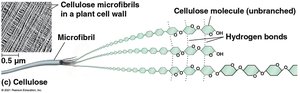
Cellulose is a major structural component of plant cell walls. It is a polymer of glucose, but its glycosidic linkages differ from those in starch, resulting in straight, unbranched molecules that form strong microfibrils. Chitin is another structural polysaccharide found in the exoskeletons of arthropods and fungal cell walls.
Cellulose: Composed of β-glucose monomers; forms microfibrils via hydrogen bonding.
Chitin: Similar to cellulose but contains nitrogen-containing side groups.
Lipids: Structure and Types
Lipids are hydrophobic molecules that do not form true polymers. They include fats, phospholipids, and steroids. Lipids are characterized by their poor solubility in water due to nonpolar hydrocarbon regions.
Fats: Composed of glycerol and fatty acids; function as energy storage.
Saturated fats: No double bonds; solid at room temperature.
Unsaturated fats: One or more double bonds; liquid at room temperature.
Phospholipids: Two fatty acids and a phosphate group; form cell membranes.
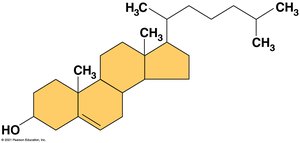
Steroids: Lipids with four fused rings; include cholesterol and hormones.
Proteins: Structure and Function
Proteins are polymers of amino acids and account for more than half the dry mass of most cells. They perform diverse functions, including catalysis, defense, transport, communication, movement, and structural support. The function of a protein depends on its three-dimensional structure, which is determined by its amino acid sequence.
Amino acids: Organic molecules with amino and carboxyl groups; differ by their R group.
Polypeptide: A polymer of amino acids linked by peptide bonds.
Protein: One or more polypeptides folded into a functional shape.
Levels of Protein Structure
Proteins have four levels of structure:
Primary structure: Sequence of amino acids.
Secondary structure: Coils (α helix) and folds (β pleated sheet) formed by hydrogen bonds.
Tertiary structure: Overall shape due to interactions among R groups.
Quaternary structure: Association of multiple polypeptide chains.

Protein Denaturation
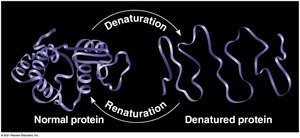
Protein structure can be affected by environmental conditions such as pH, salt concentration, and temperature. Denaturation is the loss of a protein's native structure, rendering it inactive. Some proteins can regain their structure through renaturation.
Nucleic Acids: DNA and RNA
Nucleic acids store, transmit, and help express hereditary information. The two types are DNA (deoxyribonucleic acid) and RNA (ribonucleic acid). DNA directs its own replication and the synthesis of RNA, which in turn guides protein synthesis.
Nucleotide: Monomer of nucleic acids; consists of a nitrogenous base, a pentose sugar, and phosphate group.
Pyrimidines: Single-ring bases (cytosine, thymine, uracil).
Purines: Double-ring bases (adenine, guanine).
DNA: Double helix; antiparallel strands; base pairing (A-T, G-C).
RNA: Single-stranded; uses uracil instead of thymine.
Summary Table: Biological Macromolecules
Class | Monomer | Polymer | Main Functions |
|---|---|---|---|
Carbohydrates | Monosaccharide | Polysaccharide | Energy, structure |
Lipids | Fatty acid, glycerol | Triacylglycerol, phospholipid, steroid | Energy storage, membranes, hormones |
Proteins | Amino acid | Polypeptide | Catalysis, structure, transport, signaling |
Nucleic Acids | Nucleotide | DNA, RNA | Information storage and transfer |
Key Equations
General formula for monosaccharides:
Formation of peptide bond:
