 Back
The Structure and Function of Large Biological Molecules: Carbohydrates and Lipids
Study Guide - Smart Notes
 Tailored notes based on your materials, expanded with key definitions, examples, and context.
The Molecules of Life
Introduction to Biological Molecules
All living organisms are composed of four major classes of large biological molecules: carbohydrates, lipids, proteins, and nucleic acids. These molecules are essential for life and have unique properties due to the specific arrangement of their atoms.
Macromolecules are large, complex molecules.
The unique properties of macromolecules arise from their orderly atomic arrangement.
Macromolecules: Polymers Built from Monomers
Polymers and Monomers
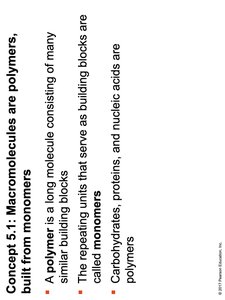
Most macromolecules are polymers, which are long molecules made up of repeating units called monomers. Carbohydrates, proteins, and nucleic acids are all polymers, while lipids are not true polymers.
Polymer: A long molecule consisting of many similar or identical building blocks linked by covalent bonds.
Monomer: The repeating units that serve as the building blocks of a polymer.
The Synthesis and Breakdown of Polymers
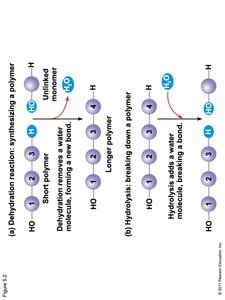
Polymers are synthesized and broken down by specific chemical reactions, often catalyzed by enzymes.
Enzymes are specialized macromolecules that speed up chemical reactions.
Dehydration reaction: Two monomers bond together through the loss of a water molecule.
Hydrolysis: Polymers are disassembled to monomers by the addition of water, essentially the reverse of dehydration.
Diversity of Polymers
Cells contain thousands of different macromolecules, which vary among cells, species, and even more between species. A huge variety of polymers can be built from a small set of monomers.
Macromolecules vary within and between species.
Polymer diversity arises from different arrangements of a limited set of monomers.
Carbohydrates: Fuel and Building Material
Overview of Carbohydrates
Carbohydrates include sugars and polymers of sugars. The simplest carbohydrates are monosaccharides, while carbohydrate macromolecules are polysaccharides, polymers composed of many sugar building blocks.
Carbohydrates serve as fuel and building material for cells.
Monosaccharides (Simple Sugars)
Monosaccharides have molecular formulas that are usually multiples of CH2O. Glucose (C6H12O6) is the most common monosaccharide. They are classified by the location of the carbonyl group (as aldose or ketose) and the number of carbons in the skeleton.
Serve as major fuel for cells and as raw material for building molecules.
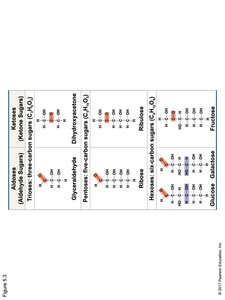
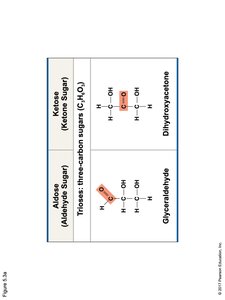
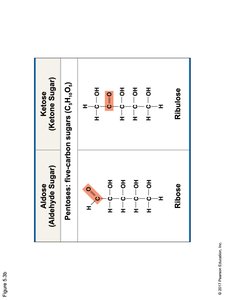
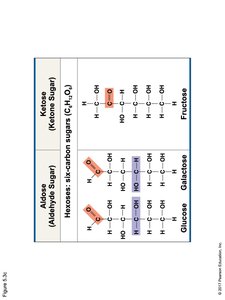
Linear and Ring Forms of Sugars
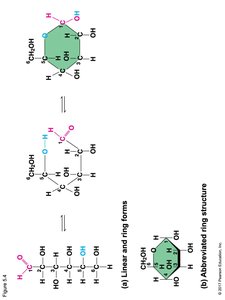
In aqueous solutions, many sugars form rings, which is the prevalent form in cells.
Disaccharides
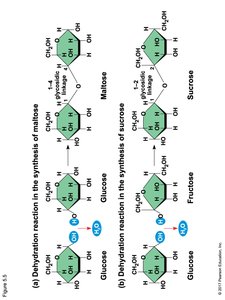
A disaccharide is formed when a dehydration reaction joins two monosaccharides. The covalent bond formed is called a glycosidic linkage.
Polysaccharides
Polysaccharides are polymers of sugars and serve storage and structural roles. Their function is determined by their sugar monomers and the positions of glycosidic linkages.
Storage Polysaccharides
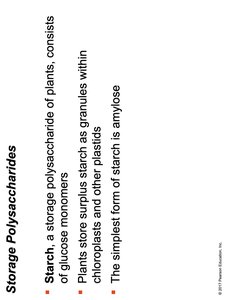
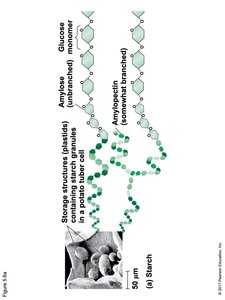
Starch is a storage polysaccharide in plants, consisting of glucose monomers. Plants store surplus starch as granules within chloroplasts and other plastids. The simplest form of starch is amylose.
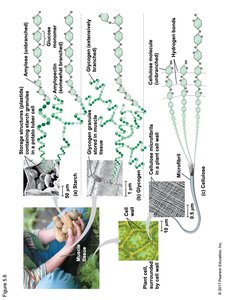
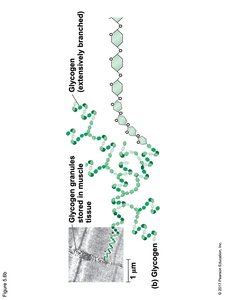
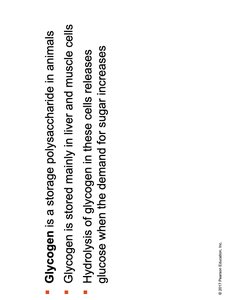
Glycogen is a storage polysaccharide in animals, stored mainly in liver and muscle cells. Hydrolysis of glycogen releases glucose when the demand for sugar increases.
Structural Polysaccharides
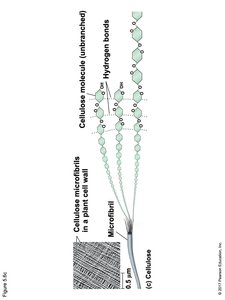
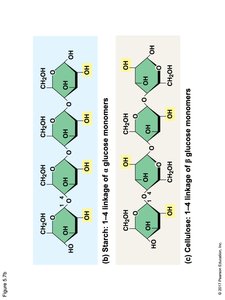
Cellulose is a major component of the tough wall of plant cells. Like starch, cellulose is a polymer of glucose, but the glycosidic linkages differ. The difference is based on two ring forms for glucose: alpha (α) and beta (β).
Starch (α configuration) is largely helical.
Cellulose molecules (β configuration) are straight and unbranched.
Some hydroxyl groups on cellulose can hydrogen-bond with parallel cellulose molecules.
Enzymes that digest starch by hydrolyzing α linkages cannot hydrolyze β linkages in cellulose. Cellulose in human food passes through the digestive tract as "insoluble fiber." Some microbes use enzymes to digest cellulose, and many herbivores have symbiotic relationships with these microbes.
Chitin
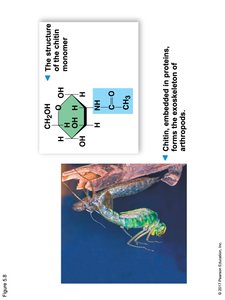
Chitin is another structural polysaccharide, found in the exoskeleton of arthropods and providing structural support for the cell walls of many fungi.
Lipids: A Diverse Group of Hydrophobic Molecules
Overview of Lipids
Lipids are the one class of large biological molecules that do not include true polymers. The unifying feature of lipids is that they mix poorly, if at all, with water due to their hydrophobic hydrocarbon regions. The most biologically important lipids are fats, phospholipids, and steroids.
Fats
Fats are constructed from two types of smaller molecules: glycerol and fatty acids.
Glycerol: A three-carbon alcohol with a hydroxyl group attached to each carbon.
Fatty acid: Consists of a carboxyl group attached to a long carbon skeleton.
In a fat, three fatty acids are joined to glycerol by an ester linkage, creating a triacylglycerol or triglyceride. The fatty acids in a fat can be all the same or of two or three different kinds.
Saturated and Unsaturated Fatty Acids
Fatty acids vary in length and in the number and locations of double bonds.
Saturated fatty acids: Have the maximum number of hydrogen atoms possible and no double bonds.
Unsaturated fatty acids: Have one or more double bonds.
Saturated fats are typically solid at room temperature (e.g., butter), while unsaturated fats are liquid (e.g., olive oil). The presence of double bonds causes kinks in the fatty acid chains, preventing tight packing.
*Additional info: The notes above are expanded with academic context to ensure completeness and clarity for college-level General Biology students. All images included are directly relevant to the adjacent explanations and reinforce the concepts discussed.*
