 Back
The Structure and Function of Large Biological Molecules (Carbohydrates Focus)
Study Guide - Smart Notes
 Tailored notes based on your materials, expanded with key definitions, examples, and context.
Macromolecules: Polymers and Monomers
Overview of Biological Macromolecules
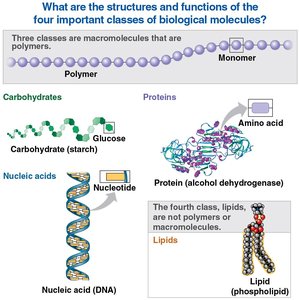
Biological macromolecules are large, complex molecules essential for life. Three of the four major classes—carbohydrates, proteins, and nucleic acids—are polymers, which are long chains of repeating units called monomers. Lipids, while crucial, are not true polymers.
Polymer: A long molecule consisting of many similar or identical building blocks (monomers) linked by covalent bonds.
Monomer: The small, repeating unit that serves as the building block of a polymer.
Examples: Carbohydrates (monomer: monosaccharide), Proteins (monomer: amino acid), Nucleic acids (monomer: nucleotide).
Synthesis and Breakdown of Polymers
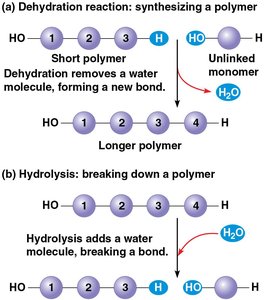
Cells assemble and disassemble polymers using similar chemical mechanisms, primarily involving dehydration and hydrolysis reactions. These processes are catalyzed by enzymes, which speed up chemical reactions in cells.
Dehydration Reaction: Monomers are joined together by covalent bonds through the removal of a water molecule. This process requires energy.
Hydrolysis: Polymers are broken down into monomers by the addition of a water molecule, releasing energy.
Enzymes: Specialized macromolecules that catalyze both dehydration and hydrolysis reactions.
Carbohydrates: Structure and Function
Classification and Structure of Carbohydrates
Carbohydrates are organic molecules that serve as fuel and building material. They include simple sugars (monosaccharides), double sugars (disaccharides), and complex sugars (polysaccharides).
Monosaccharides: The simplest carbohydrates, also known as simple sugars (e.g., glucose, fructose, ribose).
Disaccharides: Consist of two monosaccharides joined by a glycosidic bond (e.g., sucrose, lactose, maltose).
Polysaccharides: Polymers of many monosaccharides, serving storage or structural roles (e.g., starch, glycogen, cellulose, chitin).
Monosaccharides: Structure and Classification
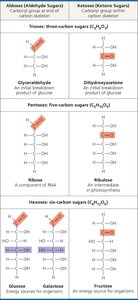
Monosaccharides have molecular formulas that are multiples of CH2O. They are classified by the location of their carbonyl group (aldose or ketose) and the length of their carbon skeleton (triose, pentose, hexose).
Functional Groups: Carbonyl group (>C=O) and multiple hydroxyl groups (–OH).
Classification by Carbonyl Location: Aldose (aldehyde sugar) or Ketose (ketone sugar).
Classification by Carbon Number: Trioses (3C), Pentoses (5C), Hexoses (6C).
Isomerism: Monosaccharides can have structural isomers (e.g., glucose and galactose).
Ring Structures of Sugars
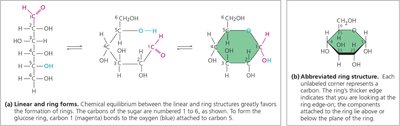
Although often drawn as linear chains, most monosaccharides (such as glucose) form ring structures in aqueous solutions. This ring formation is crucial for their biological function.
Disaccharides: Formation and Examples
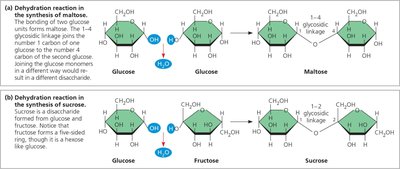
Disaccharides are formed when two monosaccharides are joined by a dehydration reaction, creating a covalent glycosidic linkage. Common examples include:
Maltose: Glucose + Glucose
Sucrose: Glucose + Fructose
Lactose: Glucose + Galactose
Polysaccharides: Storage and Structural Roles
Polysaccharides are large polymers of monosaccharides. Their function depends on the type of monomer and the glycosidic linkages present.
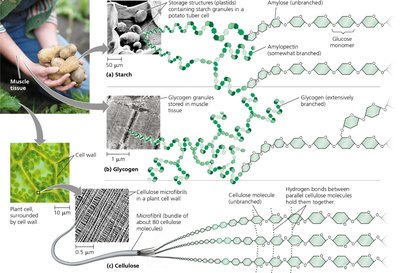
Storage Polysaccharides: Starch (plants) and glycogen (animals) store energy. Starch is composed of amylose (unbranched) and amylopectin (branched). Glycogen is highly branched and stored in liver and muscle cells.
Structural Polysaccharides: Cellulose (plant cell walls) and chitin (exoskeletons of arthropods, fungal cell walls) provide structural support.
Starch vs. Cellulose: Structural Differences
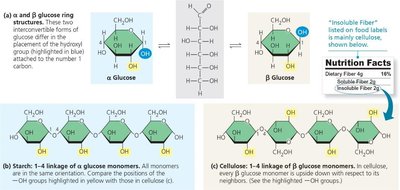
Both starch and cellulose are polymers of glucose, but they differ in the type of glucose and the glycosidic linkages:
Starch: Composed of α-glucose monomers, forming a helical structure. Digestible by humans.
Cellulose: Composed of β-glucose monomers, forming straight, unbranched fibers. Not digestible by humans due to different enzyme specificity.
Chitin: A Nitrogen-Containing Structural Polysaccharide
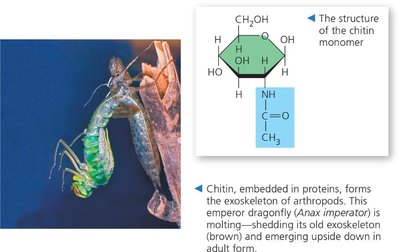
Chitin is similar to cellulose but has a nitrogen-containing appendage on each glucose monomer. It is found in the exoskeletons of arthropods and in fungal cell walls, providing both flexibility and strength.
Summary Table: Major Polysaccharides
Polysaccharide | Monomer | Linkage | Function | Occurrence |
|---|---|---|---|---|
Starch (Amylose/Amylopectin) | α-glucose | α 1–4 (amylose), α 1–6 (amylopectin branches) | Energy storage | Plants |
Glycogen | α-glucose | α 1–4, α 1–6 (highly branched) | Energy storage | Animals (liver, muscle) |
Cellulose | β-glucose | β 1–4 | Structural support | Plant cell walls |
Chitin | Modified β-glucose (with N-acetyl group) | β 1–4 | Structural support | Arthropod exoskeletons, fungi |
Key Equations
General formula for monosaccharides:
Dehydration reaction (formation of a disaccharide):
Practice Questions
What type of bond joins monomers in a polymer? Answer: Covalent bond
What reaction joins two monosaccharides? Answer: Dehydration reaction
Which polysaccharide is composed of unbranched β-glucose and is indigestible by humans? Answer: Cellulose
Which polysaccharide is most highly branched? Answer: Glycogen
Which polysaccharide contains nitrogen? Answer: Chitin
