 Back
The Structure and Function of Large Biological Molecules
Study Guide - Smart Notes
 Tailored notes based on your materials, expanded with key definitions, examples, and context.
Chapter 5: The Structure and Function of Large Biological Molecules
Introduction
This chapter explores the four major classes of biological macromolecules—carbohydrates, lipids, proteins, and nucleic acids—focusing on their structure, synthesis, and function in living organisms. Understanding these molecules is fundamental to the study of biology, as they are essential for life’s processes.
Macromolecules and Polymers
Polymers and Monomers
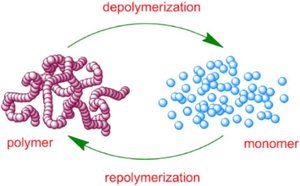
Most biological macromolecules are polymers, long chains composed of repeating subunits called monomers. The diversity of life arises from the arrangement of these monomers into unique polymers.
Polymerization: The process of linking monomers to form a polymer.
Depolymerization: The breakdown of polymers into monomers.
Polymer Synthesis and Breakdown
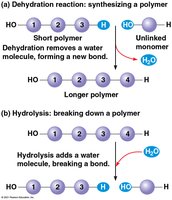
Polymers are synthesized and broken down by specific chemical reactions:
Dehydration Synthesis (Condensation Reaction): Monomers are joined by covalent bonds through the removal of a water molecule.
Hydrolysis: Polymers are disassembled into monomers by the addition of water, breaking the covalent bonds.
Types of Biological Macromolecules
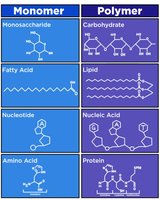
The four main classes of biological macromolecules are:
Carbohydrates
Lipids
Proteins
Nucleic Acids
Carbohydrates
Monosaccharides: Simple Sugars
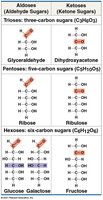
Monosaccharides are the simplest carbohydrates, generally following the formula (CH2O)n. They serve as the building blocks for more complex carbohydrates.
Common examples: Glucose, Fructose, Galactose
Classified by the number of carbons and the location of the carbonyl group (aldose or ketose).
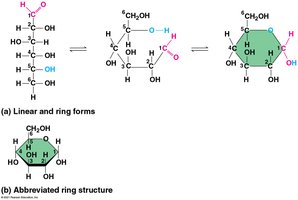
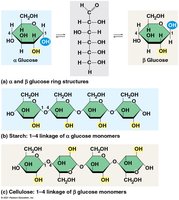
Ring Structures of Monosaccharides
Monosaccharides often form ring structures in aqueous solutions, which are important for their biological function.
Disaccharides and Glycosidic Bonds
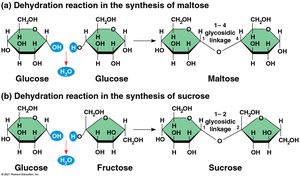
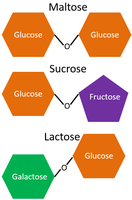
Disaccharides are formed when two monosaccharides are joined by a glycosidic bond through dehydration synthesis. Examples include maltose, sucrose, and lactose.
Polysaccharides: Storage and Structural Carbohydrates
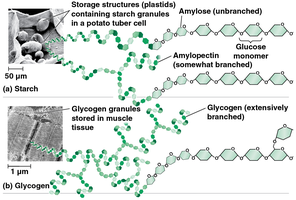
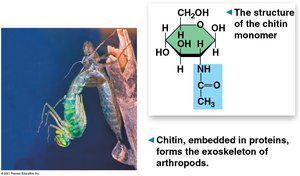
Polysaccharides are long chains of monosaccharide units. They serve as energy storage (e.g., starch in plants, glycogen in animals) or structural components (e.g., cellulose in plants, chitin in fungi and arthropods).
Starch: Composed of α-glucose; energy storage in plants.
Glycogen: Similar to starch but more branched; energy storage in animals.
Cellulose: Composed of β-glucose; structural component of plant cell walls.
Chitin: Contains N-acetylglucosamine; found in fungal cell walls and arthropod exoskeletons.
Lipids
General Properties
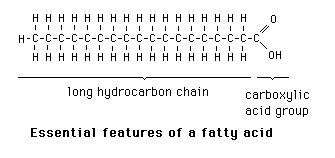
Lipids are a diverse group of hydrophobic molecules that are not true polymers. Their insolubility in water is due to their long hydrocarbon chains.
Major types: Fats (triglycerides), Phospholipids, Steroids
Fats (Triglycerides)
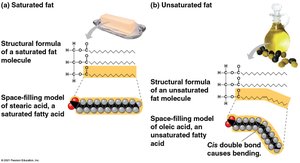
Fats are constructed from glycerol and three fatty acids, joined by ester linkages. They function as energy storage molecules.
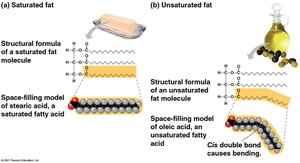
Saturated fats: No double bonds; usually solid at room temperature (animal fats).
Unsaturated fats: One or more double bonds; usually liquid at room temperature (plant oils).
Phospholipids
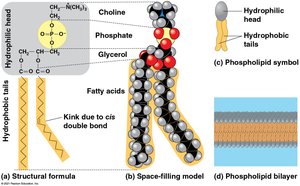
Phospholipids consist of two fatty acids, a glycerol, and a phosphate group. They are amphipathic, having both hydrophilic and hydrophobic regions, which is crucial for forming biological membranes.
Steroids
Steroids are characterized by a structure of four fused carbon rings. Cholesterol is a key steroid, serving as a component of cell membranes and a precursor for other steroids.
Proteins
Amino Acids and Peptide Bonds
Proteins are polymers of amino acids, linked by peptide bonds. There are 20 different amino acids, each with a unique side chain (R group) that determines its properties.
Primary structure: Linear sequence of amino acids.
Secondary structure: Local folding (α-helix, β-sheet) stabilized by hydrogen bonds.
Tertiary structure: Overall 3D shape due to interactions among R groups.
Quaternary structure: Association of multiple polypeptide subunits.
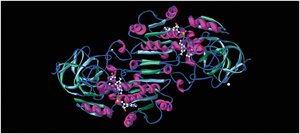
Protein Structure and Function
The function of a protein is directly related to its structure. Denaturation (loss of structure) can occur due to changes in temperature, pH, or chemical exposure, often resulting in loss of function.
Nucleic Acids
Structure and Function
Nucleic acids (DNA and RNA) store, transmit, and help express hereditary information. Their monomers are nucleotides, each composed of a pentose sugar, a nitrogenous base, and a phosphate group.
DNA: Double-stranded; stores genetic information.
RNA: Single-stranded; involved in protein synthesis and gene regulation.
Nucleotide Structure
Pyrimidines: Cytosine, Thymine (DNA), Uracil (RNA)
Purines: Adenine, Guanine
Nucleotides are joined by phosphodiester bonds.
Summary Table: Biological Macromolecules
Macromolecule | Monomer | Bond Type | Function |
|---|---|---|---|
Carbohydrate | Monosaccharide | Glycosidic linkage | Energy storage, structure |
Lipid | Fatty acid (not a true polymer) | Ester linkage | Energy storage, membranes, signaling |
Protein | Amino acid | Peptide bond | Catalysis, structure, transport, signaling |
Nucleic Acid | Nucleotide | Phosphodiester bond | Genetic information storage and transfer |
Key Equations
Dehydration Synthesis (General):
Hydrolysis (General):
Additional info: This guide expands on the provided notes with definitions, examples, and a summary table for clarity and exam preparation.
