 Back
The Structure and Function of Large Biological Molecules
Study Guide - Smart Notes
 Tailored notes based on your materials, expanded with key definitions, examples, and context.
Characteristics of Organic Compounds
Introduction to Organic Compounds
Organic compounds are molecules primarily composed of carbon atoms bonded with other elements such as hydrogen, oxygen, nitrogen, and sometimes phosphorus. The versatility of carbon allows for the formation of a vast array of complex molecules essential for life.
Carbon-carbon bonds are fundamental to the structure of all organic molecules.
Organic compounds can be very complex and are organized into five main groups: carbohydrates, lipids, proteins, nucleic acids, and ATP.
Functional groups are specific groups of atoms within molecules that determine the chemical properties and reactivity of those molecules.
Example: Glucose contains multiple hydroxyl (–OH) groups, which increase its solubility in water and enable hydrogen bonding, facilitating the formation of polysaccharide chains.
Key Terminology
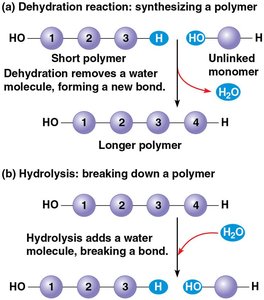
Monomer: A small molecule that can join with other similar molecules to form a polymer.
Polymer: A large molecule composed of repeating monomer units.
Hydrolysis: A chemical reaction that breaks bonds between monomers by adding water.
Dehydration synthesis: A reaction that forms a new bond between monomers by removing a water molecule.
Groups of Organic Compounds
Carbohydrates
Carbohydrates are organic molecules containing carbon, hydrogen, and oxygen, typically in a 1:2:1 ratio. They serve as energy sources and structural components in cells.
Monosaccharides: Simple sugars such as glucose and fructose; single-unit molecules.
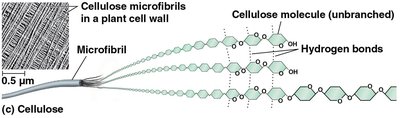
Polysaccharides: Large, complex carbohydrates like starch (energy storage in plants) and glycogen (energy storage in animals).
Carbohydrates are generally hydrophilic (soluble in water).
Lipids
Lipids are a diverse group of hydrophobic molecules composed mainly of carbon, hydrogen, and oxygen (sometimes phosphorus). They function as energy reserves, insulation, and key components of cell membranes.
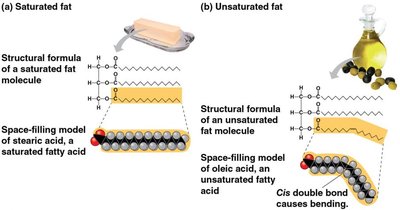
Triglycerides (fats and oils): Consist of one glycerol molecule bonded to three fatty acids.
Saturated fats: Fatty acids with no double bonds; typically solid at room temperature (e.g., butter).
Unsaturated fats: Fatty acids with one or more double bonds; usually liquid at room temperature (e.g., olive oil).
Phospholipids: Major components of cell membranes; have a hydrophilic phosphate head and two hydrophobic fatty acid tails, making them amphipathic.
Steroids: Lipids with a characteristic four-ring structure; include hormones like testosterone and estrogen, as well as cholesterol.
Other lipids: Leukotrienes and prostaglandins, which function as signaling molecules.
Proteins
Proteins are polymers of amino acids (monomers) linked by peptide bonds. They are essential for structure, function, and regulation of the body's tissues and organs.
Polypeptides: Chains of amino acids; the sequence determines the protein's structure and function.
Peptide bond: Covalent bond formed between amino acids.
The function of a protein depends on its three-dimensional shape.
Structural Organization of Proteins
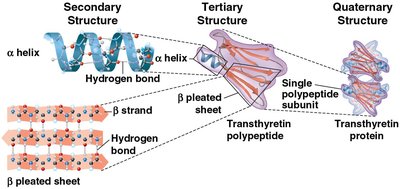
Primary structure: The unique sequence of amino acids in a polypeptide chain.
Secondary structure: Local folding into alpha-helices and beta-pleated sheets, stabilized by hydrogen bonds.
Tertiary structure: The overall three-dimensional shape of a single polypeptide chain.
Quaternary structure: The arrangement of multiple polypeptide subunits in a protein.
Protein denaturation: Loss of protein structure (and function) due to changes in temperature, pH, or other environmental factors.
Protein Functions
Enzymes: Catalyze biochemical reactions by lowering activation energy.
Support: Structural proteins provide support (e.g., collagen in connective tissues).
Transport: Transport proteins move substances across cell membranes (e.g., hemoglobin transports oxygen).
Defense: Antibodies are proteins that help defend against pathogens.
Regulation/Hormones: Some proteins act as hormones to regulate physiological processes.
Motion: Proteins like actin and myosin are involved in muscle contraction and movement.
Nucleic Acids
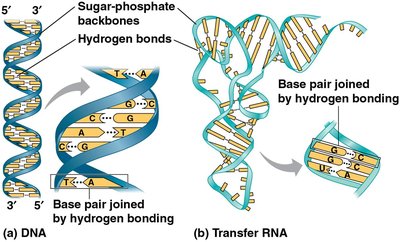
Nucleic acids, including DNA and RNA, store and transmit genetic information. They are polymers of nucleotides.
Nucleotide: The monomer of nucleic acids, consisting of a phosphate group, a five-carbon sugar (ribose or deoxyribose), and a nitrogenous base.
DNA (deoxyribonucleic acid): Contains the genetic code for all cellular functions.
RNA (ribonucleic acid): Involved in protein synthesis and gene regulation.
ATP (Adenosine Triphosphate)
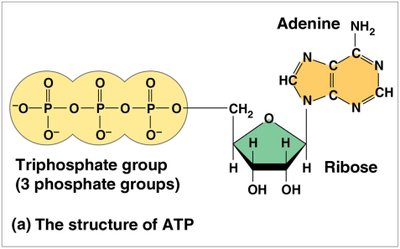
ATP is the primary energy carrier in cells. It consists of adenine, ribose, and three phosphate groups.
Structure: Adenine (a nitrogenous base), ribose (a five-carbon sugar), and three phosphate groups.
Function: ATP stores and transfers energy for cellular processes by releasing a phosphate group (hydrolysis of ATP to ADP).
Summary Table: Major Classes of Biological Molecules
Class | Elements | Monomer | Polymer | Main Functions |
|---|---|---|---|---|
Carbohydrates | C, H, O | Monosaccharide | Polysaccharide | Energy storage, structure |
Lipids | C, H, O (P) | Fatty acid, glycerol | Triglyceride, phospholipid, steroid | Energy storage, membranes, signaling |
Proteins | C, H, O, N | Amino acid | Polypeptide | Catalysis, structure, transport, defense |
Nucleic Acids | C, H, O, N, P | Nucleotide | DNA, RNA | Genetic information, protein synthesis |
ATP | C, H, O, N, P | — | — | Energy transfer |
