 Back
The Structure and Function of Large Biological Molecules
Study Guide - Smart Notes
 Tailored notes based on your materials, expanded with key definitions, examples, and context.
Chapter 5: The Structure and Function of Large Biological Molecules
Macromolecules: Polymers and Monomers
Macromolecules are large, complex molecules essential for life, constructed from smaller units called monomers. These monomers are linked together to form polymers through covalent bonds.
Polymer: A long molecule consisting of many similar or identical building blocks (monomers) linked by covalent bonds.
Monomer: The repeating subunit that serves as the building block of a polymer.
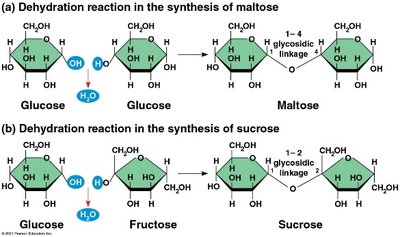
Dehydration Reaction: A chemical reaction in which two molecules are covalently bonded to each other with the removal of a water molecule.
Hydrolysis: A process that breaks the bonds between monomers by adding water, reversing the dehydration reaction.
Cells are made of four classes of biological macromolecules:
Carbohydrates
Lipids
Proteins
Nucleic acids
Carbohydrates
Monosaccharides, Disaccharides, and Polysaccharides
Carbohydrates are sugars and polymers of sugars, serving as fuel and building materials in cells.
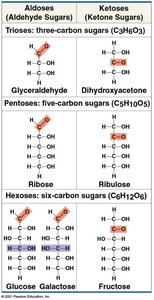
Monosaccharides: Simple sugars, the monomers of carbohydrates. Examples include glucose, galactose, and fructose.
Disaccharides: Consist of two monosaccharides joined by a glycosidic linkage (e.g., sucrose, lactose, maltose).
Polysaccharides: Macromolecules composed of hundreds to thousands of monosaccharides joined by glycosidic linkages. They serve as storage (starch, glycogen) or structural (cellulose, chitin) molecules.
Monosaccharides can be classified by:
Number of carbons (triose, pentose, hexose)
Location of the carbonyl group (aldose or ketose)
Arrangement of hydroxyl groups
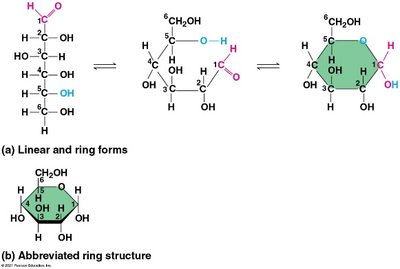
Linear or ring forms
Monosaccharides often form ring structures in aqueous solutions.
Formation of Disaccharides and Polysaccharides
Disaccharides are formed by dehydration reactions, creating glycosidic linkages between monosaccharides.
Storage and Structural Polysaccharides
Starch: Storage polysaccharide in plants, composed of glucose monomers.
Glycogen: Storage polysaccharide in animals, also composed of glucose.
Cellulose: Structural polysaccharide in plant cell walls; indigestible by most animals.
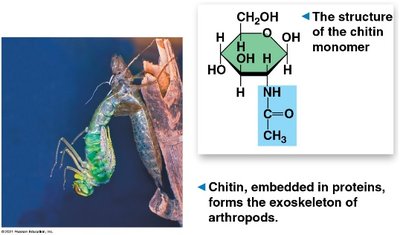
Chitin: Structural polysaccharide in fungal cell walls and arthropod exoskeletons.
Lipids
Fats, Phospholipids, and Steroids
Lipids are a diverse group of hydrophobic molecules, not true polymers, and include fats, phospholipids, and steroids.
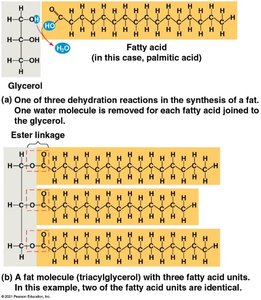
Fats (Triglycerides): Composed of glycerol and three fatty acids, joined by ester linkages. Serve as energy storage molecules.
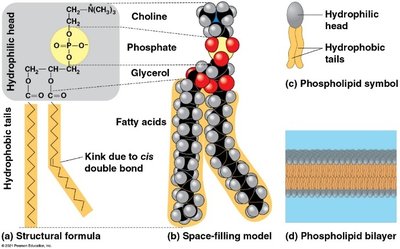
Phospholipids: Consist of a glycerol backbone, two fatty acid tails, and a phosphate group. They are amphipathic, with hydrophilic heads and hydrophobic tails, forming the structural basis of cell membranes.
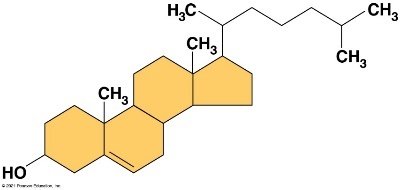
Steroids: Lipids with a structure of four fused hydrocarbon rings. Cholesterol is a key steroid, serving as a component of cell membranes and a precursor for steroid hormones.
Proteins
Structure and Function
Proteins are polymers of amino acids and account for more than 50% of the dry mass of most cells. They perform a vast array of functions, including catalysis, defense, storage, transport, communication, movement, and structural support.
Amino Acids: Organic molecules with an amino group, carboxyl group, hydrogen atom, and variable R group attached to a central alpha carbon.
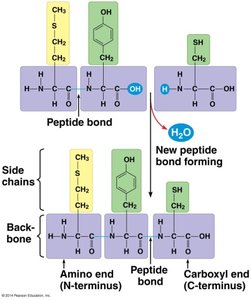
Peptide Bond: Covalent bond formed by a dehydration reaction between the amino group of one amino acid and the carboxyl group of another.
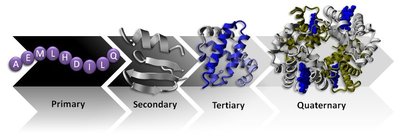
Levels of Protein Structure
Primary Structure: Linear sequence of amino acids in a polypeptide chain.
Secondary Structure: Local folding into alpha helices and beta sheets, stabilized by hydrogen bonds.
Tertiary Structure: Overall 3D shape of a polypeptide, determined by interactions among R groups.
Quaternary Structure: Association of multiple polypeptide chains to form a functional protein.
Protein Function and Examples
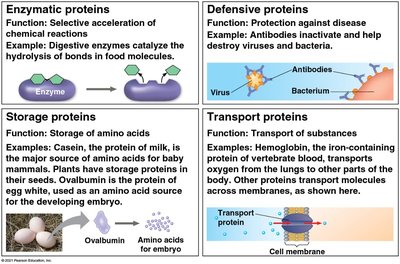
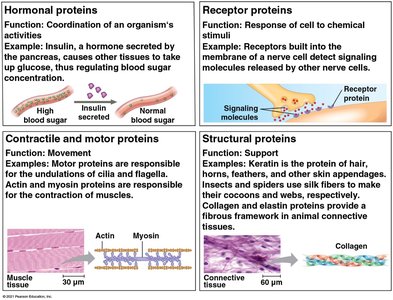
Proteins have diverse functions, including enzymatic, defensive, storage, transport, hormonal, receptor, contractile, motor, and structural roles.
Protein Folding and Denaturation
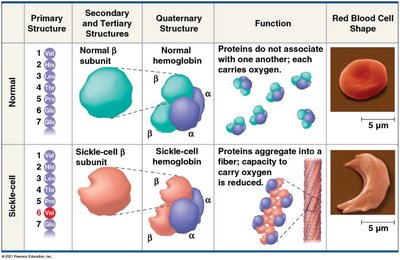
The function of a protein depends on its specific shape, which is determined by its amino acid sequence. Denaturation is the loss of a protein's native structure, resulting in loss of function. An example is sickle cell anemia, where a single amino acid change alters hemoglobin structure and function.
Nucleic Acids
DNA and RNA
Nucleic acids store, transmit, and help express hereditary information. There are two types:
DNA (Deoxyribonucleic acid): Stores genetic information; double-stranded helix.
RNA (Ribonucleic acid): Involved in gene expression; usually single-stranded.
Nucleic acids are polymers of nucleotides, each consisting of a phosphate group, a five-carbon sugar (deoxyribose or ribose), and a nitrogenous base (adenine, thymine, cytosine, guanine, or uracil).
Central Dogma of Molecular Biology
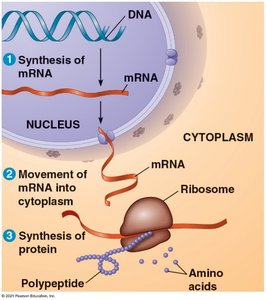
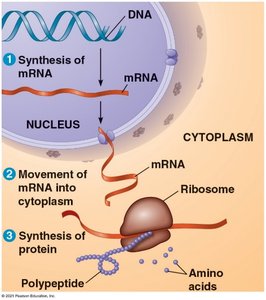
The flow of genetic information in cells follows the central dogma: DNA is transcribed into RNA, which is then translated into protein.
Genomics and Proteomics
Modern Biological Inquiry
Advances in genomics and proteomics have revolutionized biology by enabling the comparison and analysis of entire DNA and protein sequences across species. This has applications in evolutionary biology, medicine, and biotechnology.
Summary Table: Main Classes of Biological Macromolecules
Class | Monomer | Polymer | Bond Type | Function |
|---|---|---|---|---|
Carbohydrates | Monosaccharide | Polysaccharide | Glycosidic linkage | Energy storage, structure |
Lipids | Fatty acids, glycerol | Fats, phospholipids, steroids | Ester linkage | Energy storage, membranes, signaling |
Proteins | Amino acid | Polypeptide | Peptide bond | Catalysis, structure, transport, etc. |
Nucleic acids | Nucleotide | DNA, RNA | Phosphodiester bond | Information storage, transmission |
