 Back
The Structure and Function of Large Biological Molecules (Macromolecules)
Study Guide - Smart Notes
 Tailored notes based on your materials, expanded with key definitions, examples, and context.
Biological Macromolecules: An Overview
Introduction to Macromolecules
All living organisms are composed of four major classes of large biological molecules, known as macromolecules: carbohydrates, proteins, nucleic acids, and lipids. These molecules are essential for structure, function, and regulation of the body's tissues and organs.
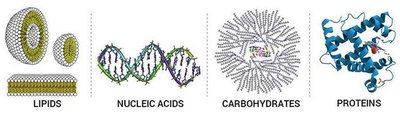
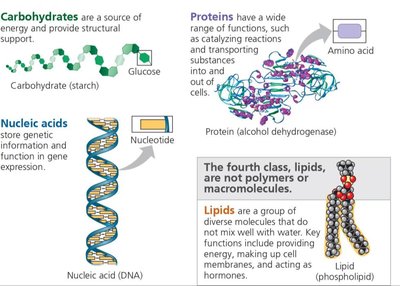
Carbohydrates: Serve as fuel and building material.
Proteins: Perform a vast array of functions including catalysis, transport, and support.
Nucleic acids: Store and transmit genetic information.
Lipids: Diverse group, mainly hydrophobic, important for energy storage, membranes, and signaling.
Building Macromolecules: Polymers and Monomers
Polymer Formation and Breakdown
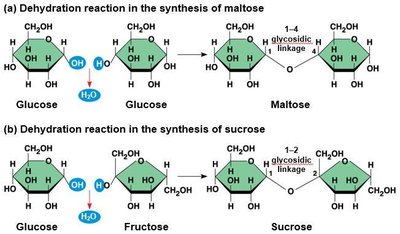
Most macromolecules (except lipids) are polymers, long chains of repeating units called monomers. Polymers are synthesized by dehydration reactions (removal of water) and broken down by hydrolysis (addition of water).
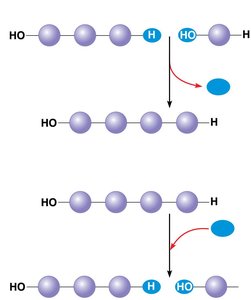
Dehydration reaction: Joins monomers by removing a water molecule.
Hydrolysis: Breaks bonds between monomers by adding water.
Lipids
Structure and Types of Lipids
Lipids are not true polymers but are grouped together due to their hydrophobic nature. Major types include fats, phospholipids, and steroids.
Fats (Triglycerides): Composed of glycerol and three fatty acids, joined by ester linkages.
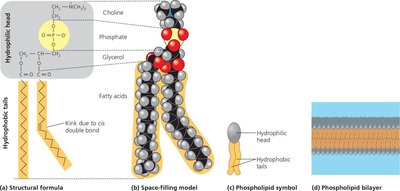
Phospholipids: Two fatty acids and a phosphate group attached to glycerol; form cell membranes.
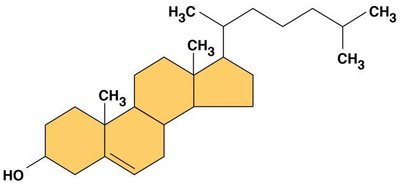
Steroids: Four fused carbon rings; cholesterol is a key example.
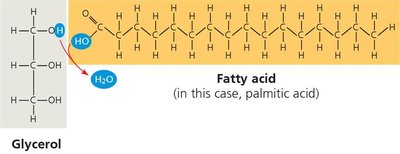
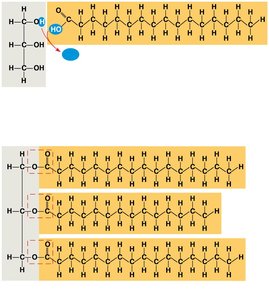
Saturated vs. Unsaturated Fats
Fatty acids vary in length and in the presence of double bonds:
Saturated fatty acids: No double bonds; solid at room temperature (e.g., animal fats).
Unsaturated fatty acids: One or more double bonds; liquid at room temperature (e.g., plant oils).
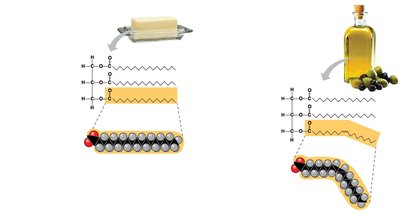
Phospholipids and Biological Membranes
Phospholipids are essential for cell membrane structure, forming a bilayer with hydrophilic heads facing water and hydrophobic tails facing inward.
Steroids
Steroids are lipids with a characteristic four-ring structure. Cholesterol is a vital component of animal cell membranes and a precursor for other steroids.
Carbohydrates
Monosaccharides and Disaccharides
Carbohydrates include sugars and their polymers. The simplest are monosaccharides (e.g., glucose), which can form disaccharides (e.g., maltose, sucrose) via dehydration reactions.
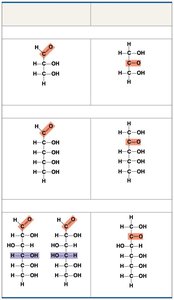
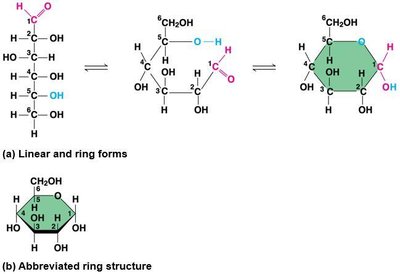
Monosaccharides: Classified by carbonyl group position (aldose or ketose) and carbon number.
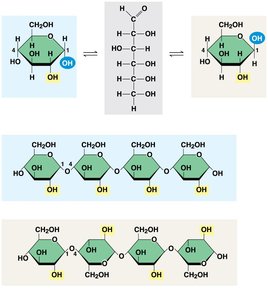
In aqueous solutions, many sugars form rings.
Polysaccharides: Storage and Structure
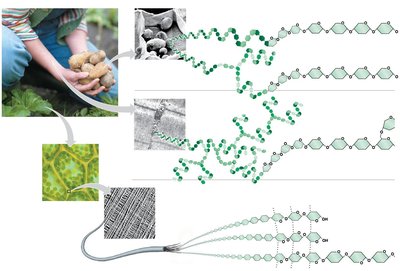
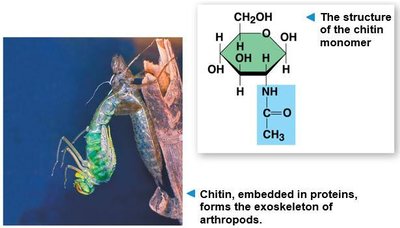
Polysaccharides are polymers of sugars with storage (e.g., starch, glycogen) or structural (e.g., cellulose, chitin) roles.
Starch: Storage in plants; composed of glucose monomers.
Glycogen: Storage in animals; highly branched glucose polymer.
Cellulose: Structural component of plant cell walls; differs from starch in glycosidic linkage.
Chitin: Structural polysaccharide in arthropod exoskeletons and fungal cell walls.
Proteins
Functions of Proteins
Proteins are the most diverse macromolecules, accounting for more than 50% of cell dry mass. They serve as enzymes, structural components, transporters, signalers, and more.
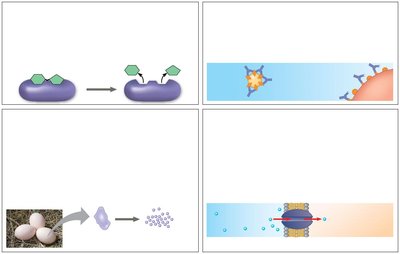
Enzymes: Catalyze biochemical reactions.
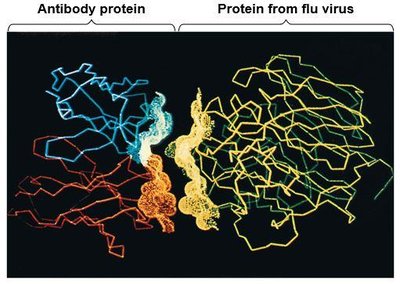
Defensive proteins: Antibodies for immune response.
Storage proteins: Store amino acids.
Transport proteins: Move substances across membranes.
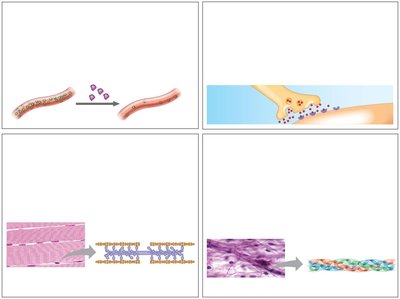
Signaling proteins: Coordinate cellular activities.
Receptor proteins: Receive signals from outside the cell.
Motor proteins: Movement (e.g., muscle contraction).
Structural proteins: Support (e.g., collagen, keratin).
Amino Acids and Polypeptides
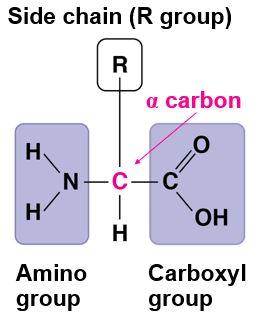
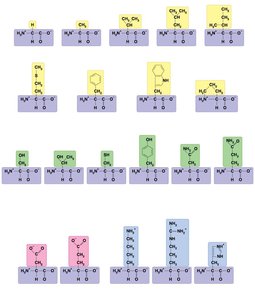
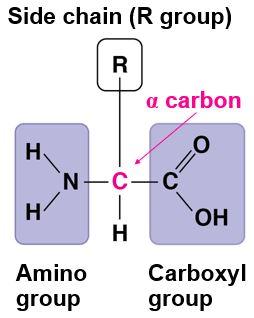
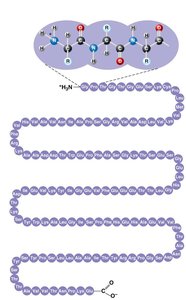
Proteins are polymers of amino acids, linked by peptide bonds to form polypeptides. Each amino acid has a central (alpha) carbon, an amino group, a carboxyl group, a hydrogen atom, and a variable side chain (R group).
Levels of Protein Structure
The function of a protein depends on its specific structure, which is organized into four levels:
Primary structure: Unique sequence of amino acids.
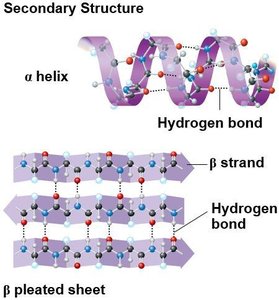
Secondary structure: Coils (α helix) and folds (β pleated sheet) stabilized by hydrogen bonds.
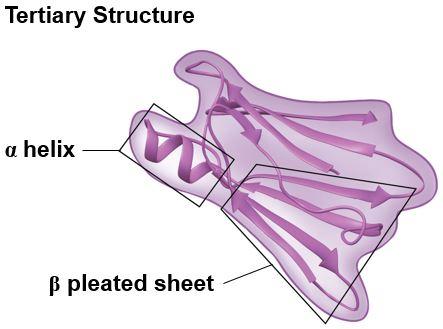
Tertiary structure: Overall 3D shape due to interactions among R groups (hydrogen bonds, ionic bonds, hydrophobic interactions, disulfide bridges).
Quaternary structure: Association of multiple polypeptide chains.
Protein Folding and Denaturation
Protein function depends on correct folding. Environmental changes (pH, temperature, salt) can cause denaturation, leading to loss of function. Chaperone proteins assist in proper folding.
Nucleic Acids
DNA and RNA: Structure and Function
Nucleic acids store and transmit hereditary information. Two main types are DNA (deoxyribonucleic acid) and RNA (ribonucleic acid). DNA provides instructions for its own replication and for protein synthesis via RNA intermediates.
Gene: Unit of inheritance, made of DNA.
Gene expression: DNA → RNA → Protein.
Nucleotide Structure
Nucleic acids are polymers of nucleotides, each consisting of a nitrogenous base, a pentose sugar, and one or more phosphate groups. Bases are classified as pyrimidines (C, T, U) or purines (A, G).
DNA Structure
DNA consists of two antiparallel strands forming a double helix, held together by hydrogen bonds between complementary bases (A-T, G-C). RNA is usually single-stranded.
Summary Table: Major Macromolecules
Class | Monomer | Polymer | Function |
|---|---|---|---|
Carbohydrates | Monosaccharide | Polysaccharide | Fuel, structure |
Proteins | Amino acid | Polypeptide | Catalysis, structure, transport, etc. |
Nucleic acids | Nucleotide | Polynucleotide | Genetic information |
Lipids | Fatty acids, glycerol | Not true polymers | Energy storage, membranes, signaling |
Additional info: This guide covers the structure and function of the four major classes of biological macromolecules, their monomers, and the chemical processes involved in their synthesis and breakdown. Understanding these molecules is foundational for all further study in biology, biochemistry, and related fields.
