 Back
BackThe Structure and Function of Large Biological Molecules: Proteins and Nucleic Acids
Study Guide - Smart Notes
 Tailored notes based on your materials, expanded with key definitions, examples, and context.
Proteins: Structure and Function
Overview of Protein Functions
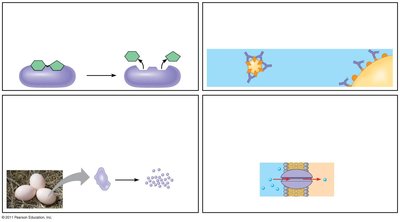
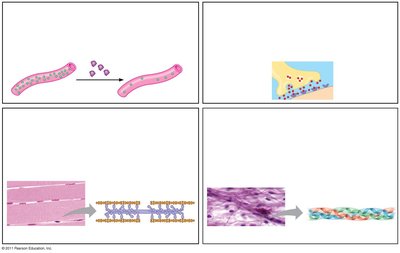
Proteins are essential macromolecules that perform a wide variety of functions in living organisms. Their diversity of structure enables them to serve roles such as structural support, storage, transport, cellular communication, movement, and defense against foreign substances.
Enzymatic proteins: Catalyze chemical reactions, e.g., digestive enzymes hydrolyze food molecules.
Defensive proteins: Protect against disease, e.g., antibodies inactivate and destroy viruses and bacteria.
Storage proteins: Store amino acids, e.g., casein in milk and ovalbumin in egg white.
Transport proteins: Move substances, e.g., hemoglobin transports oxygen in blood.
Hormonal proteins: Coordinate activities, e.g., insulin regulates blood sugar.
Receptor proteins: Respond to chemical stimuli, e.g., nerve cell receptors detect signaling molecules.
Contractile and motor proteins: Enable movement, e.g., actin and myosin in muscle contraction.
Structural proteins: Provide support, e.g., keratin in hair and collagen in connective tissue.
Polypeptides and Amino Acid Monomers
Proteins are polymers called polypeptides, composed of 20 possible amino acids. Each protein consists of one or more polypeptides, which are linear chains of amino acid monomers.
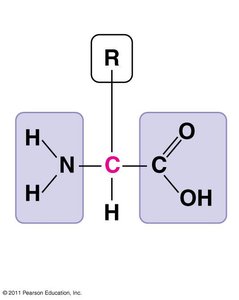
Amino acids: Organic molecules with both a carboxyl group and an amino group.
R group (side chain): The variable group that determines the properties of each amino acid.
Classification of Amino Acids
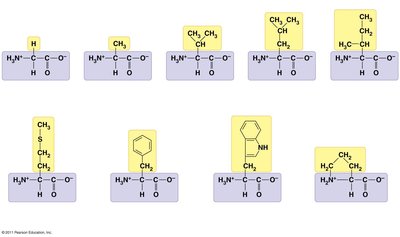
Amino acids are classified based on the properties of their side chains (R groups):
Nonpolar side chains: Hydrophobic (e.g., glycine, alanine, valine, leucine, isoleucine, methionine, phenylalanine, tryptophan, proline).
Polar side chains: Hydrophilic (e.g., serine, threonine, cysteine, tyrosine, asparagine, glutamine).
Electrically charged side chains: Hydrophilic, can be acidic (negatively charged: aspartic acid, glutamic acid) or basic (positively charged: lysine, arginine, histidine).
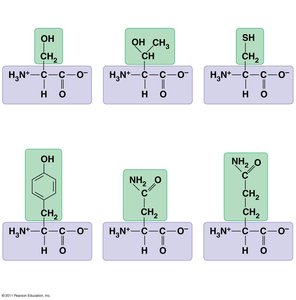
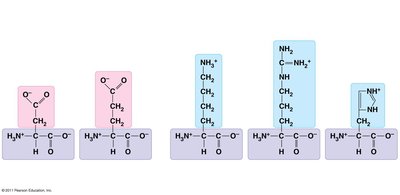
Amino Acid Polymers and Peptide Bonds
Amino acids are linked by covalent bonds known as peptide bonds, forming polypeptide chains. Each polypeptide has a unique sequence, with an amino end (N-terminus) and a carboxyl end (C-terminus).
Peptide bond: Formed by dehydration synthesis between the amino group of one amino acid and the carboxyl group of another.
Polypeptide: A polymer of amino acids, ranging from a few to thousands of monomers.
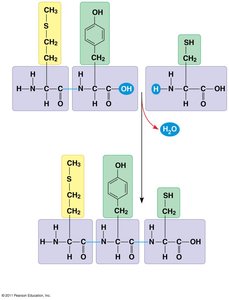
Levels of Protein Structure
Primary Structure
The primary structure is the unique sequence of amino acids in a protein, determined by genetic information. This sequence dictates all higher levels of structure.
Primary structure: Linear sequence of amino acids.
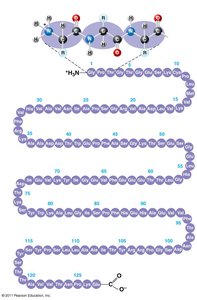
Secondary Structure
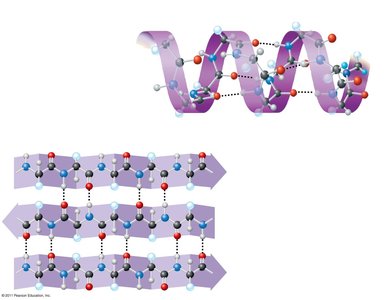
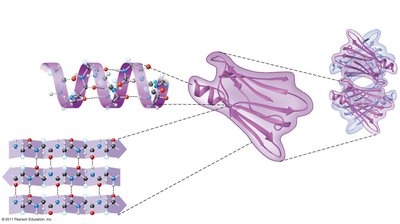
Secondary structure arises from hydrogen bonding between backbone atoms (not side chains), resulting in coils (α helix) and folds (β pleated sheet).
α helix: A coiled structure stabilized by hydrogen bonds.
β pleated sheet: A folded structure stabilized by hydrogen bonds.
Tertiary Structure
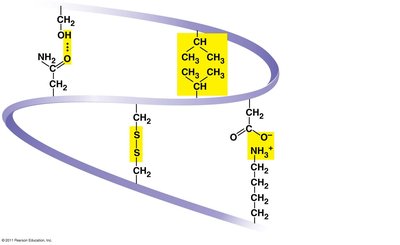
Tertiary structure is determined by interactions among R groups, including hydrogen bonds, ionic bonds, hydrophobic interactions, van der Waals forces, and disulfide bridges.
Disulfide bridges: Strong covalent bonds between cysteine residues.
Hydrophobic interactions: Nonpolar side chains cluster away from water.
Ionic bonds: Between charged side chains.
Quaternary Structure
Quaternary structure occurs when two or more polypeptide chains combine to form a functional protein. Examples include collagen (three polypeptides) and hemoglobin (four polypeptides).
Collagen: Fibrous protein with three coiled polypeptides.
Hemoglobin: Globular protein with four polypeptides (two alpha, two beta).

Summary of Protein Structure Levels
Proteins exhibit four structural levels, each contributing to their function. The sequence of amino acids (primary) leads to local folding (secondary), overall 3D shape (tertiary), and multi-chain assembly (quaternary).
Factors Affecting Protein Structure
Protein structure can be affected by environmental conditions such as pH, salt concentration, and temperature. Denaturation is the loss of native structure, rendering the protein biologically inactive. Denaturation can be reversible or irreversible depending on the protein and conditions.
Example (irreversible): Cooking an egg.
Example (reversible): Gelatin dessert liquefies with heat, gels when cooled.
Nucleic Acids: Structure and Function
Roles of Nucleic Acids
Nucleic acids store, transmit, and help express hereditary information. The sequence of amino acids in a polypeptide is programmed by genes, which are made of DNA.
DNA (deoxyribonucleic acid): Provides directions for its own replication and directs synthesis of messenger RNA (mRNA).
RNA (ribonucleic acid): Usually single-stranded, involved in protein synthesis.
Components of Nucleic Acids
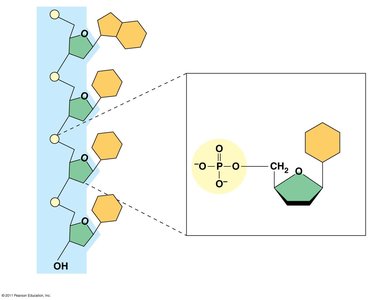
Nucleic acids are polymers called polynucleotides, made of nucleotide monomers. Each nucleotide consists of a nitrogenous base, a pentose sugar, and one or more phosphate groups. A nucleoside is a nucleotide without the phosphate group.
Nucleotide: Nitrogenous base + pentose sugar + phosphate group.
Nucleoside: Nitrogenous base + pentose sugar.
Structure of DNA and RNA Molecules
RNA molecules are usually single polypeptide chains, while DNA molecules consist of two polynucleotides forming a double helix.
DNA: Double-stranded, forms a double helix.
RNA: Single-stranded.
What You Need to Know for Exam 1
Recognize a nucleotide and its role in nucleic acids.
Know the components of a nucleotide.
Do not confuse nucleotides with amino acids.
Identification of purines and pyrimidines, and their types in DNA vs. RNA, will be covered later.
Summary Table: Levels of Protein Structure
Level | Description | Bonds/Interactions |
|---|---|---|
Primary | Sequence of amino acids | Peptide bonds |
Secondary | Local folding (α helix, β sheet) | Hydrogen bonds |
Tertiary | 3D shape of polypeptide | Hydrogen, ionic, hydrophobic, van der Waals, disulfide bridges |
Quaternary | Assembly of multiple polypeptides | Same as tertiary |
Summary Table: Components of Nucleic Acids
Component | Description |
|---|---|
Nitrogenous base | Purine or pyrimidine |
Pentose sugar | Ribose (RNA) or deoxyribose (DNA) |
Phosphate group | One or more per nucleotide |
Nucleoside | Nucleotide without phosphate group |
