 Back
BackThe Structure and Function of Macromolecules
Study Guide - Smart Notes
 Tailored notes based on your materials, expanded with key definitions, examples, and context.
Chapter 5: The Structure and Function of Macromolecules
Introduction to Macromolecules
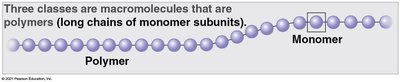
Macromolecules are large, complex molecules that are fundamental to biological structure and function. The four major classes of macromolecules in living organisms are carbohydrates, lipids, proteins, and nucleic acids. Except for lipids, these macromolecules are polymers, built from repeating monomer units.
Polymers and Monomers
Polymers are long molecules composed of many similar or identical building blocks called monomers.
Carbohydrates, proteins, and nucleic acids are all polymers; lipids are not true polymers.
Polymerization occurs through dehydration reactions, where water is removed to form a new bond. Polymers are broken down by hydrolysis, which adds water to break bonds.
Carbohydrates
Carbohydrates are sugars and polymers of sugars, serving as energy sources and structural materials in cells.
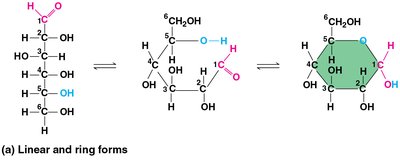
Monosaccharides are the simplest carbohydrates (simple sugars), with the general formula (CH2O)n. Glucose (C6H12O6) is the most common monosaccharide.
Monosaccharides are classified by the location of their carbonyl group (aldose or ketose) and the number of carbons in the skeleton.
Monosaccharides can exist in linear or ring forms in aqueous solutions.
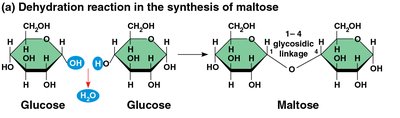
Disaccharides are formed by joining two monosaccharides via a glycosidic linkage (covalent bond), typically through a dehydration reaction. Example: maltose (glucose + glucose).
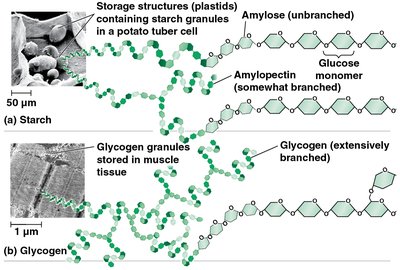
Polysaccharides are large polymers of sugars with storage (e.g., starch, glycogen) or structural (e.g., cellulose, chitin) roles.
Starch is a storage polysaccharide in plants, composed of glucose monomers (amylose and amylopectin).
Glycogen is a storage polysaccharide in animals, stored mainly in liver and muscle cells.
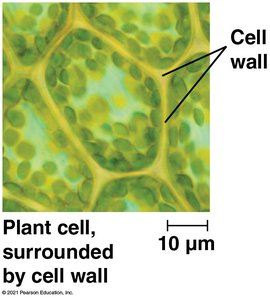
Cellulose is a structural polysaccharide in plant cell walls, composed of β-glucose monomers. Its β-linkages make it indigestible to most animals.
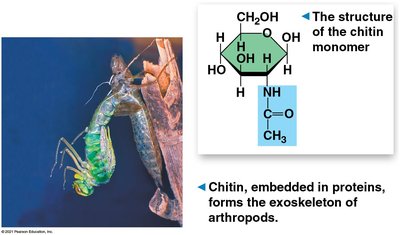
Chitin is a structural polysaccharide found in the exoskeleton of arthropods and the cell walls of fungi.
Lipids
Lipids are a diverse group of hydrophobic molecules that do not form true polymers. They include fats, phospholipids, and steroids.
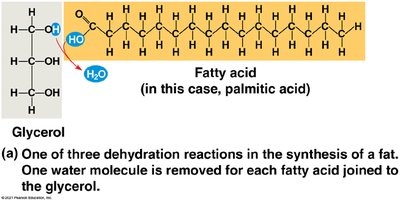
Fats (triglycerides) are constructed from glycerol and fatty acids. Their main function is energy storage, but they also cushion organs and insulate the body.
Fats are formed by joining three fatty acids to glycerol via ester linkages.
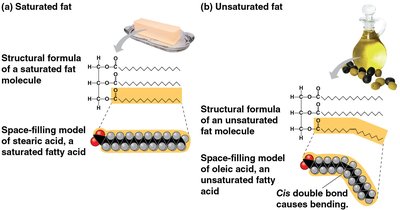
Saturated fatty acids have no double bonds and are solid at room temperature (e.g., animal fats).
Unsaturated fatty acids have one or more double bonds and are liquid at room temperature (e.g., plant and fish fats).
Trans fats are artificially created during hydrogenation and are associated with health risks.
Phospholipids consist of two fatty acids and a phosphate group attached to glycerol. They are major components of cell membranes, forming bilayers with hydrophobic tails and hydrophilic heads.
Steroids are lipids with a structure of four fused rings. Cholesterol is an important steroid in animal cell membranes and a precursor for other steroids.
Proteins
Proteins are the most functionally diverse macromolecules, serving as enzymes, structural components, transporters, and more. They are polymers of amino acids.
Amino acids are organic molecules with amino and carboxyl groups, differing in their side chains (R groups).
Polypeptides are unbranched polymers of amino acids, linked by peptide bonds.
A protein is a biologically functional molecule consisting of one or more polypeptides folded into a specific structure.
Protein structure has four levels:
Primary structure: unique sequence of amino acids.
Secondary structure: coils (α-helix) and folds (β-pleated sheet) due to hydrogen bonding.
Tertiary structure: overall 3D shape from interactions among R groups (hydrogen bonds, ionic bonds, hydrophobic interactions, disulfide bridges).
Quaternary structure: association of multiple polypeptide chains (e.g., hemoglobin).
Denaturation is the loss of a protein’s native structure due to changes in pH, temperature, or other factors, resulting in loss of function.
Protein misfolding is associated with diseases such as Alzheimer’s and sickle-cell disease.
Summary Table: Major Classes of Macromolecules
Class | Monomer | Polymer | Bond Type | Main Functions |
|---|---|---|---|---|
Carbohydrates | Monosaccharide | Polysaccharide | Glycosidic linkage | Energy storage, structure |
Lipids | Fatty acids, glycerol | Not true polymers | Ester linkage | Energy storage, membranes, signaling |
Proteins | Amino acid | Polypeptide | Peptide bond | Catalysis, structure, transport, regulation |
Nucleic Acids | Nucleotide | Polynucleotide | Phosphodiester bond | Information storage, transmission |
Additional info: Nucleic acids (DNA and RNA) are also macromolecules but were not covered in detail in the provided materials. Their structure and function are essential for genetic information storage and transfer.
