 Back
The Structure and Stability of Atoms: Periodic Table, Atomic Theory, and Chemical Laws
Study Guide - Smart Notes
 Tailored notes based on your materials, expanded with key definitions, examples, and context.
The Structure and Stability of Atoms
Introduction to the Periodic Table
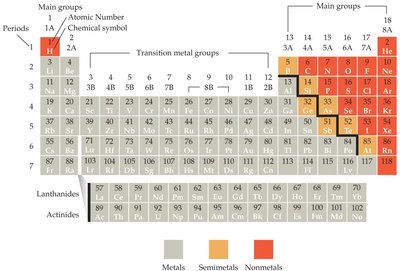
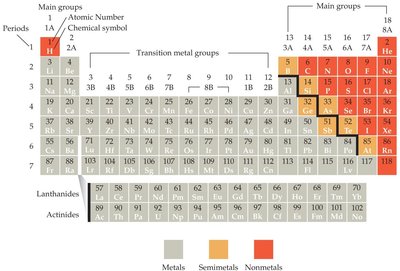
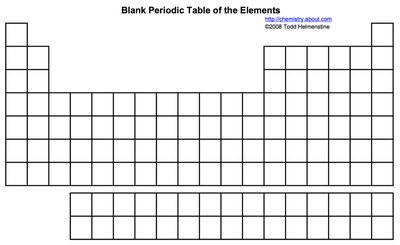
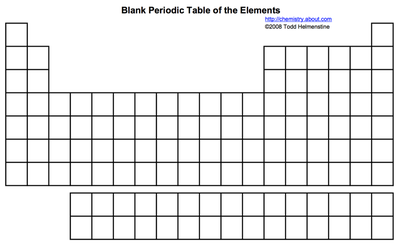
The periodic table is a systematic arrangement of elements based on their atomic number, electron configuration, and recurring chemical properties. It is divided into groups (vertical columns) and periods (horizontal rows), which help classify elements into categories such as metals, nonmetals, and metalloids.
Groups (Families): Elements in the same group have similar chemical properties.
Periods: Elements in the same period have widely varying properties.
Major Classifications: Alkali metals, alkaline earth metals, transition metals, halogens, noble gases, lanthanides, and actinides.
Classification of Elements
Elements are classified based on their physical and chemical properties:
Metals: Have metallic luster, conduct heat and electricity, and are malleable.
Nonmetals: Have dull luster, are nonconductors, and are brittle.
Semimetals (Metalloids): Exhibit properties of both metals and nonmetals; some are semiconductors.
Special Groups of the Periodic Table
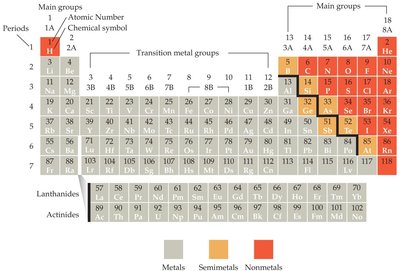
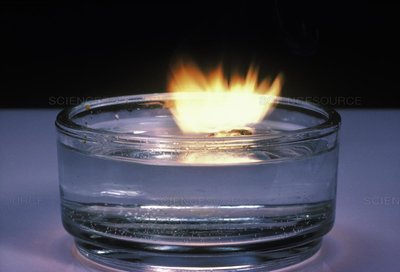
Alkali Metals: Very reactive metals found in Group 1.
Alkaline Earth Metals: Reactive metals found in Group 2.
Halogens: Very reactive nonmetals found in Group 17.
Noble Gases: Nonreactive nonmetals found in Group 18.
Naming Elements and Symbols
Each element is represented by a unique symbol, usually derived from its English or Latin name (e.g., H for hydrogen, Na for sodium).
Example: Nitrogen (N), Silver (Ag)
Law of Conservation of Mass
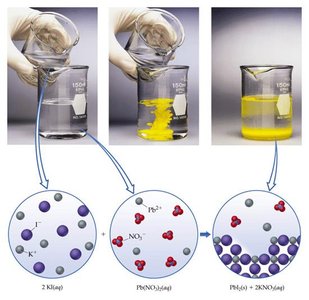
The law of conservation of mass states that mass is neither created nor destroyed in a chemical reaction. The total mass of reactants equals the total mass of products.
Example:
Measured masses: (reactants), (products)

Law of Definite Proportions
This law states that a chemical compound always contains the same proportion of elements by mass, regardless of the sample size or source.
Example: Water () always contains hydrogen and oxygen in a mass ratio of approximately 1:8.
Law of Multiple Proportions
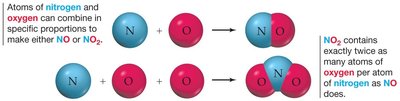
Elements can combine in different ratios to form different compounds. The mass ratios of the elements in these compounds are simple whole-number multiples of each other.
Example: Nitrogen and oxygen form both nitric oxide (NO) and nitrous oxide (), with mass ratios of oxygen that are simple multiples.
Dalton’s Atomic Theory
Dalton’s atomic theory provides the foundation for modern chemistry:
Elements are made of tiny particles called atoms.
Atoms of the same element have the same mass; atoms of different elements have different masses.
Atoms combine in small whole-number ratios to form compounds.
Chemical reactions rearrange atoms but do not change the atoms themselves.
Historical Evolution of the Atom
The atomic model has evolved over time as new discoveries were made:
Democritus (400 BC): Proposed matter is made of indivisible atoms.
John Dalton (1800s): Provided experimental evidence for atoms.
J.J. Thomson (1904): Discovered the electron.
Ernest Rutherford (1911): Discovered the nucleus.
Niels Bohr (1913): Proposed electrons move in fixed orbits.
James Chadwick (1932): Discovered the neutron.
Nuclear Theory of the Atom
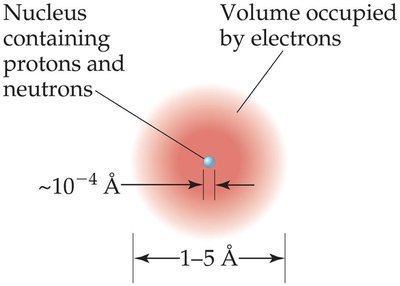
The nuclear theory describes the structure of the atom:
The nucleus contains most of the atom’s mass and all positive charge (protons and neutrons).
Most of the atom is empty space, with electrons dispersed around the nucleus.
The number of electrons equals the number of protons in a neutral atom.
Subatomic Particles
Atoms are composed of three main subatomic particles:
Proton (p+): Positive charge, located in the nucleus, relative mass ≈ 1.
Neutron (n0): No charge, located in the nucleus, relative mass ≈ 1.
Electron (e–): Negative charge, located outside the nucleus, relative mass ≈ 1/1836 of a proton.
Particle | Mass (g) | Charge (e) |
|---|---|---|
Electron | 9.109383 × 10⁻²⁸ | –1 |
Proton | 1.672622 × 10⁻²⁴ | +1 |
Neutron | 1.674927 × 10⁻²⁴ | 0 |
Atomic and Isotope Symbols
Atomic symbols represent the number of protons, neutrons, and electrons in an atom or ion. Isotopes are atoms of the same element with different numbers of neutrons.
Example: (7 protons, 7 neutrons), (47 protons, 61 neutrons)
Element Name | Symbol | Protons | Neutrons | Isotope Symbol |
|---|---|---|---|---|
Nitrogen | N | 7 | 7 | |
Silver | Ag | 47 | 61 |
Ions: Gaining or Losing Electrons
When atoms gain or lose electrons, they become ions:
Cation: Positive ion formed by losing electrons (e.g., ).
Anion: Negative ion formed by gaining electrons (e.g., ).
Example: has 12 protons, 12 neutrons, 10 electrons; has 35 protons, 45 neutrons, 36 electrons.
Chemical Reactions and Equations
Chemical reactions involve the rearrangement of atoms to form new substances. Chemical equations represent these changes using symbols and formulas.
Example:

Summary Table: Classification of Elements
Classification | Properties | Examples |
|---|---|---|
Metals | Shiny, conductors, malleable | Fe, Cu, Ag |
Nonmetals | Dull, brittle, nonconductors | C, S, Br |
Semimetals | Intermediate properties | Si, Ge |
Additional info: The content above integrates foundational chemistry concepts essential for understanding atomic structure, periodic trends, and the laws governing chemical reactions, which are also foundational for introductory biology courses.
