 Back
Chapter 1.5
Study Guide - Smart Notes
 Tailored notes based on your materials, expanded with key definitions, examples, and context.
The Tree of Life
Natural Selection and Speciation
The concept of the "Tree of Life" is central to understanding biological diversity and evolutionary relationships. Natural selection is the process that explains the pattern of evolution, leading to both changes within populations and the divergence of populations into new species, a process known as speciation.
Natural Selection: The mechanism proposed by Darwin and Wallace to explain evolutionary patterns. It results in adaptation and divergence within populations.
Speciation: The formation of new and distinct species from a single ancestral population, often visualized as branches on the Tree of Life.
Tree of Life: A phylogenetic tree representing the evolutionary history of all organisms, showing that all species share a common ancestor.
Theory Formation: Begins with observation of a pattern, but becomes a theory when a valid explanation (process) is provided.
Phylogenetic Tree: A diagram showing evolutionary relationships among taxonomic groups.
Example: All modern birds are descended from a common ancestor, but have diverged into many species due to natural selection and speciation.
Taxonomy and Classification
Before the Theory of Evolution, biologists grouped organisms based on morphology (form and structure). Carolus Linnaeus, known as the "Father of Taxonomy," established the binomial nomenclature system and a hierarchical classification scheme.
Binomial Nomenclature: The two-part scientific naming system for organisms, consisting of the genus (capitalized) and species (lowercase), always italicized or underlined when handwritten. Example: Homo sapiens.
Taxon: Each named group within the classification hierarchy.
Hierarchy of Taxonomic Groups: Kingdom, Phylum, Class, Order, Family, Genus, Species (KPCOFGS).
Problems with Common Names: Avoids issues of different languages, regional names, and misnomers.
Classification Based on Morphology: Prior to evolutionary theory, classification relied on form, which often reflects environmental adaptation rather than genetic relatedness.
Example: The term "robin" refers to different birds in Europe and America, illustrating the confusion of common names.
Evolutionary Relationships and Phylogeny
The Theory of Evolution changed taxonomy by emphasizing evolutionary relationships (phylogeny) rather than just morphology. Advances in microscopy revealed two cell types: prokaryotic (no nucleus) and eukaryotic (with nucleus). Whittaker's five-kingdom system attempted to reflect phylogeny, but further discoveries led to the recognition of three domains.
Divergent Evolution: Results in homologous structures (same underlying structure, different function), due to adaptation to different environments.
Convergent Evolution: Results in homoplasic structures (similar function and appearance, different underlying structure), due to adaptation to similar environments.
Homology: Indicates common ancestry; divergent evolution.
Homoplasy: Indicates similar environmental pressures; convergent evolution.
Example: The wings of bats and birds are homoplasic, while the forelimbs of humans and whales are homologous.
Additional info: Morphology alone can be misleading for classification, as environmental adaptation may obscure evolutionary relationships.
Modern Phylogenetic Analysis: rRNA and Domains
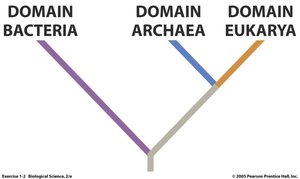
Carl Woese revolutionized classification by analyzing small subunit rRNA, a molecule found in all organisms. The sequence of ribonucleotides changes over time due to mutation, allowing scientists to infer evolutionary relationships. Woese's work revealed three major domains of life: Bacteria, Archaea, and Eukarya.
rRNA Analysis: More closely related species have similar rRNA sequences; distant species have divergent sequences.
Phylogenetic Tree: Depicts evolutionary history and relationships among groups.
Three Domains:
Domain Bacteria: Prokaryotic organisms.
Domain Archaea: Prokaryotic, but distinct from Bacteria.
Domain Eukarya: Eukaryotic organisms, including plants, animals, fungi, and protists.
Surprising Relationships: Archaea and Eukarya share a more recent common ancestor than either does with Bacteria. Fungi are more closely related to animals than to plants.
Kingdoms: Current classification includes six kingdoms, with Bacteria and Archaea as prokaryotic, and Protista, Plantae, Fungi, and Animalia as eukaryotic.
DNA Sequences: Used alongside rRNA to establish phylogenies.
Work in Progress: The shape of the phylogenetic tree changes as new data is gathered and analyzed.
Taxonomic Levels and Nutritional Modes
After the rRNA tree was published, the domain level was added above kingdom. The six kingdoms are:
Kingdom | Domain | Cell Type | Nutritional Mode |
|---|---|---|---|
Bacteria | Bacteria | Prokaryotic | Varied |
Archaea | Archaea | Prokaryotic | Varied |
Protista | Eukarya | Eukaryotic | Varied (most diverse, no unique defining feature) |
Plantae | Eukarya | Eukaryotic | Photosynthetic autotrophs |
Fungi | Eukarya | Eukaryotic | Absorptive heterotrophs |
Animalia | Eukarya | Eukaryotic | Ingestive heterotrophs |
Additional info: Protista is the most diverse kingdom and lacks a unique defining feature. Plantae, Fungi, and Animalia are distinguished by their nutritional modes.
