 Back
ch 36
Study Guide - Smart Notes
 Tailored notes based on your materials, expanded with key definitions, examples, and context.
Chapter 36: The Urinary System
Overview
The urinary system is essential for excreting metabolic wastes and maintaining homeostasis in animals. This chapter explores the structure and function of urinary systems across different animal groups, the process of urine formation, and the system's role in regulating internal environments.
Major Functions of Urinary Systems
Excretion and Homeostasis
Excretion is the elimination of metabolic wastes from the body, primarily through urine.
Urinary systems help maintain homeostasis by regulating water content, pH, and concentrations of ions and small organic molecules in body fluids.
Urine is a watery fluid containing filtered waste products, excess ions, and other substances not needed by the body.
The main nitrogenous wastes excreted are ammonia, urea, and uric acid, which result from protein and nucleic acid metabolism.
Nitrogenous Waste Types
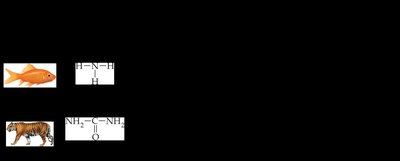
Ammonia (NH3): Highly toxic, excreted directly by aquatic animals.
Urea: Less toxic, produced by mammals and some amphibians; requires energy to synthesize but conserves water.
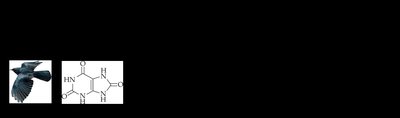
Uric Acid: Least toxic, excreted by birds and many reptiles as a paste or solid; conserves the most water.
Nitrogenous Waste | Example Animal | Water Requirement | Toxicity |
|---|---|---|---|
Ammonia | Fish | High | High |
Urea | Mammals | Moderate | Moderate |
Uric Acid | Birds | Low | Low |
Invertebrate Urinary Systems
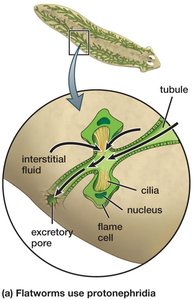
Protonephridia in Flatworms
Flatworms use protonephridia, a network of tubules capped by ciliated flame cells, to filter interstitial fluid and excrete wastes.
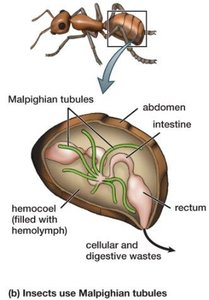
Malpighian Tubules in Insects
Insects possess Malpighian tubules that extend from the intestine into the hemolymph, filtering wastes and returning useful substances to the body before excretion.
Nephridia in Annelids and Mollusks
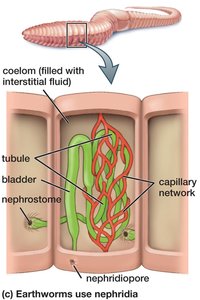
Earthworms and similar animals use nephridia, tubular structures that filter coelomic fluid, reabsorb nutrients, and excrete wastes through nephridiopores.
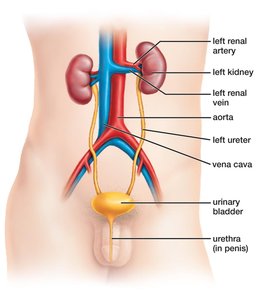
Structure of the Mammalian Urinary System
Major Organs and Their Functions
Kidneys: Filter blood, form urine, and regulate homeostasis.
Ureters: Muscular tubes that transport urine from kidneys to bladder.
Bladder: Stores urine until excretion.
Urethra: Conducts urine from bladder to outside the body.
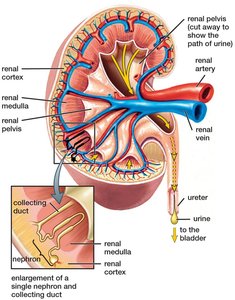
Kidney Structure
Renal cortex: Outer layer where urine formation begins.
Renal medulla: Inner region containing nephron loops and collecting ducts.
Renal pelvis: Funnel-like chamber collecting urine for passage to ureter.
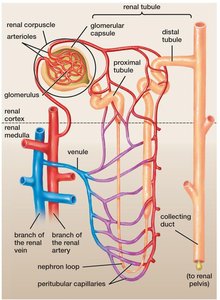
Nephron: The Functional Unit
Each kidney contains about 1 million nephrons.
Nephron parts:
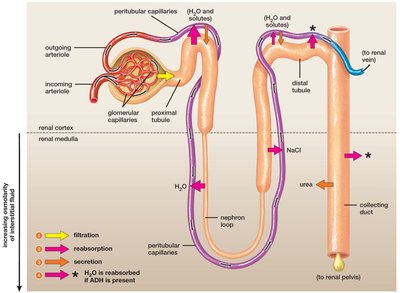
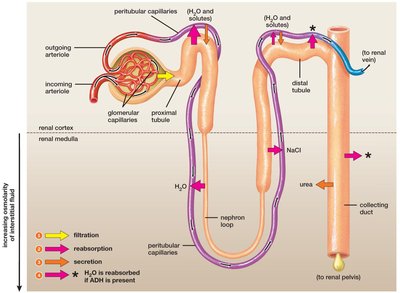
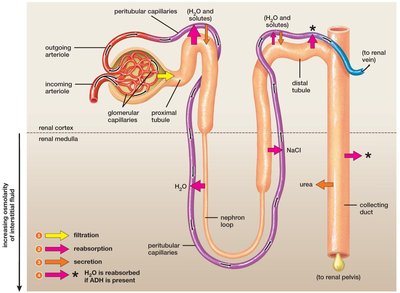
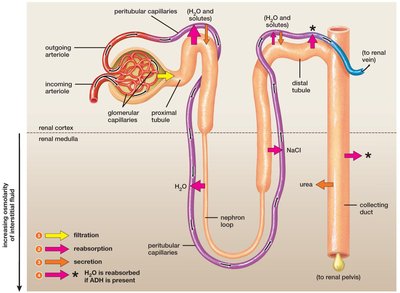
Renal corpuscle: Includes the glomerulus (capillary knot) and glomerular capsule (collects filtrate).
Renal tubule: Proximal tubule (reabsorption), nephron loop (concentration), distal tubule (secretion and further reabsorption).
Collecting duct: Receives urine from multiple nephrons and channels it to the renal pelvis.
Urine Formation
Filtration
Filtration occurs in the glomerulus, where blood pressure forces water and small solutes through capillary walls into the glomerular capsule, forming filtrate.
Glomerular capillaries are highly porous, and pressure is high due to narrow outgoing arterioles.
Reabsorption
Reabsorption returns most water, ions, and nutrients from the filtrate back to the blood, mainly in the proximal tubule, but also in the nephron loop and distal tubule.
Occurs by diffusion and active transport.
Distal tubule reabsorption is hormonally regulated.
Secretion
Secretion actively transports additional wastes and excess ions from the blood into the renal tubule, mainly in the proximal and distal tubules.
Includes K+, H+, ammonia, drugs, and toxins.
Homeostatic Functions of Vertebrate Urinary Systems
Osmoregulation and Water Balance
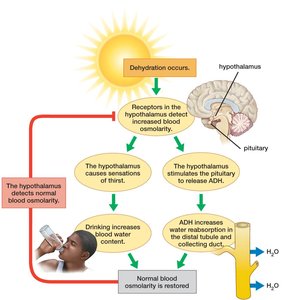
Osmoregulation is the maintenance of blood osmolarity (solute concentration) within strict limits.
Kidneys adjust urine concentration based on hydration status, regulated by the hormone antidiuretic hormone (ADH).
ADH increases water reabsorption in the distal tubule and collecting duct by increasing aquaporin channels.
Adaptations to Environment
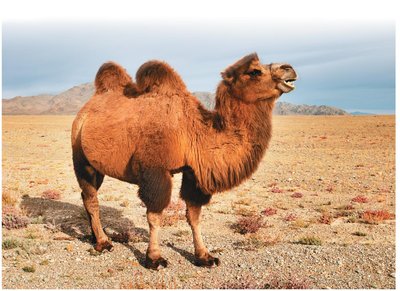
Mammals in dry environments have more nephrons with long loops of Henle, allowing greater urine concentration (e.g., desert rodents).
Mammals in wet environments have more short-looped nephrons (e.g., beavers).
pH and Blood Pressure Regulation
Kidneys maintain blood pH by reabsorbing bicarbonate (HCO3-) and secreting H+.
Release of renin and angiotensin regulates blood pressure by increasing Na+ reabsorption, water retention, and vasoconstriction.
Release of erythropoietin stimulates red blood cell production in response to low oxygen.
Osmoregulation in Fish
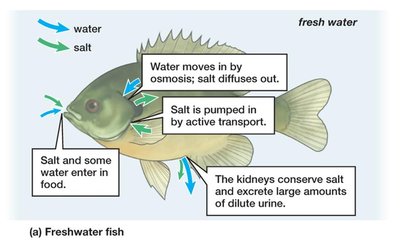
Freshwater fish live in hypotonic environments; they excrete large amounts of dilute urine and actively uptake salts.
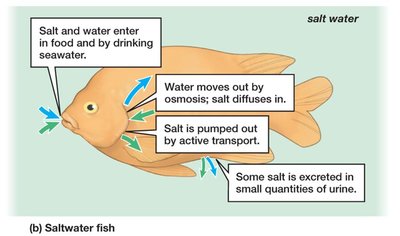
Saltwater fish live in hypertonic environments; they drink seawater, excrete excess salt through gills, and produce small amounts of concentrated urine.
Fish nephrons lack loops of Henle, so they cannot concentrate urine above blood osmolarity.
Summary Table: Nitrogenous Wastes
Waste | Animals | Water Needed | Toxicity | Energy Cost |
|---|---|---|---|---|
Ammonia | Fish, aquatic invertebrates | High | High | Low |
Urea | Mammals, amphibians | Moderate | Moderate | Moderate |
Uric Acid | Birds, reptiles, insects | Low | Low | High |
Key Equations:
Osmolarity:
Renin-Angiotensin System (simplified):
Additional info: This guide expands on the original notes with definitions, examples, and summary tables for clarity and completeness.
