Back
BackThe Working Cell: Membrane Structure, Transport, and Energy
Study Guide - Smart Notes
 Tailored notes based on your materials, expanded with key definitions, examples, and context.
The Working Cell
Introduction
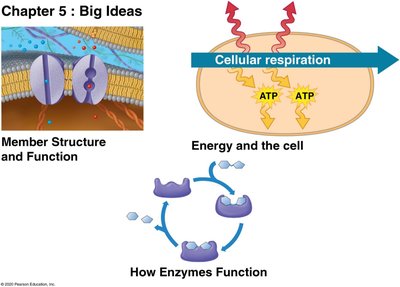
The cell membrane, energy, and enzymes are essential for cellular survival and function. This chapter explores how membranes regulate cellular environments, how cells harness and use energy, and the role of enzymes in facilitating biochemical reactions.
Membrane Structure and Function
Fluid Mosaic Model
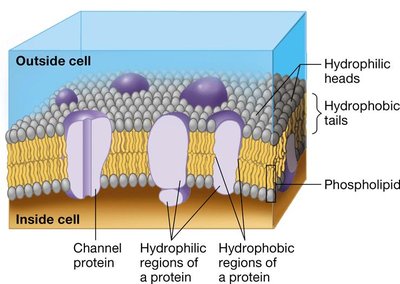
The fluid mosaic model describes the structure of cell membranes as a mosaic of diverse protein molecules embedded in a fluid bilayer of phospholipids. The components are not fixed in place but move laterally, allowing flexibility and dynamic interactions.
Phospholipid bilayer: Forms the fundamental structure, with hydrophilic heads facing outward and hydrophobic tails inward.
Proteins: Embedded or associated with the bilayer, performing transport, signaling, and structural roles.
Selective permeability: The membrane allows some substances to cross more easily than others, maintaining internal balance.
Membrane Lipids
Membrane lipids include phospholipids, glycolipids, and cholesterol, each contributing to membrane structure and function.
Phospholipids: Amphipathic molecules with hydrophilic heads and hydrophobic tails, forming a bilayer.
Glycolipids: Phospholipids with carbohydrate groups, contributing to cell recognition and the glycocalyx.
Cholesterol: Modulates membrane fluidity and stability by interacting with phospholipids.
The Plasma Membrane
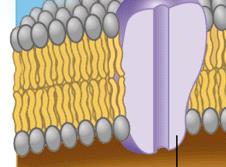
The plasma membrane defines the cell boundary, mediates interactions with the environment, and controls the passage of materials. It has distinct intracellular and extracellular faces and is largely impermeable to ions and large molecules, but allows small uncharged molecules to pass.
Membrane Transport Mechanisms
Diffusion
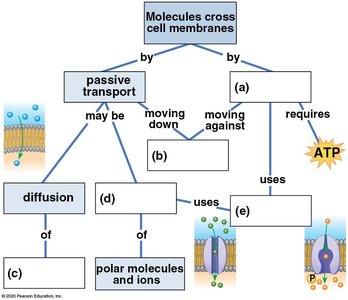
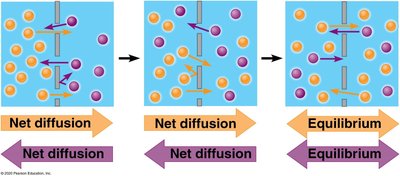
Diffusion is the passive movement of particles from an area of higher concentration to an area of lower concentration, driven by the concentration gradient. It does not require energy input and continues until equilibrium is reached.
Passive transport: Movement of substances across membranes without energy input.
Equilibrium: State where concentrations are equal on both sides of the membrane.
Osmosis
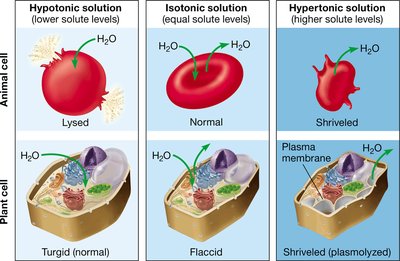
Osmosis is the diffusion of water across a selectively permeable membrane. Water moves from regions of lower solute concentration to higher solute concentration until equilibrium is achieved. The ability of a solution to cause a cell to gain or lose water is called tonicity.
Isotonic solution: Solute concentration is equal inside and outside the cell; animal cells are normal, plant cells are flaccid.
Hypertonic solution: Higher solute concentration outside; cells lose water and shrink (crenation in animals, plasmolysis in plants).
Hypotonic solution: Lower solute concentration outside; cells gain water and swell (lysis in animals, turgid in plants).
Facilitated Diffusion and Transport Proteins
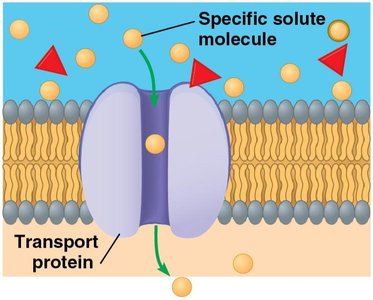
Polar or charged substances cannot easily cross the lipid bilayer. Transport proteins facilitate their movement across the membrane via facilitated diffusion, which is still passive and driven by concentration gradients. Aquaporins are specialized proteins for rapid water transport.
Active Transport
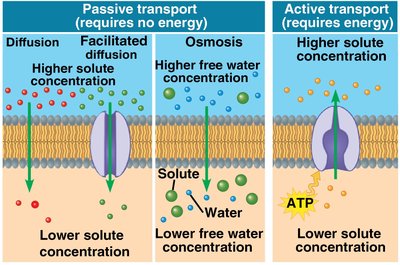
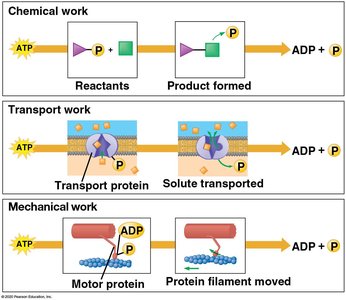
Active transport moves substances against their concentration gradient, requiring energy input, usually from ATP. This process is essential for maintaining concentration differences across membranes.
ATP: Provides the energy for active transport by transferring a phosphate group to the transport protein.
Vesicular Transport
Large particles or volumes are transported via vesicles in processes such as endocytosis (into the cell) and exocytosis (out of the cell). Endocytosis includes phagocytosis (cell eating), pinocytosis (cell drinking), and receptor-mediated endocytosis (specific uptake).
Transcytosis: Material moves through a cell by endocytosis followed by exocytosis.
Cellular Energy and ATP
Energy in the Cell
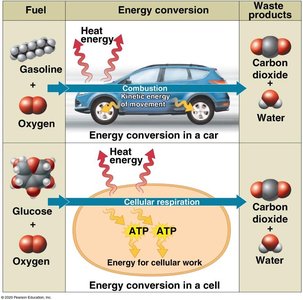
Energy is the capacity to cause change. Cells use energy for work, which can be chemical, transport, or mechanical. According to the laws of thermodynamics, energy can be transformed but not created or destroyed, and energy transformations increase entropy (disorder).
Adenosine Triphosphate (ATP)
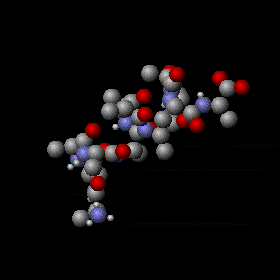
ATP is the main energy currency of the cell. It powers cellular work by coupling exergonic (energy-releasing) and endergonic (energy-consuming) reactions. The hydrolysis of ATP releases energy by removing a phosphate group:
Enzymes and Metabolic Regulation
How Enzymes Function
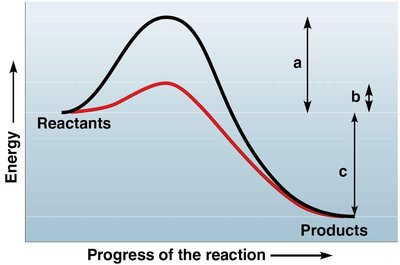
Enzymes are protein catalysts that speed up chemical reactions by lowering the activation energy required. They are not consumed in the reaction and are highly specific for their substrates, which bind at the enzyme's active site.
Enzyme Specificity and Inhibition
Enzymes bind specific substrates at their active sites. Enzyme activity can be regulated by inhibitors:
Competitive inhibitors: Bind to the active site, blocking substrate access.
Noncompetitive inhibitors: Bind elsewhere, changing enzyme shape and reducing activity.
Feedback inhibition: The end product of a pathway inhibits an earlier step, preventing overproduction.
Enzyme Inhibitors in Medicine and Industry
Many drugs, pesticides, and poisons act as enzyme inhibitors, either beneficially (as medications) or harmfully (as toxins).
Summary Table: Membrane Transport Mechanisms
Transport Type | Energy Required? | Direction | Example |
|---|---|---|---|
Diffusion | No | Down gradient | O2, CO2 |
Facilitated Diffusion | No | Down gradient | Glucose via transport protein |
Osmosis | No | Water down gradient | Water via aquaporin |
Active Transport | Yes (ATP) | Against gradient | Na+/K+ pump |
Vesicular Transport | Yes (ATP) | Bulk movement | Endocytosis, exocytosis |