 Back
The Working Cell: Membrane Structure, Transport, and Energy
Study Guide - Smart Notes
 Tailored notes based on your materials, expanded with key definitions, examples, and context.
The Working Cell
Membrane Structure
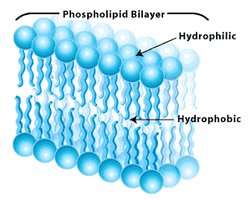
The plasma membrane is a dynamic structure that separates the interior of the cell from its external environment. It is primarily composed of a phospholipid bilayer with embedded proteins, cholesterol, glycoproteins, and glycolipids. This structure allows the membrane to be selectively permeable, controlling the movement of substances in and out of the cell.
Phospholipid Bilayer: Consists of hydrophilic (water-attracting) heads and hydrophobic (water-repelling) tails, forming a double layer.
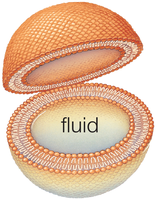
Fluid Mosaic Model: Describes the membrane as a fluid, dynamic arrangement of lipids and proteins that move laterally within the layer.
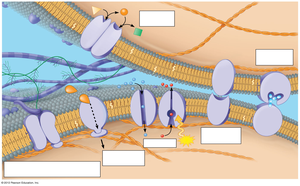
Membrane Proteins: Include enzymes, transport proteins, receptor proteins, attachment proteins, and junction proteins, each with specialized functions.
Cholesterol: Stabilizes membrane fluidity across temperature changes.
Glycoproteins and Glycolipids: Involved in cell recognition and signaling.
Membrane Function
Cell membranes perform a variety of essential functions that support cellular life and communication.
Selective Permeability: Allows small nonpolar molecules (e.g., O2, CO2) to diffuse freely, while restricting others.
Enzyme Activity: Membrane-bound enzymes catalyze metabolic reactions.
Cell-Cell Recognition: Glycoproteins identify and interact with neighboring cells.
Intercellular Junctions: Proteins connect adjacent cells for communication and structural support.
Signal Transduction: Receptor proteins transmit signals from the external environment to the cell's interior.
Attachment: Proteins anchor the membrane to the cytoskeleton and extracellular matrix (ECM).
Diffusion and Membranes
Diffusion
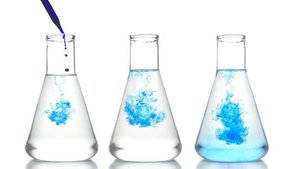
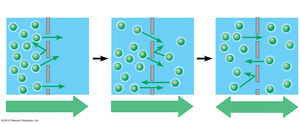
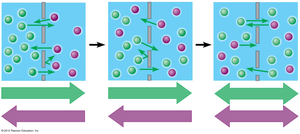
Diffusion is the spontaneous movement of molecules from an area of higher concentration to an area of lower concentration, driven by the random motion of particles. This process is fundamental for the movement of substances into, through, and out of cells.
Concentration Gradient: The difference in concentration across a space; substances diffuse down their own gradient.
Passive Transport: Diffusion does not require energy input from the cell.
Examples: Oxygen and carbon dioxide gas exchange in cells.
Osmosis
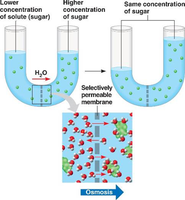
Osmosis is the diffusion of water across a selectively permeable membrane. Water moves toward the side with a higher solute concentration, balancing solute levels on both sides of the membrane.
Direction of Water Movement: Water moves from areas of low solute concentration to high solute concentration.
Biological Importance: Maintains cell volume and internal environment stability.
Tonicity
Tonicity describes the ability of a surrounding solution to cause a cell to gain or lose water. It is determined by the relative concentrations of solutes inside and outside the cell.
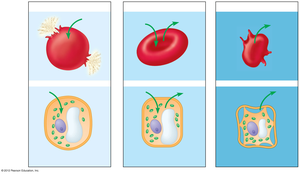
Hypotonic Solution: Lower solute concentration than the cell; water enters the cell, which may swell or burst (lyse).
Isotonic Solution: Equal solute concentration; no net water movement, cell remains normal.
Hypertonic Solution: Higher solute concentration than the cell; water leaves the cell, causing it to shrink (crenate or plasmolyze).
Osmoregulation: The control of water balance by cells and organisms.
Turgor Pressure
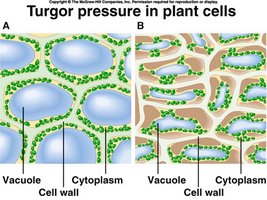
Turgor pressure is the pressure exerted by water inside the cell against the cell wall. It is crucial for maintaining the structural integrity of plant cells.
Osmotic Pressure: The pressure required to stop osmosis; helps keep plant cells plump and prevents bursting.
Isotonic Conditions: Water movement is balanced; plant cells are flaccid.
Hypotonic Conditions: Water enters the cell, increasing turgor pressure; cells become turgid.
Hypertonic Conditions: Water leaves the cell, turgor pressure drops; cells become plasmolyzed.
Membrane Transport Mechanisms
Facilitated Diffusion
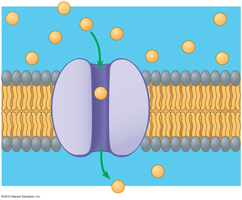
Facilitated diffusion is a type of passive transport where specific transport proteins help move substances across the membrane without energy input. This process is essential for molecules that cannot diffuse freely through the lipid bilayer.
Transport Proteins: Channel proteins (e.g., aquaporins for water) and carrier proteins assist in the movement of ions and polar molecules.
Direction: Always down the concentration gradient.
Active Transport
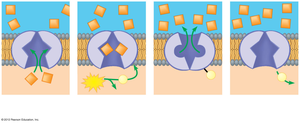
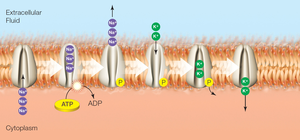
Active transport moves substances against their concentration gradient, requiring energy (usually from ATP). This process is vital for maintaining concentration differences of ions and other substances across the membrane.
ATP-Powered Pumps: Transport proteins use energy from ATP hydrolysis to change shape and move solutes.
Examples: Calcium pumps, sodium-potassium pumps (Na+/K+ ATPase).
Co-transporters: Move two substances simultaneously, often coupling the movement of one substance down its gradient to the movement of another against its gradient.
Transport of Large Molecules
Large molecules, such as proteins and polysaccharides, are transported across membranes via vesicular transport mechanisms.
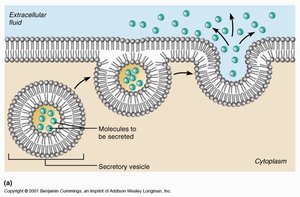
Exocytosis: Vesicles fuse with the plasma membrane to expel contents outside the cell.
Endocytosis: The cell membrane engulfs material, forming a vesicle that brings substances into the cell. Includes phagocytosis (cell eating), pinocytosis (cell drinking), and receptor-mediated endocytosis (selective uptake).
Additional info:
Energy for active transport is provided by the hydrolysis of ATP:
Osmosis and tonicity are critical for maintaining homeostasis in both animal and plant cells.
Facilitated diffusion and active transport are essential for nutrient uptake, waste removal, and ion balance.
