 Back
The Working Cell: Membrane Structure, Transport, Energy, and Enzymes
Study Guide - Smart Notes
 Tailored notes based on your materials, expanded with key definitions, examples, and context.
The Working Cell
Membrane Structure and Function
The plasma membrane is a dynamic, fluid mosaic composed of lipids, proteins, and carbohydrates. It acts as a selectively permeable barrier, regulating the movement of substances into and out of the cell. The mosaic nature arises from the diversity of molecules embedded within the membrane, including transport proteins, receptor proteins, and cholesterol.
Fluid Mosaic Model: Describes the membrane as a two-dimensional liquid where lipids and proteins can move laterally.
Selective Permeability: Only certain molecules can freely cross the membrane, while others require specialized transport proteins.
Membrane Proteins: Functions include transport, receptor activity, cell adhesion, recognition (glycoproteins), junction formation, and enzymatic activity.
Phospholipid Structure: Amphipathic molecules with hydrophilic heads and hydrophobic tails, forming a bilayer.
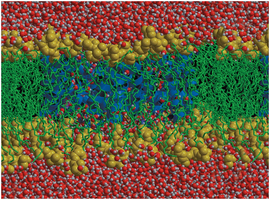
Transport Across the Membrane
Cells utilize both passive and active mechanisms to move substances across the membrane. Passive transport does not require energy, while active transport requires ATP to move substances against their concentration gradient.
Passive Transport: Includes diffusion, osmosis, and facilitated diffusion. Molecules move from areas of high concentration to low concentration.
Active Transport: Requires energy (ATP) to move molecules from low to high concentration, often via carrier proteins.
Transport Proteins: Facilitate movement of ions, large molecules, or polar substances across the membrane.
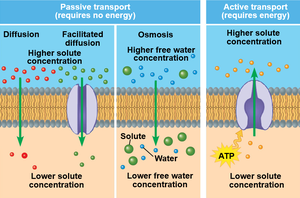
Passive Transport
Diffusion: Movement of molecules down their concentration gradient, driven by kinetic energy.
Osmosis: Diffusion of water across a selectively permeable membrane. Water moves toward higher solute concentration.
Tonicity: Describes the relative concentration of solutes in solutions (hypotonic, hypertonic, isotonic).
Facilitated Diffusion: Uses carrier or channel proteins to transport molecules that are too large, not lipid-soluble, or charged.
Ion Channels: Specific membrane proteins that allow ions (Na+, K+, Cl-, Ca2+) to move with their concentration gradient.
Aquaporins: Specialized channel proteins for rapid water transport.
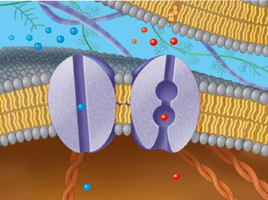
Active Transport
Cell Membrane Pumps: Carrier proteins (e.g., sodium-potassium pump) use ATP to move ions against their gradient.
Endocytosis: Uptake of large substances or quantities via vesicle formation (includes phagocytosis, pinocytosis, receptor-mediated endocytosis).
Exocytosis: Export of large molecules by fusion of vesicles with the plasma membrane.
Passive Transport:
uses no ATP
moves substances down the concentration gradient ([high] --> [low])
Diffusion:
the movement of molecules down their concentration gradient, driven by kinetic energy
Osmosis:
the diffusion of water
aquaporins - specialized channel proteins that allow rapid water transport
Energy and the Cell
Types of Energy
Cells require energy to perform work, which can be classified as kinetic (motion), potential (stored), chemical, thermal, or light energy. Energy transformations are governed by the laws of thermodynamics.
Kinetic Energy: Energy of motion.
Potential Energy: Stored energy due to position or structure.
Chemical Energy: Energy stored in chemical bonds.
Thermal Energy: Energy associated with heat.
Thermodynamics in Biology
First Law: Energy cannot be created or destroyed, only transformed.
Second Law: Every energy transformation increases entropy (disorder) in the universe.
Entropy: Measure of disorder; increases as energy disperses.
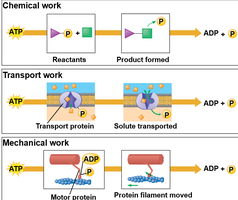
Cellular Work and ATP
ATP (adenosine triphosphate) is the cell's energy currency, powering chemical, transport, and mechanical work. Hydrolysis of ATP releases energy, and phosphorylation transfers energy to drive cellular processes.
ATP Hydrolysis:
Energy Coupling: ATP links exergonic and endergonic reactions.
Metabolic Pathways: Series of enzyme-mediated reactions (linear or cyclic).
How Enzymes Function
Enzyme Structure and Action
Enzymes are biological catalysts that speed up chemical reactions by lowering activation energy. Each enzyme is specific to its substrate and operates via an active site.
Activation Energy: Minimum energy required to start a reaction.
Substrate: The reactant an enzyme acts upon.
Active Site: Region of enzyme where substrate binds.
Mechanisms: Enzymes force substrates together, orient them, induce fit, and exclude water.
Enzyme Regulation
Cofactors: Nonprotein helpers (metal ions, vitamins).
Coenzymes: Organic cofactors (e.g., NAD+, ATP).
Inhibitors: Chemicals that decrease enzyme activity (competitive or noncompetitive).
Feedback Inhibition: End product inhibits pathway.
Key Terms and Word Parts
Aquaporin: Transport protein for water.
Cofactor: Required for enzyme function.
Endergonic/Exergonic: Energy-requiring/releasing reactions.
Endocytosis/Exocytosis: Cellular uptake/export of materials.
Hypertonic/Hypotonic/Isotonic: Relative solute concentrations.
Kinetic Energy: Energy of motion.
Osmosis: Diffusion of water.
Phagocytosis/Pinocytosis: Cellular eating/drinking.
Thermodynamics: Study of energy transformations.
